
The practical answer
Cash-and-carry shelf prices often look lower than broadline invoices, but the fair comparison is landed cost: shelf price plus the time to shop, load and unload, vehicle cost and membership, against the distributor's price plus delivery fees minus rebates and credits. Moving part of an order can also push the delivered order below a minimum and trigger fees. Calculate the price gap a trip must beat, then use a hybrid: buy only categories where the gap is consistently large and keep the delivered order above its minimums.
Why the shelf-price comparison misleads
Owners regularly ask some version of the question in Restaurant Depot/Costco etc vs. Sysco/USFoods etc.: how big is the real price gap between cash-and-carry warehouses and broadline distributors? The record available here is a search excerpt showing the question, not the answers, but the thread's engagement shows how often the comparison comes up.
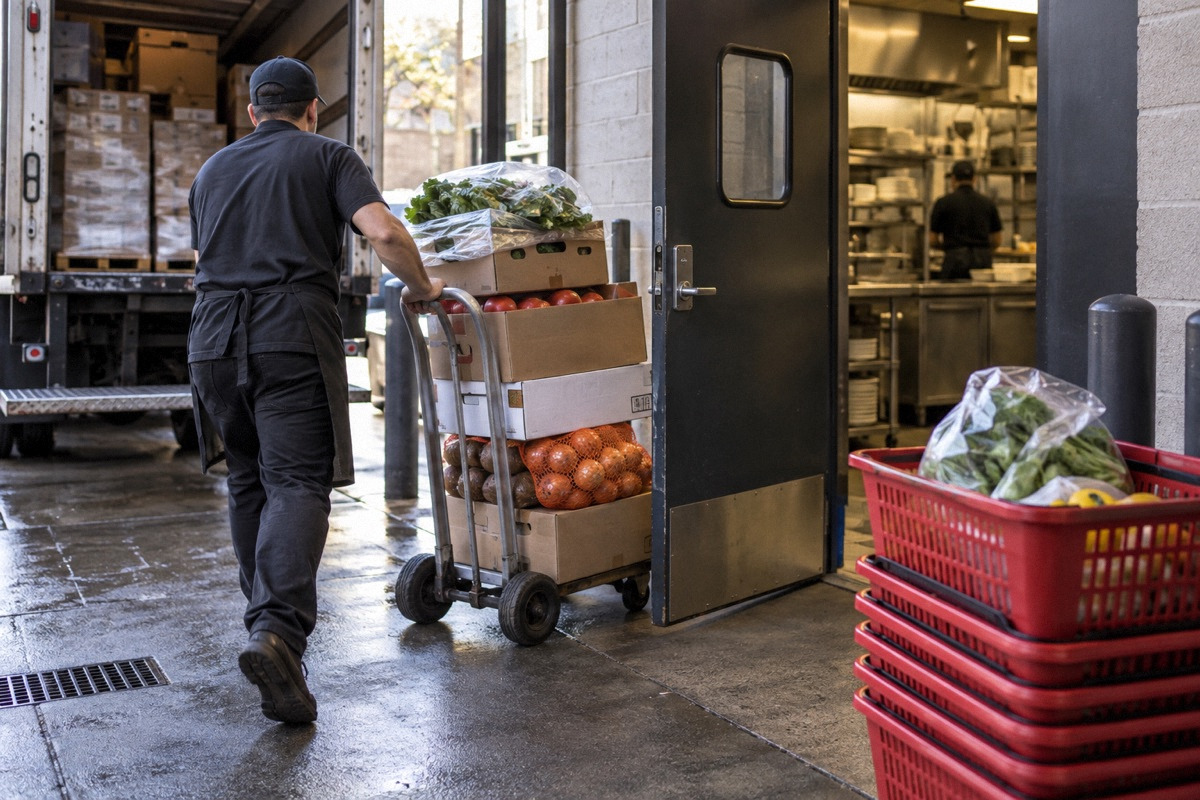
The comparison usually starts with two prices for the same item, one on an invoice and one on a shelf tag. That ignores most of what you actually pay. A delivered case arrives at your back door, is checked by your receiver, and can often be refused or credited on the spot. A warehouse case requires someone to drive, shop, load, drive back and unload, using a vehicle, and is paid for at the register. A commenter in a small business thread on Sysco, GFS and Costco put it plainly: they would rather have someone bring what they need than spend the day driving between big box stores, because their time belongs at the desk or on the floor. The same thread notes a Costco business location being cheaper but carrying a narrower range. Both are single comments from a search excerpt.
A landed-cost worksheet for both channels
Landed cost is everything you pay to get a usable product into your walk-in or dry storage. For a delivered order, start with the invoice price, add delivery, fuel or minimum-order fees, and subtract any rebate. For a warehouse trip, start with the shelf price, then add staff time for the whole trip, vehicle cost, any membership fee spread across trips, and losses from damage or temperature problems in transit.
Do the worksheet for a real basket, the items you would actually move, not a single item. Some items will be much cheaper at the warehouse and others more expensive; the basket total is what matters. Measure the trip time from leaving the restaurant to finishing put-away, because unloading and storage are part of it.
| Cost element | Broadline delivery | Cash-and-carry trip |
|---|---|---|
| Product price | Invoice price | Shelf price |
| Fees | Fuel, delivery or below-minimum fees if charged | Membership spread per trip |
| Labor | Receiving time | Drive, shop, load, return, unload, put away |
| Vehicle | None | Your per-mile cost estimate |
| Rebates and credits | Rebate if offered; credits at delivery | Usually none; returns need another trip |
| Payment timing | Invoice terms if offered | Paid at purchase |
Hypothetical worked example: a weekly $2,400 basket
All figures are hypothetical. A restaurant's weekly broadline basket lists at $2,400. The distributor adds a $15 fuel fee and pays a 1% rebate, worth $24. Net delivered cost is $2,400 plus $15 minus $24, which equals $2,391.
The same basket at a warehouse costs $2,160 on the shelf, 10% less. The trip takes a manager 2.5 hours at a $25 loaded hourly cost, or $62.50. The round trip is 30 miles, and the owner's own estimate of vehicle cost is $0.70 a mile, or $21. A membership of $260 a year is $5 a week. Landed cost is $2,160 plus $62.50 plus $21 plus $5, or $2,248.50, saving $142.50 a week compared with delivery.
Now shrink the gap. If the shelf price is only 4% below list, $2,304, landed cost is $2,392.50, about the same as delivery. The trip overhead of $88.50 means the warehouse basket must cost less than $2,302.50 to win, about 4.1% below the broadline list in this example. That break-even gap is the most useful number on the worksheet. Every operator's will differ with distance, wages, rebates and fees.
Valuing the owner's or manager's time honestly
Many small operators treat their own time as free, which makes the warehouse look cheaper than it is. If the owner makes the run, the cost is whatever that time would otherwise produce: covering a shift that would need a paid employee, handling vendor and staff problems, or simply rest that prevents burnout. A reasonable minimum is the loaded hourly cost of the person who would cover for them. The reverse also applies: if a scheduled employee makes the run during hours that would otherwise be slow, the added cash cost is lower than their hourly rate implies, though the work they would have done still has value. Record which case applies so the worksheet reflects actual, not assumed, labor cost.
In the directly inspected Sysco pricing thread, opinions split along this line. A caterer said that with 400 people to feed on a tight timeline, chasing small price differences across stores was picking up pennies instead of dollars, and that warehouse prices changed often too. Another owner described buying one high-volume item at a warehouse club for about $0.52 a unit against $1.10 from the distributor, then getting the distributor down to $0.72 after negotiating. Both are individual accounts. Together they show the decision is item-specific: a large, steady gap on a high-volume item justifies effort, while small gaps across many items often do not.
Minimums and fees: the hidden cost of moving part of an order
Moving items to a warehouse does not only change those items. It shrinks the delivered order. The small business commenter warned that orders below a distributor's minimum can draw fees such as fuel surcharges or freight charges, and in the inspected Sysco thread an owner mentioned a $50 minimum order fee, while another commenter warned that splitting orders across vendors invites minimum penalties.
Before moving a category, check your distributor's minimums and fee schedule and recalculate the delivered order without that category. If the remaining order drops below the threshold, add the fee to the warehouse side of the comparison, or consider dropping a delivery day so the remaining orders consolidate above the minimum. The related article on supplier fuel surcharges and minimum-order fees covers fee audits in more detail.
Credits, returns and product condition
Delivered orders come with a built-in inspection point. If a case arrives damaged or short, your receiver can note it for a credit or refuse it while the driver is there. Product that arrives at an unsafe temperature should be rejected under your receiving procedure; a credit does not make unsafe food acceptable to keep. Warehouse purchases shift that responsibility to your shopper. Damage noticed back at the restaurant means another trip, a receipt and whatever return policy applies. That cost is real even if it happens only occasionally.
Temperature control also moves to you. Operational suggestion: use insulated containers or coolers for refrigerated and frozen items, shop for them last, drive straight back, and put them away first. Follow your local health code for receiving and storage temperatures; in Washington, DC that means DC Health requirements rather than a general rule of thumb. Count any product you discard after a hot day or a delayed return as part of the warehouse landed cost.
Building a hybrid sourcing plan
A common outcome owners describe is a mix. The distributor carries items where its price is competitive, where delivery and credit handling matter, or where volume keeps the order above minimums. The warehouse or an online supplier carries categories with a large, steady price gap, often dairy, disposables or specific staples, picked up on a trip that is already happening. Several commenters in the inspected thread described exactly this pattern, using warehouse or online suppliers for dry goods and paper while buying other items from distributors.
Revisit the split periodically. Warehouse prices also move, as one commenter noted, and distributor prices may change when you show them a competing price. Keep the basket worksheet current so decisions follow numbers rather than habit.
- Calculate your break-even gap from actual trip time and distance
- Move only categories whose gap consistently exceeds it
- Recheck the delivered order against its minimum after moving items
- Combine warehouse purchases into trips you already make
- Assign who shops, and give them the list and price targets
- Re-run the basket comparison every quarter
Checklist and records to keep
Treat the comparison as a recurring calculation, not a one-time verdict. Keep the evidence so you can show a partner, a manager or yourself why the split looks the way it does.
- Basket list with item, pack size and unit price for each channel
- Timed trip records including unloading and put-away
- Vehicle cost assumption and membership cost
- Distributor fees, minimums and rebate terms
- Credits received on delivered orders and returns made on warehouse items
- Discarded product from transit issues
Questions that come up next
Is Restaurant Depot or Costco cheaper than Sysco or US Foods?
On shelf price, some items often are, but it varies by item, region and account. The fair comparison is landed cost: shelf price plus staff time, vehicle cost and membership, against delivered price plus fees minus rebates. Work out the price gap a trip must beat for your actual basket before switching.
Will buying some items at a warehouse raise my distributor costs?
It can. Owners report that smaller delivered orders can fall below minimums and draw fuel, freight or minimum-order fees. Before moving a category, recalculate the remaining delivered order against your distributor's minimum and fee schedule, and include any new fee in the comparison.
Sources & context
Forum accounts are unverified experiences. Read government sources for their stated jurisdiction and check requirements with the responsible authority for your location.
- Restaurant Depot/Costco etc vs. Sysco/USFoods etc. (r/restaurantowners)reddit · Search excerpt of the question only; no answers were recorded. Shows the comparison is a common owner question; no price-gap figures are drawn from it.
- Question for small restaurant owners: How do food prices from Sysco/GFS compare to Costco? (r/smallbusiness)reddit · Search excerpt. Comments on below-minimum fees, about 2% rebates on request, the value of delivery time, and a Costco business location being cheaper with narrower range. Individual comments.
- How do you guys manage random pricing at Sysco? (r/restaurantowners)reddit · Thread directly inspected. Individual accounts of warehouse versus distributor unit prices, a $50 minimum fee, warehouse price changes, and hybrid sourcing. Not a price survey.


