
The practical answer
Some distributor items move every week because they are tied to commodity markets: produce, dairy, many proteins. Others, like gloves, paper and frozen prepared items, should be more stable, and frequent swings on them are worth questioning. Sort your order guide into market-priced and stable items, track unit price per SKU on every invoice, and ask for a fixed or price-protected list on the stable core. Escalate politely beyond the rep if needed, and add a second vendor for categories where the comparison saves enough to justify the extra minimums.
The frustration in one thread, and what it reveals
In a widely discussed post, How do you guys manage random pricing at Sysco?, an owner describes spending 40 minutes on the phone placing a smallish order while the rep clicks item by item to request system approval for lower prices, with approval coming through more than half the time. Their complaint is that items like gloves and frozen crispitos bounce up and down from invoice to invoice, and later in the thread they describe a case of gloves swinging by about $15 over five weeks. This thread was inspected directly for this article, so the comments described below are from the recorded discussion, but every claim in it is one person's account rather than verified fact.
The replies split into useful categories. Some owners compare weekly order guides from several distributors and buy each item where it is cheapest. A former rep says it is usually not the rep's fault and options are limited until the business walks away. One commenter says another distributor keeps core items like gloves, dry goods and flour nearly the same week to week. Several commenters describe the pricing as algorithm-driven and say lowering a few items leads to small increases elsewhere. That last idea is an owner perception, not something the thread demonstrates, and this article does not assume it. What the thread does show clearly is that unpredictable prices on items that should be stable cost owners time and trust.
Market-priced items versus items that should be stable
Not every price change is a problem. Fresh produce, dairy, eggs, many proteins and cooking oils track commodity markets that move weekly or faster, and distributors generally pass those changes through. One commenter in the thread made this distinction directly, accepting that dairy and produce move while questioning why frozen burritos and crispitos would. A weekly change on romaine is normal. A weekly change on a case of the same gloves, napkins or a shelf-stable frozen item is not obviously explained by the market and deserves a question.
Sort your order guide into two lists. Market-priced items get monitored for trend and compared across vendors, but you expect movement. Stable items get a baseline price, and any change beyond a threshold you choose gets flagged for a question to the rep. The threshold is your call; a few percent is a reasonable starting point for items with no obvious commodity driver. This sorting is the foundation for both tracking and negotiation, because it lets you ask for price protection only where it is reasonable.
| Category | Typical behavior | How to treat it |
|---|---|---|
| Produce, dairy, eggs | Moves with market, often weekly | Track trend, compare vendors, no contract expectation |
| Fresh proteins | Moves with commodity cuts | Track per pound, consider short fixed-price windows |
| Frozen prepared items | Should be relatively stable | Baseline price, flag swings, ask for protection |
| Gloves, paper, disposables | Should be relatively stable | Baseline price, compare with specialty suppliers |
| Dry goods, flour, sugar, salt | Moderately stable | Baseline price; check items you rarely look at |
Track unit price per SKU, not invoice totals
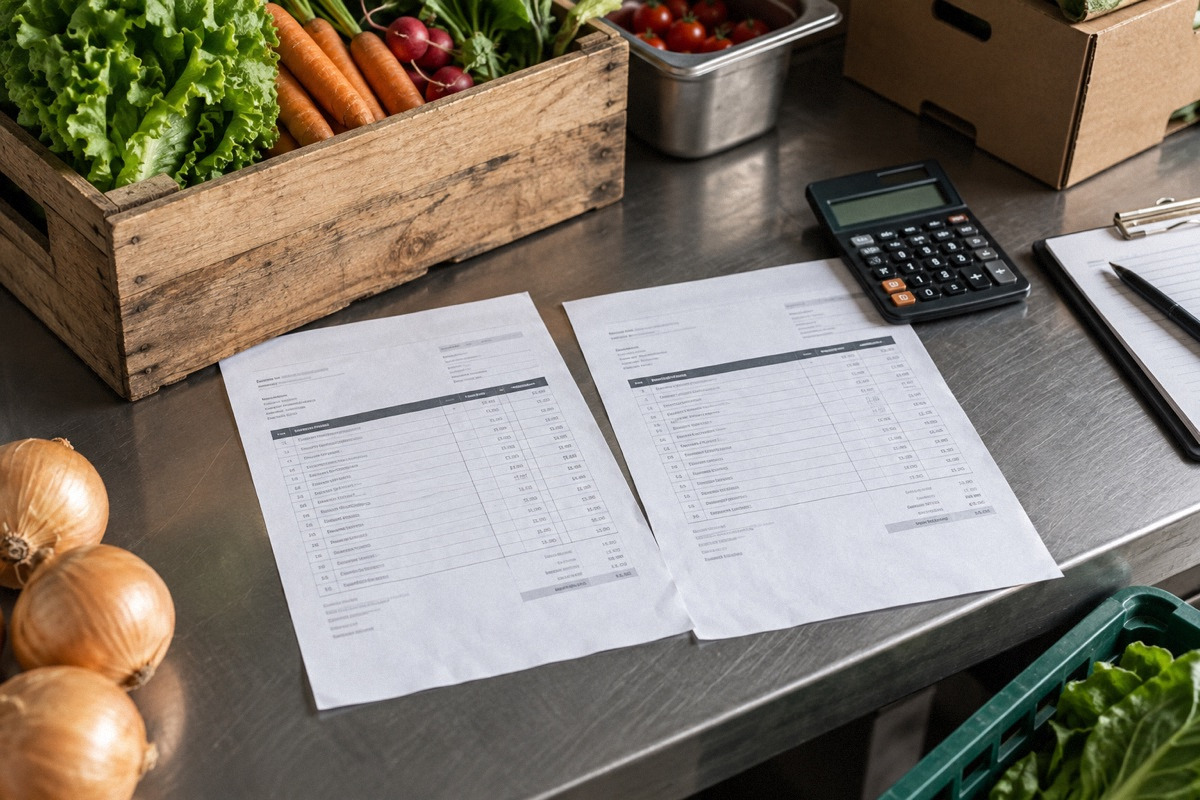
Invoice totals hide price movement because quantities change. Build a simple sheet with one row per invoice line: date, vendor, item number, description, pack size, unit of measure, case price and unit price, meaning price per pound, per each or per ounce. Unit price matters because pack sizes differ and sometimes change. A commenter in the thread described discovering that a friend's cheaper case of 2-ounce soufflé cups held a different count than theirs, so the comparison was not like for like until they checked the count.
Another commenter warned that buyers watch the prices of their headline items, like flour and cheese for a pizzeria, and neglect items such as sugar or salt. Whether or not that reflects any deliberate strategy, it is a practical reminder: track a basket that includes low-attention items, not only the ones you already know by heart. Several owners in the thread build this in a shared spreadsheet with each vendor's item numbers side by side and the best current price highlighted.
- Record pack size and count on every line
- Convert to unit price before comparing
- Include low-attention staples in the tracked basket
- Flag stable items that move beyond your threshold
- Note substitutions; a different item at a different price is not a price change on the original
Hypothetical worked example: what weekly swings cost on a stable basket
All numbers are hypothetical. A restaurant buys one case of gloves a week. Over six weeks the invoices show $42, $48, $45, $57, $44 and $50, totaling $286, an average of about $47.67 and a range of $15 from low to high. If the restaurant had a protected price of $45, six weeks would have cost $270, a difference of $16. On one item that is minor and could easily be noise.
The picture changes when the same pattern runs through a basket. Suppose the restaurant has 40 stable items, and tracking shows they average $3 a week above the price the distributor is willing to confirm when asked. That is $120 a week, or $6,240 over 52 weeks, plus the time spent calling to correct it. The first number tells you whether a contract request is worth the effort; the second tells you the cost of continuing to correct prices one call at a time.
Asking for contract or price-protected pricing
One reply in the thread was blunt: get contracted pricing or find a new distributor. For a single small unit, a full contract may not be offered, but there are intermediate asks. Request a price-protected order guide covering your stable items for a stated period, such as a month or a quarter, with any change notified in advance. Ask for the weekly order guide with current prices sent before you order, which several commenters described as standard practice with their vendors and one treated as a condition of doing business. Commit to a realistic weekly volume on the protected items in return.
Larger or multi-unit operators can ask for cost-plus pricing, where the distributor charges a disclosed markup over its cost, covered in the related article on cost-plus contracts. A commenter noted that operators with three or more units have more options than single units, which is consistent with how volume affects bargaining position.
An escalation path that stays professional
Start with the rep, in writing. List the specific SKUs, dates and prices that moved, and ask for an explanation and a protected price. A rep may have limited authority, as the former rep in the thread suggested, so the written list also gives them something to take to their manager. If nothing changes, ask for a meeting with the rep and their sales manager, which another commenter recommended. Bring the tracking sheet and a specific request, not a general complaint.
Avoid making accusations you cannot prove. You may suspect that the pricing system offsets reductions elsewhere, but what you can show is that stable items moved and by how much. Keep the conversation on documented changes and on what arrangement would make prices predictable. If a pattern of billing errors appears, such as charges for items not delivered, handle that through your receiving and credit process with documentation.
When adding a second vendor is worth it
Owners in the thread described using two to four distributors and moving items to whoever was cheapest each week. Others warned of the cost: one replied that splitting orders invites minimum-order penalties and that small operators may do better consolidating with the distributor that has the best prices on key items to qualify for a rebate. The original poster mentioned being charged a $50 minimum order fee in a situation they considered the rep's error. Both views can be right depending on volume.
Use the tracking sheet to decide. A second vendor makes sense for categories where the price gap is large and steady, such as disposables bought from a specialty supplier, or where the second vendor's quality is better. It makes less sense when it pushes either vendor below a minimum or adds a delivery day you must staff. Compare the total savings with added fees and the time spent ordering and receiving, which the related articles on cash-and-carry comparisons and supplier fees cover in detail. On benchmarking, note that third-party price databases built from operator invoices exist or have been proposed; in an older price transparency thread, owners pushed back on giving their invoice data away for free. Read any such service's data terms before uploading invoices.
Monthly routine and records to keep
Turn the approach into a short monthly routine so it survives busy periods. The original poster in the thread recognized that ordering and receiving were handled by others and planned to set up a system the manager and receiver would follow. That is the right instinct: price control works when it is part of ordering and receiving, not a periodic owner project.
- Weekly: receive price lists or order guides before ordering
- Weekly: enter invoice lines with unit prices
- Monthly: review flagged stable items and send the rep a written list
- Monthly: compare a basket against a second source
- Quarterly: renew or request price protection on stable items
- Keep: invoices, price lists, rep correspondence and agreed prices
Questions that come up next
Is it normal for distributor prices to change every week?
For produce, dairy, eggs and many proteins, yes; those follow commodity markets. For stable items such as gloves, paper goods and frozen prepared products, frequent swings are less easily explained and worth questioning. Separate the two groups, track unit prices per SKU, and ask the distributor for price protection on the stable list.
Can a small single-location restaurant get contract pricing?
Sometimes, in a limited form. A full cost-plus contract is more common for larger or multi-unit accounts, but a single unit can ask for a price-protected order guide on stable items for a set period, advance notice of changes, and weekly price lists before ordering, in exchange for a predictable volume.
Sources & context
Forum accounts are unverified experiences. Read government sources for their stated jurisdiction and check requirements with the responsible authority for your location.
- How do you guys manage random pricing at Sysco? Every invoice same item bounces up and down (r/restaurantowners)reddit · Thread text directly inspected. Owner accounts of weekly swings on stable items, item-by-item approvals, multi-vendor comparison, a $50 minimum order fee, and advice to get contracted pricing or escalate. Claims about algorithmic pricing are commenter perceptions and are not treated as fact.
- Price transparency for Sysco, US Foods etc (r/restaurantowners)reddit · Search excerpt. A founder seeks invoices to build a price database; owners object to giving data free. Supports the benchmarking-difficulty and data-terms points only.


