The practical answer
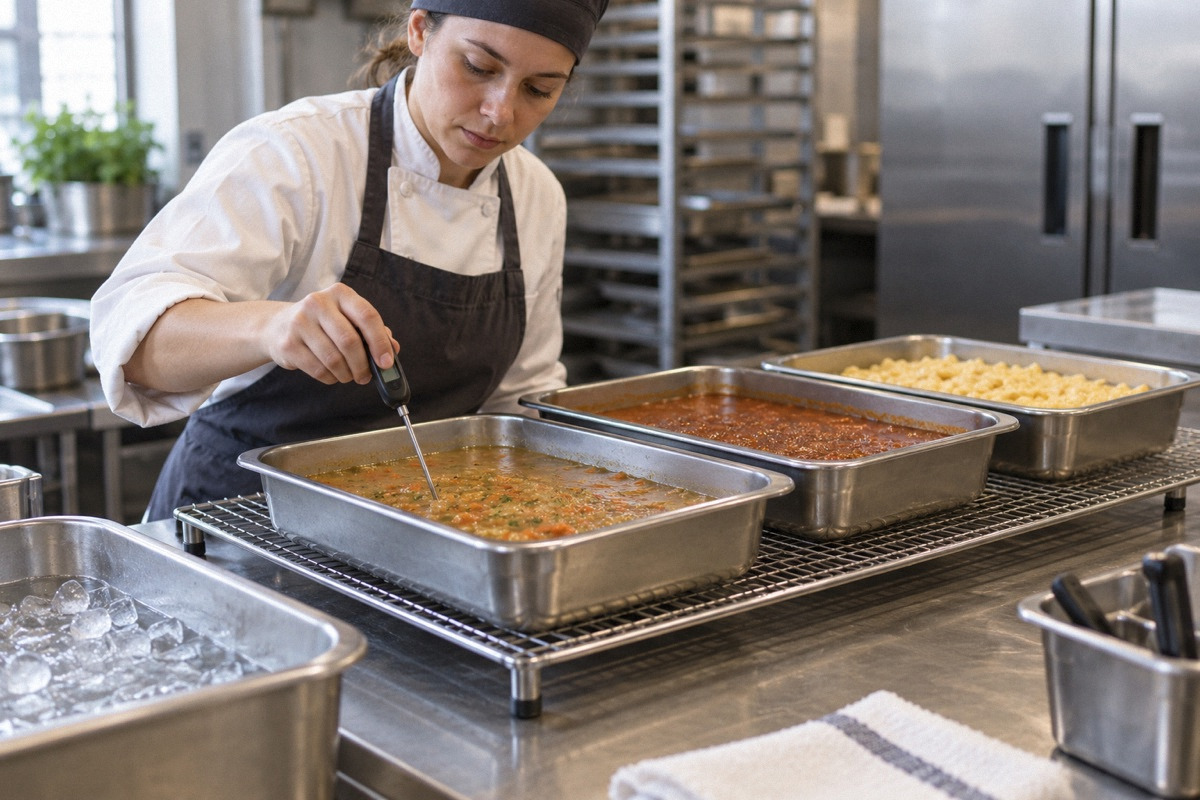
Cooling fails when large, deep, covered batches go into a walk-in that cannot pull heat out fast enough; the center stays warm for hours. In the District of Columbia, DC Health states hot foods must cool from 135F to 70F within 2 hours and from 70F to 41F within 4 hours. Divide food into shallow portions, use ice baths, ice wands or a blast chiller, place it where cold air can circulate, and log temperatures at each stage. Moving food does not restart the clock. A batch that misses a limit is not made safe by rechilling.
What actually goes wrong: the bucket-of-soup problem
A widely upvoted post on r/KitchenConfidential described a buffet kitchen with no cooling procedure: hot soups and gravies poured into large plastic buckets while piping hot and put straight into the walk-in, and mac and cheese poured into 6-inch-deep third pans right off the boiler and put in the walk-in, with large vent holes in the lids as the only cooling measure (Reddit discussion). The poster said they quit and called the health inspector. That account was recorded as a search excerpt, it is one cook's description of one kitchen, and it does not establish what the inspector found. It is useful because it describes the classic failure so precisely.
Another KitchenConfidential thread about things inspectors missed includes a commenter describing food sitting out for hours in a warm kitchen and never cooled properly (Reddit discussion). That is the opposite mistake: leaving food on the counter to cool slowly at room temperature. Neither approach controls the time food spends in the range where bacteria grow. The walk-in is not the villain in the first story, and the counter is not a cooling method in the second. The problem in both is that nobody measured whether the food actually cooled fast enough, and the containers and methods made it unlikely.
The cooling limits that apply, and where they come from
In the District of Columbia, DC Health's explainer on food establishment inspections states that hot foods must be cooled from 135F to 70F within 2 hours and from 70F to 41F within 4 hours, and that foods prepared from ambient-temperature ingredients, such as reconstituted foods and canned tuna, must be cooled to 41F within 4 hours (DC Health, Understanding Food Establishment Inspections). The same page states that cold foods must be held at 41F or below, and it lists cooling among the time and temperature controls inspectors check. DC Health describes its rules as Title 25 of the DC Municipal Regulations, adopted from the FDA model Food Code. The explainer is guidance drawn from those regulations; the regulations and the inspection report govern.
Two features of the DC limits matter in practice. First, there are two stages, and the first is the tighter one: food has only 2 hours to get from 135F down to 70F. Second, the clock follows the food. Moving a pan from an ice bath to a reach-in, or from one shelf to another, does not restart either stage; the time already spent counts.
Outside DC, check the code your state or local health department has adopted. FDA publishes the Food Code as a model offered for adoption by jurisdictions and lists a resource on cooling cooked time/temperature control for safety foods for food employees on its Food Code 2022 page (FDA, Food Code 2022). FDA has since published a 2026 edition and encourages jurisdictions to adopt the latest version (FDA, Food Code 2026). Neither edition is local law until your jurisdiction adopts it, and adopted versions may be amended.
Why deep, covered containers fail
Heat leaves food through its surface. In a deep container, heat at the center has to travel a long way through thick, often viscous food before it reaches a surface exposed to cold air. Soups, gravies and starchy dishes like mac and cheese are especially slow because they do not circulate much on their own. A tall plastic bucket adds insulation, and a lid traps heat and steam above the food. Vent holes let a little steam out but do nothing about the depth of food the heat must cross, which is why they cannot fix the buffet kitchen's method.
The refrigerator's air is also a weaker cooling medium than it seems. Walk-ins and reach-ins are designed mainly to hold food that is already cold. Cold air carries heat away far more slowly than ice water in direct contact with a container. A large hot load can also warm the unit and the food around it, especially if the walk-in is crowded or the door is opened often. So the issue is not that hot food can never go into refrigeration. It is that a deep, covered, high-volume batch, in a unit with limited capacity and blocked airflow, is unlikely to meet the first-stage limit unless something else removes heat first.
Shallow pans, ice baths, ice wands and blast chillers
Every effective method does one of two things: it reduces the distance heat must travel, or it surrounds the food with a colder, more conductive medium than air. Most kitchens combine them, for example dividing a batch into shallow pans and then setting them in an ice bath or loading them into a blast chiller.
No method guarantees a result; the only proof is a measured cooling curve for your batch size, container and equipment. Choose a method, then verify it with a calibrated probe thermometer at the center of the thickest portion. The pan depths and ice ratios that work in one kitchen are a starting point to test, not a universal recipe, and your local health department may have its own approved procedures or guidance.
| Method | How it removes heat | Best for | Cautions |
|---|---|---|---|
| Divide into shallow pans | Less food depth, more surface area | Soups, sauces, rice, mac and cheese, braises | Must still be placed where cold air or ice can reach the pans; verify with a probe |
| Ice-water bath | Cold water in contact with container walls | Liquids and sauces in metal containers | Ice melts; replenish and stir the food; keep water below the container rim |
| Ice wand or cooling paddle | Frozen insert pulls heat from inside the batch | Large pots of soup or stock before portioning | Wand must be clean and sanitized; stir to move warm food from the center |
| Adding ice as an ingredient | Replaces some water in the recipe with ice | Stocks and soups made with water | Only where the recipe allows; ice must be safe and suitable for food |
| Blast chiller | High-velocity cold air designed to remove heat fast | Regular large batches, shallow pans | Load per manufacturer limits; still log temperatures |
| Cutting large items | Smaller pieces cool faster | Roasts, large cuts | Cut with clean tools; cool pieces spaced apart |
Loading the walk-in without overloading it
Shallow portions that have already been brought down quickly, or that are going into refrigeration with enough capacity and airflow to keep cooling them, can belong in a walk-in or reach-in. What fails is stacking, crowding and assuming the unit will do all the work. Treat refrigeration space as part of the cooling plan, with its own limits.
These are operational suggestions to adapt and verify, not code requirements. Your local code may have specific rules on covering, placement and protection during cooling, so check them.
- Place cooling pans on racks with space between and above them so air can circulate; do not stack pans directly on each other.
- Position cooling food where nothing can drip into it, and protect it from contamination while letting heat escape, as your local code allows.
- Keep cooling food away from the evaporator fan's direct path if it blocks airflow, and do not block the fan with product.
- Stagger large batches so the unit is not asked to absorb every hot item at once; check the walk-in's air temperature after loading.
- If you regularly cannot meet the first stage with the space available, the answer is a blast chiller, more ice-bath capacity or smaller batches, not a fuller walk-in.
A two-stage cooling log that proves the process
A cooling log turns the limits into checkpoints that someone actually measures. Record the time and temperature when the food reaches 135F and cooling begins, check at regular intervals, record when it reaches 70F, and record when it reaches 41F. Take readings with a calibrated probe at the geometric center of the thickest portion, and record the reading, not a checkmark. Calibrate thermometers on a schedule and note it.
A practical rule is to check before each limit could be missed, not only at the deadline. If a pan is at 95F at the one-hour mark, there is still time to move it into an ice bath; if you only look at two hours, there is not.
| Field | Example entry |
|---|---|
| Food, batch size and container | Tomato soup, 4 gallons, divided into four 2-inch hotel pans |
| Method | Ice bath with stirring, then walk-in rack |
| Time at 135F (cooling start) | 2:00 p.m., 135F |
| Interim check | 2:45 p.m., 95F |
| Time reached 70F (stage 1 limit is 2 hours from start) | 3:30 p.m., 68F |
| Interim check | 5:00 p.m., 50F |
| Time reached 41F (stage 2 limit is 4 hours from reaching 70F) | 6:15 p.m., 40F |
| Corrective action, if any | None needed |
| Initials and thermometer ID | Initials, probe number |
When a batch misses a limit
If a log shows that food did not reach 70F within 2 hours, or 41F within the following 4 hours, or if nobody knows how long a batch has been cooling, stop. Do not serve it, and do not mix it with other product. Segregate and label it, and decide what happens to it under the corrective actions in your adopted local code and any procedure your health department has approved for your establishment. If you are not certain what your code allows, discard it or ask your health department; uncertainty is not a reason to keep it.
Rechilling does not make food safe once it has spent too long in the unsafe range, and neither does putting it in a colder unit. Reheating is not a universal fix either; some codes specify limited corrective actions in particular circumstances, and those depend on the exact code language and timing, which this article does not reproduce. Food with an unknown cooling history should be treated as having failed.
Then fix the cause. A failed batch is usually a process problem: too large a batch, too deep a container, no ice bath capacity, a crowded walk-in or a cook who did not know the limits. Record the failure, what was done with the food and what was changed, so the same batch does not fail again next week.
Worked example: the soup bucket versus a measured method
Hypothetical example, for illustration only; these readings are not a prediction for any kitchen. A cook finishes a 4-gallon batch of soup that reaches 135F at 2:00 p.m. Under the old habit, it goes into a covered plastic bucket in the walk-in. A reading at 4:00 p.m., two hours later, shows 112F at the center. The first-stage limit in DC, 70F within 2 hours, has been missed by 42 degrees. The batch is not served. It is segregated and labeled and, because the kitchen's procedure provides no approved corrective action for this situation, it is discarded and the loss is recorded.
For the next batch, the kitchen divides the soup into four 2-inch hotel pans, sets them in an ice bath and stirs every 15 minutes. Readings: 95F at 2:45 and 68F at 3:30, so the soup passed 70F one and a half hours after cooling began, inside the 2-hour first stage. The pans move to spaced racks in the walk-in. The second stage allows 4 hours from reaching 70F, so 41F must be reached by 7:30 p.m. The 6:15 reading is 40F, 2 hours and 45 minutes into stage two. Total time from 135F to 41F was 4 hours and 15 minutes, from 2:00 to 6:15.
One successful batch does not validate a method. The kitchen repeats the measured process on several batches and on its largest typical volume, keeps the logs, and writes the method into its prep procedures. If the walk-in is crowded on a busy day and a batch slows down, the interim check catches it while there is still time to add ice.
Checking your local code and keeping records
Before writing your cooling procedure, read the cooling section of the code your health department enforces, or ask the department directly for its current cooling requirements and any guidance documents. In DC, DC Health's food establishments page links to the regulations and other resources and notes that DC inspections are pass or fail, with Priority, Priority Foundation and Core violations tallied on each report (DC Health, Food Establishments). DC's explainer lists cooling among the time and temperature controls inspectors examine. If an inspection notes a cooling problem, correct the immediate hazard right away; a correction period on a notice is not permission to keep serving food that has not been cooled safely.
Keep cooling logs, thermometer calibration records, the written cooling procedure for each major batch type, records of any failed batch and what was done with it, and training records showing staff know the two stages. These records show inspectors that cooling is measured rather than assumed, and they show you whether your methods actually work at your volumes.
Questions that come up next
Can you put hot food directly in the walk-in cooler?
Shallow portions can go into refrigeration with enough capacity and airflow, if measurements show they meet the cooling limits. What fails is a deep, covered, high-volume batch in a crowded unit. In DC, DC Health states food must cool from 135F to 70F within 2 hours and to 41F within 4 more. Use shallow pans, ice baths or a blast chiller and log temperatures.
What is two-stage cooling?
Two-stage cooling splits cooling into two timed limits. In the District of Columbia, DC Health states hot food must go from 135F to 70F within 2 hours, then from 70F to 41F within 4 hours. Moving food doesn't restart the clock. Other jurisdictions adopt their own versions of FDA's model Food Code, so check your local health department's adopted rules.
Sources & context
Forum accounts are unverified experiences. Read government sources for their stated jurisdiction and check requirements with the responsible authority for your location.
- Am I an a-hole for calling the health inspector (r/KitchenConfidential)reddit · Search excerpt of a highly upvoted post. A cook describes a buffet putting hot soups and gravies in plastic buckets and mac and cheese in 6-inch third pans straight into the walk-in, with vent holes as the only measure. One person's account of one kitchen; inspection outcome not established.
- Worst/most obvious thing that the health inspector didn't notice (r/KitchenConfidential)reddit · Search excerpt. A commenter describes a kitchen where food sat out for hours in a warm kitchen and was never cooled properly. Anecdotal; illustrates room-temperature cooling as a failure mode.
- Understanding Food Establishment Inspections (DC Health)government · District of Columbia only. States cooling limits (135F to 70F within 2 hours, 70F to 41F within 4 hours; ambient-temperature ingredients to 41F within 4 hours), 41F cold holding, and that DC rules are DCMR Title 25 adopted from the FDA model Food Code. Explainer page; the regulations and inspection reports govern.
- Food Establishments (DC Health)government · District of Columbia only. Links regulations and resources; states DC inspections are pass/fail with Priority, Priority Foundation and Core violations tallied. Does not itself state cooling limits.
- Food Code 2022 (FDA)government · Federal model code, offered for adoption by jurisdictions; lists a cooling resource for food employees on cooling cooked TCS foods. Not the latest edition and not local law unless adopted.
- Food Code 2026 (FDA)government · Confirms the 2026 model edition and FDA's encouragement to adopt the latest version. Cited for edition status only; its cooling text was not reviewed for this article.


