The practical answer
If several unrelated products in a walk-in read in the same warm range, the unit itself is likely failing. In the District of Columbia, DC Health's cold-holding requirement is 41 F or below. Log both the air reading and probed product temperatures at fixed times every shift, and watch the trend, not just single readings. Add an alarm that alerts before product reaches the limit. Call for service when readings drift. When product is found above 41 F, decide its fate from known time and temperature under approved procedures, and discard it if that history can't be established.
The diagnosis: one warm item versus everything warm
In a KitchenConfidential thread about a posted inspection report, How scary are these restaurant inspection violations? Would you eat here?, one commenter noted that the beef temperatures in the walk-in might have a benign explanation, such as product that had just been prepped or was cooling. Another replied that several separate items all reading in the same five-degree range suggested the walk-in itself was sitting around 50 F. The thread is a search excerpt of strangers reacting to a report, not an investigation. The reasoning is still worth making explicit, because it is the first diagnostic question when a walk-in reading looks wrong.
One warm container usually has a local cause. It may be a batch still in the cooling process, a delivery just put away, or a pan stored against the door. Many unrelated products at similar elevated temperatures point to the box. Refrigeration capacity, airflow, door management or a mechanical fault is letting the whole space warm. The two situations need different responses. A cooling batch needs its cooling log checked against the time limits. A warm box needs the product evaluated, cold holding moved elsewhere and a service call placed now.
The local standard and what the DC paperwork asks
In the District of Columbia, DC Health's page Understanding Food Establishment Inspections states the cold-holding requirement: cold foods shall be maintained at 41 F or below. The same page lists inadequate refrigeration among the grounds for closure due to imminent public health risk, and describes severe temperature abuse of food as an imminent health hazard. DC Health's Plan Review Guidance Packet (Dec 2019, ver. 8) asks new establishments whether adequate, approved refrigeration and freezer capacity is available. It also asks whether each refrigerator and freezer has a thermometer, and how many units of each there are.
The packet's cold-storage question puts frozen and refrigerated foods in one sentence with the 41 F figure. Do not read that as saying 41 F is adequate for frozen storage. A freezer's job is to keep frozen food frozen. Product that has gone soft in a freezer is no longer being stored frozen, whatever the dial says. Outside DC, check the cold-holding temperature in your own adopted code. The FDA Food Code is a model that states and localities adopt, often with amendments, so its edition is not automatically your local law.
Logging cadence: air, product and the trend line
Many logs fail because they record the wrong thing too rarely. A single daily tick next to 'walk-in OK' records only that someone walked past. A useful log records actual numbers at fixed times. That means the air thermometer reading and at least one probed product reading (a different product type each time), at opening, mid-shift and close, with initials. Air temperature responds quickly to door openings and defrost cycles. Product temperature changes slowly and shows what the food has actually experienced. Recording both lets you tell a door-traffic spike from a real decline.
Look at the log as a line, not a list. A walk-in that read 35 F three weeks ago and reads 39 F now has not failed, but it is telling you something. Coils may be icing, a gasket may be tearing, the condenser may be clogging or the box may be overloaded. Assign one manager to review the week's log every Monday and write one sentence: stable, drifting up or erratic. That sentence is what turns a log into an early warning.
| Reading | When | What it tells you |
|---|---|---|
| Air thermometer | Opening, mid-shift, close | Box performance; spikes may reflect door traffic or defrost |
| Probed product (rotate item type) | Opening, mid-shift, close | What food has actually experienced; compare to 41 F |
| Door and gasket check | Daily | Torn gaskets, doors left ajar, strip curtains missing |
| Evaporator coil visual | Weekly | Ice buildup restricting airflow |
| Weekly trend sentence | Monday review | Stable, drifting up or erratic; triggers service decision |
Wireless sensors and alarm thresholds
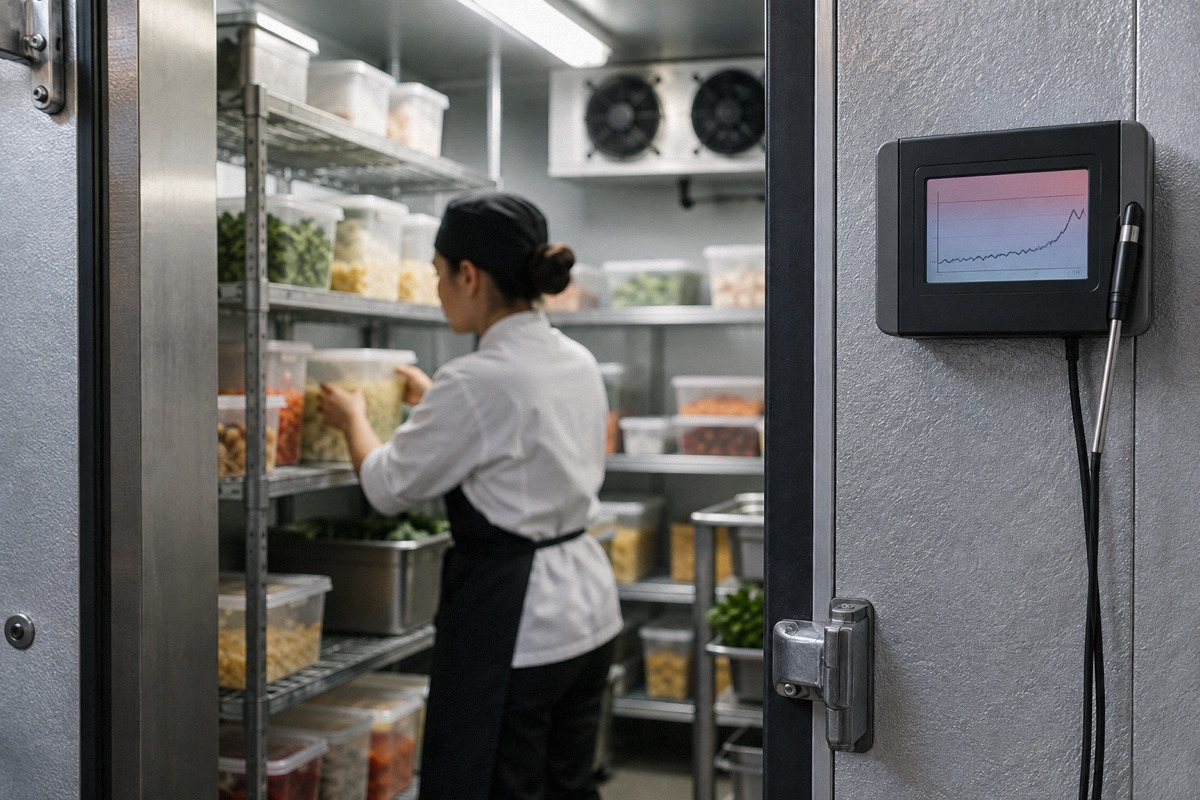
Manual logs only catch what happens during staffed hours. A walk-in that fails at 1 a.m. can sit warm until opening, with nobody knowing how long the product was exposed. Wireless temperature sensors that record continuously and send alerts close that gap. Their most useful output is not the alert itself but the history. When product is found warm at opening, a continuous record lets you see exactly when the temperature started rising, which is what makes a sound disposition decision possible.
The following is an operational suggestion, not a code requirement. Set alert thresholds that fire early enough for someone to act before product reaches 41 F. A sensor measuring air will spike during deliveries and defrost, so one approach is an alert delay, or a probe placed in a glycol or product-simulating bottle, to filter out short spikes. Follow the sensor maker's guidance. Test the alert path monthly. Confirm the right phone actually receives it overnight, and keep a written escalation list naming who is called if the first person doesn't respond. Sensors do not replace manual product probing. Verify sensor accuracy against a calibrated probe thermometer on a schedule.
Hypothetical worked example: a slow drift caught before it becomes 50 F
This is a hypothetical with no real establishment implied. A DC restaurant's opening air readings for its walk-in over one week are: Monday 36 F, Tuesday 37 F, Wednesday 38 F, Thursday 39 F, Friday 40 F. Probed product on Friday morning reads 39 F for a container of cooked rice and 40 F for raw chicken. Everything is still at or below 41 F, so none of these readings is itself a violation of DC's cold-holding requirement.
The trend is the problem. The air reading has risen 4 F over four days, about 1 F per day. A straight-line projection would have the air reaching 41 F in about a day and passing it soon after. Two sparse readings a day don't support confident forecasting, so treat that projection only as a reason to act now, not as a schedule. The manager calls for refrigeration service that morning. While waiting, the manager reduces door openings, moves the most temperature-sensitive prepared foods to a reach-in with room, and increases product probing to every two hours. The technician finds a heavily iced evaporator coil and a defrost timer fault.
Compare the version of this week with no trend review. Each daily reading would have passed. The first reading anyone noticed might be the following Tuesday at 47 F across the board, with no record of when it crossed 41 F. At that point the disposition decision is much harder, and the cost is the whole box. The difference between the two outcomes is one Monday sentence and one phone call.
What to do with product found above 41 F
When product in a failing walk-in reads above 41 F, the decision depends on what you actually know: how warm it is, for how long, and what kind of food it is. Make the decision under your jurisdiction's adopted code and any approved written procedure. Seek DC Health's direction where needed, and follow an inspector's instructions where an inspector is involved. This article deliberately does not offer a universal time allowance, because the applicable rules depend on the adopted code and the circumstances. One principle holds everywhere. If you cannot establish the time-temperature history, you cannot establish that the food is safe, and moving it to a colder unit or rechilling it does not change that.
Act on the box and the product separately. Stop putting product into the failing unit. Move items whose history is known and acceptable to working refrigeration. Segregate items whose history is unknown or unacceptable, label them clearly as not for use, and dispose of them under your procedure. Write a disposition log listing item, quantity, temperature, the time it was found, the decision and who made it. Don't let anyone quietly mix questionable product back into service to save cost. That behavior turns an equipment failure into a food safety and integrity failure.
- Probe several product types, not just one, to judge whether the whole box is affected.
- Pull the continuous sensor history or manual log to establish when temperatures began rising.
- Segregate and label product whose history is unknown or unacceptable; do not rechill it as a fix.
- Record every disposition decision with item, quantity, reading, time and initials.
- Keep the service ticket and post-repair readings with the disposition log.
Service-call triggers and what staff should not attempt
Define in advance the conditions that require a service call, so nobody has to judge it at 9 p.m. on a Friday. The following triggers are operational suggestions. Call when the weekly trend is drifting upward, when air readings stay above your alert threshold after a door-closed recovery period, when product in multiple containers reaches the limit, when ice is building on the evaporator coil, when the compressor runs constantly or cycles rapidly, or when water pools under the evaporator. Gaskets can often be replaced by trained staff with the correct manufacturer part. Electrical, refrigerant and control work belongs to a qualified refrigeration technician.
The freezer version deserves the same attention. In another KitchenConfidential thread, Worst/most obvious thing that the health inspector didn't notice, the original poster described a freezer where food was soft rather than frozen, which a manager allegedly brushed off. That is a single account, but soft product is unambiguous evidence the unit isn't doing its job. Evaluate the product's actual temperature and history and decide its use or disposal under your procedure. Don't wait for an inspector to notice.
Records an inspector can use, and that you should want anyway
During an inspection, being able to show a dated log with real numbers, a weekly trend note, sensor alert history, a service ticket and a disposition log tells the inspector that the operation finds its own failures. Those same records protect you if a guest later questions a meal, and they show your refrigeration contractor a documented failure pattern instead of a vague 'it's been running warm.'
Keep logs in a consistent place and retain them for at least as long as your jurisdiction or insurer requires; check both. Never fill in missing readings after the fact. A gap honestly recorded as 'not taken' prompts a training conversation. A fabricated reading hides exactly the information the log exists to capture and misrepresents conditions to anyone who relies on it, inspector or guest.
Questions that come up next
What temperature should a restaurant walk-in cooler hold in DC?
DC Health's inspection guidance states that cold foods shall be maintained at 41 F or below, so the walk-in must keep product at or below that temperature. As an operational choice, running the box a few degrees colder leaves a margin for door traffic. Log both air and probed product temperatures, because air readings swing quickly while product readings show what the food actually experienced.
Can I move warm product to another cooler and keep using it?
Only if you can establish that its time and temperature history is acceptable under your adopted code and approved procedures. Moving or rechilling food does not reset its exposure. If the history is unknown, for example because the walk-in failed overnight with no sensor record, segregate the product, label it not for use, dispose of it under your procedure, and log the decision.
Sources & context
Forum accounts are unverified experiences. Read government sources for their stated jurisdiction and check requirements with the responsible authority for your location.
- How scary are these restaurant inspection violations? Would you eat here? (r/KitchenConfidential)reddit · Search excerpt: commenter reasons that several items in the same warm range suggest a walk-in near 50 F; another notes possible cooling context. Strangers interpreting a report, not a verified investigation.
- Worst/most obvious thing that the health inspector didn't notice (r/KitchenConfidential)reddit · Search excerpt: soft, not-frozen freezer reportedly ignored by a manager. Single personal account; used for the freezer illustration only.
- DC Health: Understanding Food Establishment Inspectionsgovernment · District of Columbia guidance: cold holding at 41 F or below; inadequate refrigeration among closure grounds; severe temperature abuse as imminent hazard. Does not set log cadence or alarm thresholds; those here are operational suggestions.
- DC Health Food Establishment Plan Review Guidance Packet (Dec 2019, ver. 8)government · District of Columbia plan review form, read directly: asks about adequate refrigeration/freezer capacity with a 41 F figure and whether each unit has a thermometer. A questionnaire, not full rule text; does not mean 41 F is adequate frozen storage.


