
The practical answer
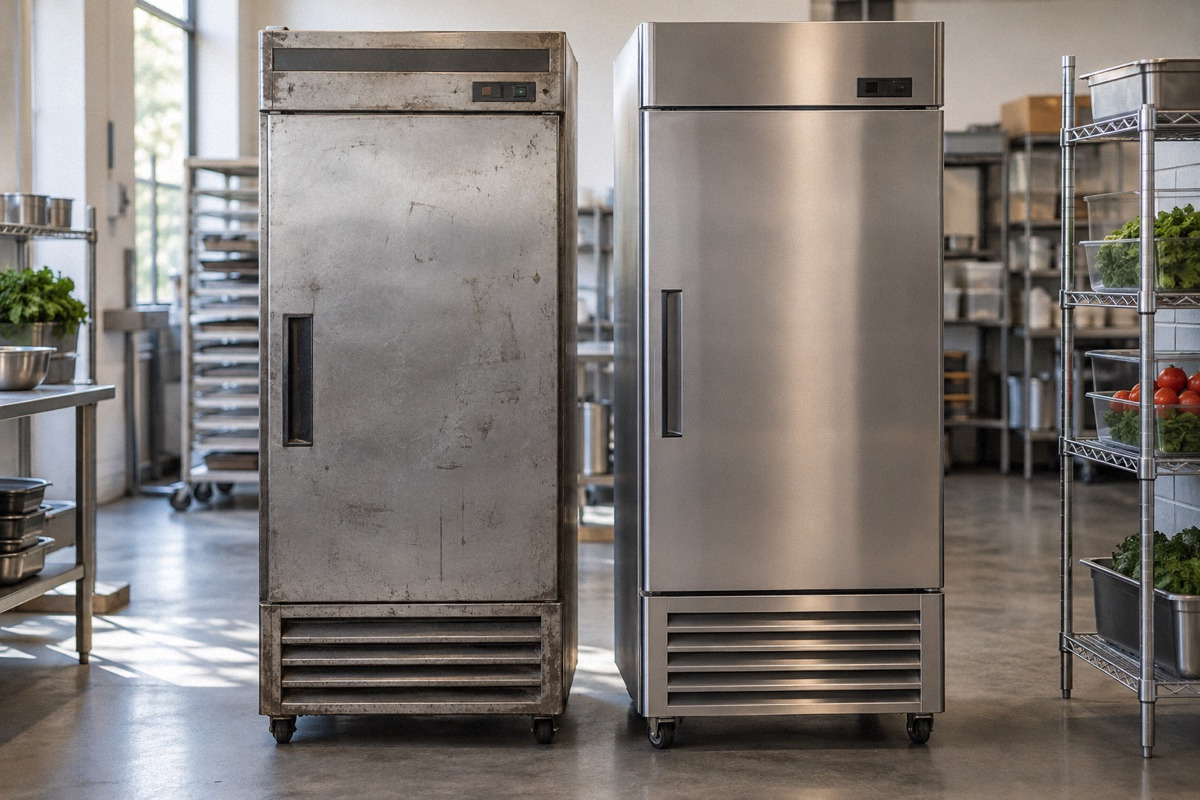
Used refrigeration carries more hidden risk than most used kitchen equipment. A sealed system can hide its condition, a failure can spoil the food as well as the unit, and warranty coverage on used units ranges from none to limited. Owners and a self-described repair tech in forum threads favor used ovens without steam features, whose faults show up in a test fire. If you buy used refrigeration, get a technician's inspection, budget a repair reserve plus a separate allowance for a major failure, and plan where the food goes if it fails.
Why used refrigeration hides more risk than most equipment
This is a risk comparison, not a measured ranking of failure rates. Many used-equipment faults are visible before you buy. A burner won't light, a door hinge sags, a fryer won't hold its set temperature. Refrigeration fails in ways that are hard to judge in a showroom or a closing restaurant's back room. Compressor wear, a slow refrigerant leak, a fan motor near the end of its life and a clogged condensate drain can all leave a unit that seems cold on the day you look at it. The faults show up weeks later, under a full load, on a hot line.
The cost of a failure is also different. When a used range breaks you lose cooking capacity. When a used cooler breaks you lose capacity and you may also lose everything inside it. That food becomes questionable as soon as it climbs above the cold-holding limit. In the District of Columbia, DC Health states that cold foods must be held at 41°F or below (DC Health, Understanding Food Establishment Inspections). The same DC page lists inadequate refrigeration among the conditions that can justify suspending an establishment's license for an imminent health hazard. Other jurisdictions set their own limits, so check the code your health department enforces. Whatever the number, a used cooler puts a code requirement and your inventory at risk, not just a piece of equipment.
What owners in the threads report, and the limits of that evidence
The question comes up again and again in owner forums, and the answers split in a consistent way. In a r/restaurantowners thread on used versus new fridges, one owner said they always regretted buying used and that the discount should be around 25 percent of the new price or less. Another owner in the same thread took the opposite view. They said used equipment almost always needs repair money, but that it costs well under a quarter of the new price. They reported budgeting about $2,000 a year for cooling repairs, against roughly $40,000 to buy all their fridges and walk-ins new.
In a separate thread asking for used-equipment advice, the top short reply was never to buy refrigeration used. A follow-up comment argued that you never know how the previous owner maintained a unit, that a new compressor can cost nearly as much as the equipment itself, and that dirty coils, overheated compressors and wiring shorts can make used refrigeration a fire hazard. In a third thread, New versus used?, a commenter who said they are a repair tech and restaurant owner advised against used refrigeration, called ovens a better used buy unless they have steam, and said the refrigeration problem has gotten worse in the last 10 to 15 years.
Read these as experienced opinions, not data. Our research recorded them as search excerpts, not complete thread reviews. The dollar figures are one restaurant's numbers, and the repair-tech credential is a self-description we cannot verify. Still, the pattern is useful. Even the owner who favors used refrigeration does so with a standing repair budget, and nobody argues it's free money.
Inspecting a used refrigerator or freezer before you pay
If a used unit is still on the table, inspect it the way a repair tech would and write down what you find. Ideally, pay a refrigeration technician you trust to look at it before the money changes hands. A seller who refuses a running test or a tech inspection has told you something about the unit.
Ask to see the unit running and holding product, or at least running for several hours with the doors closed and a thermometer inside. A unit that has been unplugged in storage tells you almost nothing until it has run long enough to cycle.
- Data plate: model, serial number, refrigerant type and electrical rating are legible. Without them, you can't order parts or show the equipment's listing to a plan reviewer.
- Condenser coil: look for heavy dust, grease matting and bent fins. Matted coils mean the compressor has been working hot.
- Compressor and fans: listen for short-cycling, rattling or a fan that labors to start. Feel whether the compressor compartment is unusually hot.
- Evaporator: look for ice buildup, corrosion or oil spots, which can indicate a leak.
- Drain line and pan: confirm the condensate drains, with no standing water, slime or rust trails inside the cabinet.
- Gaskets and hinges: torn or hardened gaskets and doors that don't self-close cost energy and temperature control.
- Cabinet: check for rust at the floor seams, cracked liners, and missing shelf clips or casters.
- History: ask why it's being sold, how old it is, and for any service invoices.
Warranty, the repair reserve and the discount you actually need
New equipment doesn't mean no repairs. The owner who regretted buying used acknowledged that new units break too, but said parts, and sometimes service, are often under warranty. The real comparison is a new unit with a manufacturer warranty against a used unit whose coverage depends on the seller. A private sale or auction is usually as-is. Some used dealers and refurbishers offer a limited warranty, such as parts-only coverage for a short period. Get any warranty in writing, including what it covers and who does the work.
That's why the purchase price alone is the wrong number to compare. Add three things to the used price. First, the cost of a pre-purchase inspection. Second, an annual repair reserve for routine repairs, kept as a separate budget line. Third, a separate allowance for one major failure that the routine reserve wouldn't absorb, which on refrigeration often means a compressor or refrigerant leak repair plus the food lost when it happens. Keep the reserve and the major-failure allowance separate so the same repair isn't counted twice. A reserve is money set aside, not money you will necessarily spend. Then compare that total with the new price plus the routine maintenance a warranty doesn't cover, such as coil cleaning and gasket replacement. Warranty terms vary by manufacturer and model, and parts coverage is not always labor coverage, so read the actual warranty before you assume the new unit costs nothing to fix.
Worked example: a four-year budget test of the used discount (hypothetical numbers)
All figures in this example are hypothetical, chosen to show the arithmetic. They are not market prices or expected costs. This is a budget comparison. Reserves are money set aside for repairs, not money the owner will necessarily spend. Suppose a new two-door reach-in is quoted at $5,200. A used unit of the same size is offered at $1,300, which is 25 percent of the new price, sold as-is. A technician charges $175 to inspect it. The owner budgets a routine repair reserve of $500 a year for the used unit, meant for small jobs such as a fan motor, a thermostat or a drain clearing. For the new unit, the owner budgets $150 a year for maintenance outside warranty. The comparison runs over four years.
Used at 25 percent: $1,300 + $175 + (4 × $500) = $3,475 budgeted. New: $5,200 + (4 × $150) = $5,800 budgeted. Now stress-test the used unit with one major failure that the routine reserve was not sized for: a $1,600 compressor job plus $400 of discarded food, or $2,000. This amount is in addition to the reserve, not paid from it, so nothing is counted twice. The used budget becomes $5,475, only $325 below new, and the owner also lost a day or more of capacity.
Repeat the test with the used unit at 40 percent of new, or $2,080. The budget is $2,080 + $175 + $2,000 = $4,255. With the same additional $2,000 failure it becomes $6,255, which is $455 more than buying new. If the reserve goes partly unspent, the used options look better than this. If there's a second major failure, they look worse. In this example, the used deal survives one major failure only near the deep discount the regretful owner described.
| Four-year budget (hypothetical; reserves are set aside, not necessarily spent) | Used at 25% of new | Used at 40% of new | New |
|---|---|---|---|
| Purchase price | $1,300 | $2,080 | $5,200 |
| Pre-purchase inspection | $175 | $175 | $0 |
| Routine repair reserve or maintenance budget | $2,000 | $2,000 | $600 |
| Budget before any major failure | $3,475 | $4,255 | $5,800 |
| Stress test: one $2,000 major failure beyond the reserve | $5,475 | $6,255 | $5,800 |
Ovens and other equipment that tolerate a second owner
The repair-tech comment draws the line between refrigeration and ovens, and the reasoning is easy to test. A standard gas or electric convection oven, a deck oven or a range has fewer hidden systems. You can run it at temperature, watch the burners or elements, check the fan, and confirm the thermostat with your own oven thermometer in a single visit. What you see is close to what you get.
The same commenter carved out ovens with steam, and that matters. Combi ovens and steam equipment add water systems, generators and scale-prone components that are as hard to judge as a compressor. Treat them like refrigeration. Stainless worktables, shelving, sinks and many smallwares are the easiest used purchases of all, because nothing inside them can quietly fail. Gas equipment, new or used, still needs proper connection by a qualified installer and any permits your jurisdiction requires. Buying used doesn't change who is allowed to hook it up.
Paperwork a used unit still needs (DC example)
Used equipment can create plan-review problems that new equipment avoids. DC Health's Food Establishment Plan Review Guidance Packet (Dec 2019, ver. 8) asks applicants for manufacturer specification sheets for each piece of equipment on the plan. It also asks for an equipment schedule with make and model numbers that lists equipment certified for sanitation by an ANSI-accredited certification program, where applicable. A used cooler with a missing data plate or an obscure model can be hard to document. Confirm you can get the spec sheet and listing information before you buy, not after the plan reviewer asks.
The same DC packet asks whether adequate approved freezer and refrigeration capacity is available to store frozen foods and refrigerated foods at 41°F (5°C) or below, and whether each refrigerator and freezer has a thermometer. Read that as two separate jobs. Refrigerated foods must be at 41°F or below, and freezers must keep frozen food frozen. A freezer holding 41°F is not doing its job. The packet also states that plan review does not mean compliance with other codes, and that a pre-opening inspection with equipment in place and operating is needed. If you're outside DC, your health department's plan-review checklist is the document to check. This DC packet is an example, not your local rule.
Decision table by equipment category
The table below is an editorial risk judgment based on how hidden each category's failure points are. It is not measured failure data. Use it as a starting rule, then adjust it for your repair access. An owner with a responsive refrigeration tech nearby can take more used risk than one whose nearest service company has a week-long backlog. As one commenter in the New versus used thread put it, used equipment is fine as long as you have a repair person on speed dial. That's a condition, not a footnote.
| Equipment | Hidden-fault risk (editorial judgment) | Main reason | Condition to buy used |
|---|---|---|---|
| Reach-in and prep coolers | High | Hidden compressor, leak and drain faults; food loss on failure | Deep discount, tech inspection, repair reserve |
| Walk-in boxes and remote systems | High | Panels may be reusable, but compressors and controls are the risk; relocation needs a refrigeration contractor | Tech evaluates the system; budget for new refrigeration components |
| Ice machines | High | Water systems, scale and sanitation history | Full cleaning and tech check; prefer new |
| Convection and deck ovens (no steam) | Moderate to low | Faults are visible in a test fire | Run at temperature and verify the thermostat |
| Combi and steam ovens | High | Water and steam components hide wear | Service history and tech check |
| Ranges and griddles | Moderate to low | Simple components | Inspect burners, valves and the gas connection |
| Stainless tables, shelving, sinks | Low | Nothing to fail internally | Check welds, legs and sanitation condition |
Failure modes and what to keep on file
The common mistakes follow a pattern. Owners buy a unit that was never run under load. They skip the inspection to save a small fee on a much larger purchase. They spend the repair reserve on something else. Or they put a used cooler on the hottest part of the line, the position where marginal refrigeration fails first. Another quiet failure is buying a used unit with no data plate, then discovering that parts can't be ordered and the plan reviewer can't verify its listing.
For every used refrigeration purchase, keep a file with the bill of sale, photos of the data plate, the technician's inspection notes, the first week of temperature readings, and every later repair invoice. That file answers the question that matters at replacement time: has this unit cost more in repairs and lost food than a new one would have? Without records, the decision gets made on the memory of the last breakdown.
Questions that come up next
How much cheaper should used restaurant refrigeration be before it's worth buying?
There's no standard figure. One owner in a forum thread suggested about 25 percent of the new price or less. Work it out as a budget. Add the inspection cost and a routine repair reserve to the used price. Then stress-test it with one major failure, such as a compressor job plus discarded food, counted separately from the reserve. Compare that total with the new price plus maintenance not covered by warranty. If one major failure erases the saving, the discount is too small.
Is a used oven a safer purchase than a used fridge?
Usually, if it has no steam features. A commenter who described themselves as a repair tech and restaurant owner called ovens a better used buy, except steam models. Ovens show their faults when you run them at temperature, while refrigeration can hide compressor, leak and drain problems. Gas units still need qualified installation and any permits your jurisdiction requires.
Sources & context
Forum accounts are unverified experiences. Read government sources for their stated jurisdiction and check requirements with the responsible authority for your location.
- r/restaurantowners: Used vs New Fridge Equipmentreddit · Search-excerpt evidence. One owner regretted buying used and suggested a discount to about 25% of new or less. Another reported about $2,000 a year in cooling repairs versus about $40,000 to buy all new. These are individual accounts, not market data.
- r/restaurantowners: used equipment - Advicereddit · Search-excerpt evidence. Includes 'never buy refrigeration equipment used' and a comment that dirty coils, overheated compressors and wiring shorts can make used refrigeration a fire hazard. These are commenter opinions, not engineering findings.
- r/restaurantowners: New versus used?reddit · Search-excerpt evidence. A self-described repair tech and owner advises against used refrigeration and calls ovens without steam a better used buy. The credential is self-reported and unverified.
- DC Health: Understanding Food Establishment Inspectionsgovernment · District of Columbia source for cold holding at 41°F or below and for inadequate refrigeration as grounds for closure due to an imminent health hazard. Applies to DC only; other jurisdictions set their own rules.
- DC Health Food Establishment Plan Review Guidance Packet (Dec 2019 ver. 8)government · DC plan-review questionnaire: spec sheets per item, an equipment schedule listing ANSI-accredited sanitation certification where applicable, cold-storage capacity at 41°F or below, and a thermometer in each refrigerator and freezer. Dated 2019; confirm the current version with DC Health.


