The practical answer
If a reach-in that was holding temperature starts running warm, turning the control colder usually treats a symptom. When the cause is a frozen evaporator, a blocked drain, a dirty condenser or crowded airflow, a colder setting can build more ice and lead to a bigger repair. First protect the food: move it to a unit that is holding, and in DC keep cold-held food at 41°F or below. Then check airflow, coils, drain and doors. If it still won't hold, or the coil is iced, call a refrigeration technician.
Why cranking the control backfires
A refrigeration technician started a r/restaurantowners thread on refrigeration issues with a direct request. Stop turning the thermostat colder on units that aren't holding temperature. According to the post, it doesn't fix the problem, it makes things worse, and it leads to a bigger bill because of the labor needed to thaw the unit. The poster said that as a chef they had called their refrigeration company at the slightest rise in temperature or any icing on the coil.
A reply in the same thread added a fair distinction. If a working unit simply has its set point too high, lowering the set point is the right fix. If the unit is malfunctioning, it needs repair. Another commenter put the practical test plainly: if you have ice, you have a problem. These comments were recorded as search excerpts, not a complete thread review, but together they give a useful first rule. Change the setting only after you've confirmed it was set wrong. A unit that used to hold at its normal setting and no longer does has developed a fault, and the dial won't fix it.
The mechanism explains why. Many reach-in faults reduce the evaporator's ability to move heat. Frost or ice on the coil, a stopped evaporator fan, product packed against the air path and a clogged condensate drain all do this. A colder setting makes the system run longer, and a coil that's already icing collects more ice. The cabinet can get warmer even as the compressor works harder. A dirty condenser coil has a similar effect from the other side: the system can't reject heat, so longer run time gains little.
Symptoms checklist: what you're seeing and what it suggests
Before calling anyone, spend five minutes observing and write down what you find. The table matches common symptoms with likely causes and a first action. It's a guide to likely causes, not a diagnosis. Several faults can produce the same symptom, and only a technician can confirm problems with the sealed refrigeration system.
| Symptom | Possible causes | First action |
|---|---|---|
| Frost or ice on the evaporator coil or its cover | Blocked drain, failed defrost, stuck fan, door seal leak, set point pushed too low | Move food; don't chip ice; call a technician |
| Water pooling inside the cabinet or under the unit | Clogged or frozen condensate drain | Move food; note where the water collects; report it |
| Compressor runs constantly; cabinet slowly warming | Dirty condenser, blocked airflow, hot location, refrigerant or component fault | Check condenser area and clearance (power off before touching) |
| Compressor short-cycling or not running | Control, electrical or overheating fault | Call a technician; don't keep resetting it |
| Warm only at the top or near the door | Overloading, blocked fan, door gasket or frequent door opening | Unload the air path; check gasket and door closure |
| Thermometer and display disagree | Display sensor drift or misplaced probe | Trust a calibrated food thermometer in product |
Protect the food first: holding while you wait (DC example)
Repairing the unit is the second job. The first is keeping time and temperature control safe. In the District of Columbia, DC Health states that cold foods shall be maintained at 41°F or below (DC Health, Understanding Food Establishment Inspections). The same page explains that the DC food regulations, DCMR Title 25, were adopted from the FDA model Food Code. The FDA model isn't law anywhere until a jurisdiction adopts it, so outside DC, check the cold-holding limit in your own state or local code. The DC page also notes that when time rather than temperature is used as the public health control, written procedures must exist and be followed. That's not something to improvise during a breakdown.
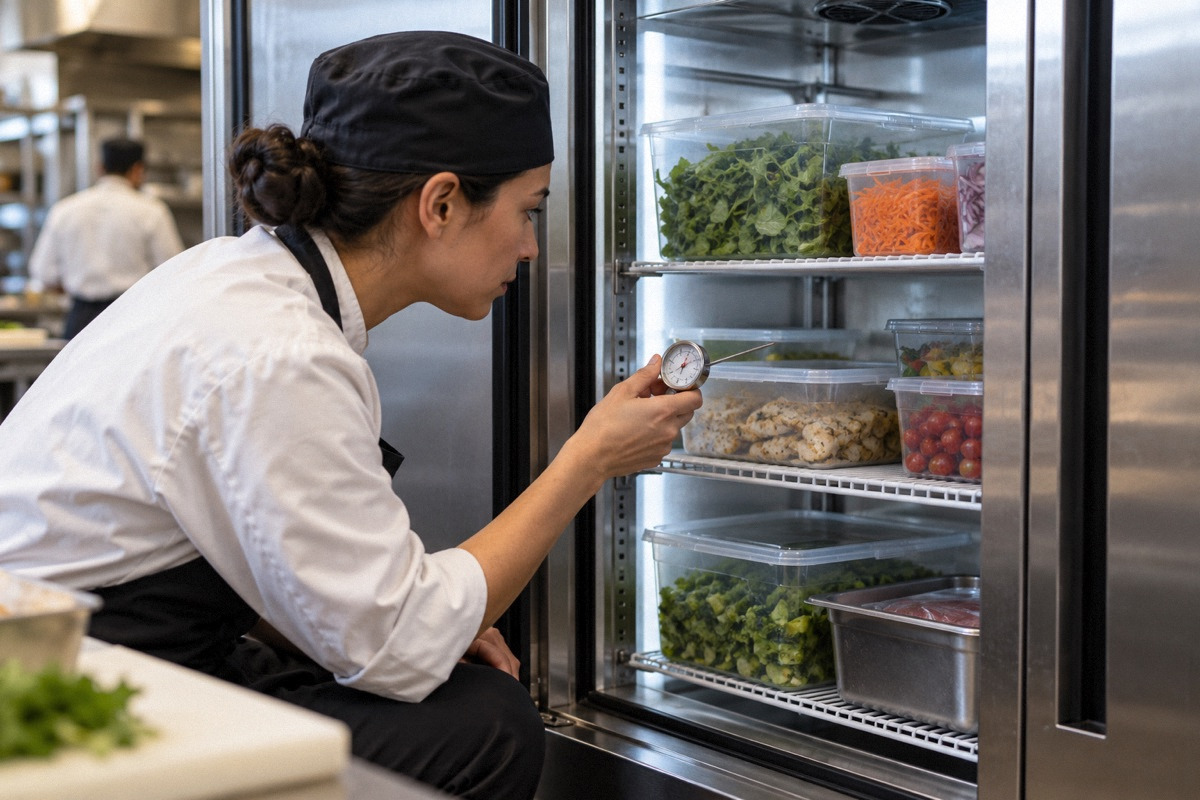
As soon as a unit reads above your limit, move time- and temperature-controlled food to a unit that is holding. Take temperatures of the food itself with a calibrated probe, not just the cabinet display, and write them down with the time. DC Health's Plan Review Guidance Packet (Dec 2019, ver. 8) asks whether each refrigerator and freezer has a thermometer. That thermometer is what lets staff spot drift before food is affected.
What to do with food that has already been above the limit is a food-safety decision. It belongs to your jurisdiction's rules and your written procedures, not to the repair schedule. If you can't document how long food was above the limit and at what temperature, the cautious course is to discard it. When you're unsure, contact your health department. Don't hold questionable food back for service until the unit is repaired. DC Health lists inadequate refrigeration among the conditions that can justify suspending a license for an imminent health hazard. It also gives refrigerator repair or replacement as an example of something that can't be corrected on site during an inspection.
What staff should not do
Most expensive reach-in repairs start with a well-meaning fix by staff. Post these rules near the unit and repeat them in training, so the closing cook knows them as well as the chef does.
- Don't turn the control colder on a unit that used to hold at its normal setting. Log the reading and tell a manager.
- Don't chip or pry ice off the evaporator with knives or tools. Puncturing a coil turns a service call into a major repair.
- Don't spray water or degreaser into the compressor or electrical compartment.
- Don't keep power-cycling a compressor that keeps stopping.
- Don't stack product against the evaporator fan guard or block the return air path.
- Don't leave food in a failing unit 'to see if it comes back'. Move it now.
Coil, drain and airflow checks owners can do safely
Some causes are within an owner's reach, and they're the ones that recur. Disconnect power before touching anything near fans or electrical parts, and follow the manufacturer's manual for access panels and cleaning. Leave anything involving refrigerant, sealed-system components or wiring to a qualified technician.
Start at the condenser. On many reach-ins it sits behind a front or rear grille. Grease-matted dust on a line cooler's condenser is a common reason a unit can't keep up on a hot afternoon. Check the clearance the manufacturer requires around the unit's air intake and exhaust. A reach-in wedged next to a fryer, or with a box leaning on its grille, is starving itself. Inside, look at how product is loaded. One commenter in the refrigeration thread pointed out that cramming product against the cooling components can make a unit freeze up. Leave space in front of the evaporator fan. Then check the condensate drain. Another commenter said one problem station was fixed by adjusting the thermostat and clearing the drain lines, and another described having to snake a drain line that kept clogging. Finally, close each door on a slip of paper. If it pulls out with no resistance, the gasket isn't sealing there.
Worked example: one afternoon's log and what it showed (hypothetical)
This timeline and its numbers are hypothetical, to show how a written log guides both the food decision and the repair. A two-door reach-in on a grill line reads 38°F at the 10:00 opening check. At 13:00, a cook notices 42°F and turns the control two steps colder. At 15:00, the manager sees 45°F, frost covering the evaporator cover, and water pooled on the bottom shelf. The manager moves all food to the walk-in, logs probe temperatures of the product, and takes the unit out of service.
The food decision comes first. The log shows the cabinet was at or below 41°F at 10:00 and above it by 13:00, but nobody knows when between those checks it crossed. Because the time above the limit can't be documented, the manager discards the time- and temperature-controlled items from that unit under the restaurant's written procedure, and records what was discarded and why.
The repair comes second. The technician finds a clogged condensate drain. Water had backed up and frozen around the coil, and the colder setting had added more ice. Suppose, hypothetically, the technician bills $120 an hour, the rate one commenter in the thread mentioned paying. Clearing the drain on a unit caught early might take about an hour, or $120. Defrosting a heavily iced unit, clearing the drain and confirming it holds might take three hours, or $360. The extra $240, plus the discarded food, came from the two hours between the first warm reading and the call. The log also points to prevention: drain cleaning added to the monthly checklist, and a rule that a reading above 41°F triggers a manager call, not a dial change.
When to call a refrigeration technician
Call the same day if you see ice on the evaporator coil, if the unit can't hold your cold-holding limit at its normal setting after you've cleared airflow and confirmed the doors seal, if the compressor short-cycles or won't start, or if you see oil spots or hear new grinding or rattling. Water you've already cleared once that comes back is a recurring fault, not a cleaning job.
Give the technician something to work with. Have ready the model and serial number from the data plate, your temperature log with times, what changed recently (the setting, the location, the load, a new neighbor appliance), and what you've already checked. A good technician will want this information. The refrigeration-issues thread includes complaints about technicians who only wash coils or change filters and can't go further when that doesn't solve it. Clear history helps you judge whether the diagnosis addresses what you saw. For building a technician roster before the next failure, see our guide to setting up equipment repair and preventive maintenance.
The inspection snapshot and the habits that prevent the next failure
A failing unit often shows up first in an inspection. In a r/KitchenConfidential thread about inspection violations, commenters reading a report noted walk-in items around 50°F and read it as a failing walk-in. Others pointed out that an inspection is a snapshot of a single day. Both points apply to your kitchen. The inspector sees one moment. Your log shows whether that moment was a fluke or a trend.
Prevention is routine work. Log the temperature of every unit at set times each shift. Clean condenser coils on a schedule set by the manufacturer's guidance and your kitchen's grease load. Check drains and gaskets monthly. Train staff that a warm reading triggers a manager call, not a dial change. Our guide to walk-in temperature logs covers how to set up logging that catches a slow rise before it becomes a discard.
Questions that come up next
Should I turn the thermostat colder if my commercial fridge isn't cooling?
Only if you've confirmed the set point was simply too high on a unit that otherwise works. If it held fine at its normal setting and now runs warm, something has changed, such as an icing coil, a clogged drain, a dirty condenser or blocked airflow. A colder setting can build more ice and make the repair bigger. Move the food, do the safe checks and call a technician.
Can we keep using food from a cooler that reached 45°F?
That depends on how long it was above your jurisdiction's cold-holding limit and what your code and written procedures allow. It isn't a repair question. DC Health requires cold foods at 41°F or below. If you can't document the time and temperature, the cautious choice is to discard the food, and to ask your health department when unsure. Don't hold it back for service.
Sources & context
Forum accounts are unverified experiences. Read government sources for their stated jurisdiction and check requirements with the responsible authority for your location.
- r/restaurantowners: Refrigeration issuesreddit · Search-excerpt evidence. Post by a self-described refrigeration technician against lowering the thermostat on units not holding temperature; replies on set point versus malfunction, drain-line clearing, loading too close to cooling components, and frustrations with service technicians. The credential is unverified.
- r/KitchenConfidential: How scary are these restaurant inspection violations? Would you eat here?reddit · Search-excerpt evidence. Commenters read walk-in items around 50°F as a failing walk-in and note that inspections are snapshots. Indirect support: the thread is about a walk-in, not a reach-in.
- DC Health: Understanding Food Establishment Inspectionsgovernment · District of Columbia guidance: cold foods at 41°F or below; written procedures when time is the control; inadequate refrigeration as a closure ground; refrigerator repair is not correctable on site; Title 25 DCMR adopted from the FDA model Food Code. DC only.
- DC Health Food Establishment Plan Review Guidance Packet (Dec 2019 ver. 8)government · DC plan-review questionnaire asks whether each refrigerator and freezer has a thermometer and whether refrigeration can hold refrigerated foods at 41°F or below. It is a plan-review form, not a repair standard.


