
The practical answer
When a delivery platform refunds a customer and charges the amount back to your restaurant, your leverage depends on two things: what your merchant agreement says you are responsible for, and whether you can show the order left complete and sealed. Read the agreement's accuracy and adjustment terms, seal every bag with a tamper-evident label, photograph it at handoff with the order number visible, and dispute each charge inside the window your merchant portal shows. Track results by reason and item so you fix real kitchen errors and escalate genuine patterns.
Why a complete, sealed order can still cost you money
On your own takeout channel, you decide how to respond when a guest says something was missing. On a delivery app, the platform usually decides first. A customer reports a problem in the app, the platform issues a refund or credit to keep that customer, and depending on your merchant agreement, some or all of that amount may later appear on your statement as an adjustment or error charge. By the time you see it, the decision has already been made, and the burden falls on you to show the charge should not apply.
That is a different problem from the direct-takeout policy covered in the related article on missing-item claims. You are not deciding how generous to be with a guest. You are presenting evidence to a business partner under a contract, through a process the partner controls. The useful questions are therefore narrower: what did you agree to be responsible for, what evidence does the platform's process accept, and how quickly must you submit it.
What your merchant agreement actually obligates
Start with the contract you signed, not with what other owners say theirs contains. A commenter in a since-removed r/restaurants post argued that their obligation to the apps ended when the order left the building accurate, intact and sealed (Reddit discussion). That may describe their agreement; it is a claim about one operator's contracts, not a statement of what every platform requires. Your agreement and the platform's merchant terms define who bears the cost of missing items, incorrect items, spills, late orders and orders never delivered, and those terms can differ between platforms and change over time.
Find and save the current version of three things: the section describing order accuracy and adjustments or error charges, any description of how merchants may dispute those charges, and the dispute-resolution clause for disagreements that the normal process does not settle. Note the date you saved each one. If the terms say you are responsible only for items you failed to include or packaging you failed to seal, your evidence should be aimed squarely at those points. If the terms are vague, that ambiguity is itself something to raise with your account representative. The related article on reading third-party delivery contracts covers the wider agreement.
Seal and photo evidence that answers the actual question
Most adjustment disputes come down to one question: did the order leave your restaurant complete and closed? Evidence that answers that question is worth collecting on every order. Evidence that answers some other question, such as how good the food tasted, rarely helps.
A tamper-evident seal is the backbone. Use stickers or tape that tear visibly when opened, applied across the bag's closure after the check station confirms the contents. The seal does not prove what is inside, but it narrows the possibilities: if the seal was intact when the customer received the bag, the item was either never packed or the claim is mistaken. That makes your packing check the decisive step, which is why the check should be done by someone other than the packer and recorded with initials on the ticket.
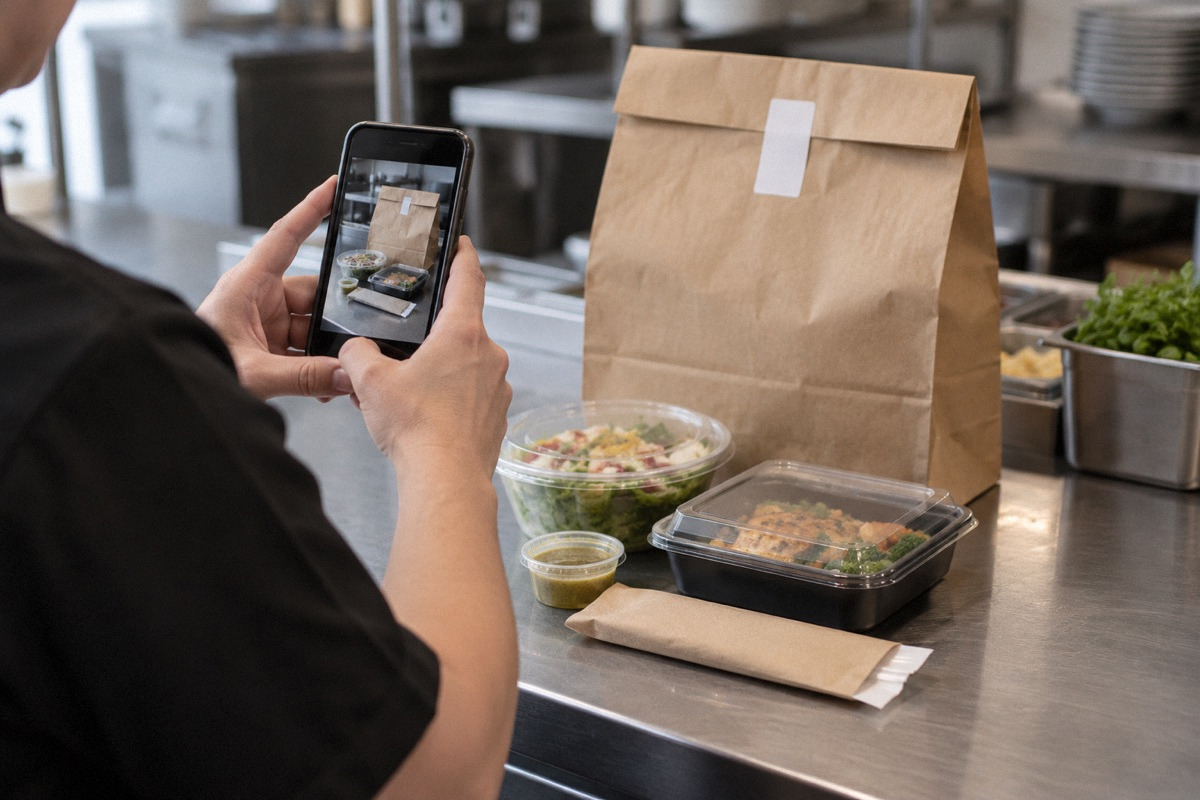
Photographs at handoff complete the record. The owner thread on missing-item claims includes a suggestion to photograph each order labeled with its order number or name (Reddit discussion). For delivery orders, the most useful image shows the sealed bag, the platform's order identifier on the ticket or label, and ideally the shelf or handoff point. If your packing step allows it, a second photo of the open bag before sealing shows the containers. Keep the device clock accurate, because timestamps are part of the story.
- Second-person check of ticket against containers, initialed on the ticket.
- Tamper-evident seal applied across the closure immediately after the check.
- Photo of the sealed bag with the platform order identifier legible.
- Optional photo of the open bag for larger or high-value orders.
- Time the bag was placed on the pickup shelf, and time the driver collected it if your tablet or POS records it.
- Photos stored by date and platform order identifier, retained at least through the platform's dispute window.
Dispute windows and a repeatable submission routine
Platforms typically allow merchants to contest adjustments only for a limited time after the order, and the window, the submission format and the evidence accepted are set by the platform and may change. This article does not state specific deadlines because they vary by platform and agreement; check your merchant portal and help documentation and write the current window for each platform on your dispute log. A strong photo submitted a day after the window closes is worth nothing.
A routine keeps disputes from becoming an occasional, frustrated catch-up session. Assign one person to review adjustments on a fixed schedule well inside the shortest window you face, for example twice a week. For each charge, they pull the order's photo and ticket, decide whether the evidence actually contradicts the claim, and submit a short, factual dispute only where it does. Disputing every charge regardless of evidence wastes time and may weaken your credibility with the platform's review team when you do have a strong case.
| Customer's reported issue | Evidence that helps | Evidence that rarely helps | Dispute? |
|---|---|---|---|
| Item missing | Open-bag photo showing item; initialed ticket; intact-seal photo | General statement that you always check | Yes, if photo or initials cover that item |
| Wrong item | Ticket matching what the customer ordered; open-bag photo | Photo of a sealed bag only | Yes, if the ticket and photo match the order |
| Spilled or damaged | Sealed, upright bag photo; lidded and taped containers | Recipe or food-quality claims | Sometimes; handling after pickup is outside your control |
| Never delivered | Driver pickup timestamp from tablet or POS | Photo of food on the shelf with no pickup record | Yes, if pickup is recorded |
| Food quality or taste | Usually none that addresses the claim | Photos of plating | Rarely; treat as feedback |
A forum statistic you should not borrow
The same removed-post commenter said that in their experience about 75 to 80 percent of delivery-app refunds were fraudulent, meaning the order had left accurate and sealed. That figure is an unverified anecdote from one person, recorded only as a search excerpt from a post that has since been removed. It is not a measured rate, it says nothing about your restaurant, and you should not repeat it to staff, to a platform or in a dispute submission as though it were evidence.
What you can do is calculate your own numbers. Over a month or a quarter, record how many adjustments you received, how many you disputed, how many were reversed, and, of the undisputed ones, how many your own photos and tickets showed were genuine kitchen errors. Those four figures tell you far more than any forum percentage: whether your packing process is failing, whether disputes are worth the labor, and whether a pattern exists that justifies escalation.
Tracking patterns by reason, item and shift
A dispute log becomes useful when you review it as a whole. Group adjustments by reported reason, by item and by shift. If one side dish accounts for many missing-item charges across many customers, the likely cause is a station or packing gap, and fixing it saves money no matter how disputes go. If charges spike on one shift, look at staffing and the check station during that shift.
Customer-level patterns are harder because platforms may show you little or no identifying information, and your agreement probably limits how you can use what you do see. Do not try to contact customers outside the platform or identify them by other means. If you see repeated charges that appear linked to the same customer or delivery address in the information the platform provides, report the pattern to the platform with your evidence and let it investigate. Likewise, never accuse a named driver; if pickup timestamps and seal photos suggest a problem after handoff, give the platform the order identifiers and let its process handle it.
Worked example: one month of adjustments at a fast-casual kitchen
Hypothetical example, for illustration only. A fast-casual kitchen processes 2,000 delivery-app orders in a month and receives 60 adjustments averaging $14, a total of 60 times $14, or $840. Before this month it disputed nothing.
After adding seals, handoff photos and initialed tickets, the manager reviews all 60. Fifteen show a genuine kitchen error, such as an unchecked item or a missing sauce, so those are not disputed; 15 times $14 is $210 the kitchen has to fix through process, not argument. The remaining 45 have evidence that contradicts the claim and are disputed. If the platform reverses 27 of them, the restaurant recovers 27 times $14, or $378.
The labor cost matters too. At about 4 minutes per dispute, 45 disputes take 180 minutes, or 3 hours. At a hypothetical $20 per hour for the manager's time, that is $60, so the net recovery is $378 minus $60, or $318 for the month. The example also shows the second payoff: the 15 genuine errors cluster around two items, and fixing those stations should reduce future adjustments whether or not disputes succeed. Actual reversal rates depend on the platform, the agreement and the evidence, and nothing here predicts what yours will be.
Escalation when the normal process isn't working
If well-documented disputes are routinely denied, move up deliberately. First, compile a short summary: number of adjustments, number disputed with seal and photo evidence, number reversed, and two or three representative examples with order identifiers. Send it to your account representative or merchant support with a specific request, such as a review of the denied cases or clarification of what evidence the platform accepts. A pattern presented with numbers is harder to dismiss than individual complaints.
If that does not resolve it, the options are business decisions rather than tactics. You can remove the items that generate most disputed adjustments from the delivery menu, adjust delivery pricing to reflect your actual adjustment cost, renegotiate terms at renewal, or reduce reliance on that platform. If you believe the platform is not following its own contract, the agreement's dispute-resolution clause governs what happens next, and that is the point to consult an attorney rather than escalate in public.
Failure modes and records to retain
The failures are mostly about consistency. Seals applied only when someone remembers, photos without a legible order identifier, disputes filed after the window, and disputes filed without evidence all undermine the process. So does treating every adjustment as fraud, which hides the kitchen errors that your own data would otherwise reveal.
Retain the saved versions of each platform's merchant terms with the date you saved them, the dispute log with outcomes, handoff photos and initialed tickets for at least the dispute window, and copies of escalation correspondence. Those records support individual disputes, show whether the effort pays for itself, and give you a factual basis for any contract conversation.
Questions that come up next
Can a restaurant dispute a DoorDash or Uber Eats refund charge?
Platforms generally provide a way for merchants to contest adjustments or error charges, but the window, format and accepted evidence are set by each platform and your agreement, and can change. Check your merchant portal for current rules, then submit a short, factual dispute with a sealed-bag photo showing the order identifier and an initialed ticket where your evidence actually contradicts the claim.
Is it true that most delivery-app refunds are fraudulent?
There is no reliable figure in the sources reviewed for this article. A forum commenter claimed 75 to 80 percent in their own restaurant, but that is an unverified anecdote from a removed post. Measure your own adjustments instead: how many you received, disputed and won, and how many your photos showed were genuine kitchen errors.
Sources & context
Forum accounts are unverified experiences. Read government sources for their stated jurisdiction and check requirements with the responsible authority for your location.
- Removed r/restaurants post (commenter on delivery-app refund fraud)reddit · Search excerpt from a post since removed. A commenter claims about 75-80 percent of their delivery-app refunds are fraud and says their contractual obligation ends when an order leaves accurate, intact and sealed. Used only to illustrate an owner's perspective; the percentage is unverified and is explicitly not used as a statistic, and the contract description applies only to that commenter's agreements.
- How do you handle 'I didn't receive' or 'missing' item claims from take out? (r/restaurantowners)reddit · Search excerpt only. Supports the practice of photographing each order labeled with an order number or name. The thread concerns takeout generally, so its application to delivery-platform disputes is indirect.


