
The practical answer
A broadline truck tells guests who you buy from, not what you do with it. Distributors sell raw produce, proteins and dry goods as well as fully prepared items. The honest response starts with an internal audit: which dishes you cook from raw ingredients, which use a purchased component, and which are prepared products you finish or reheat. Then make your menu, website and review replies match that audit. Federal advertising guidance judges the overall impression your words and images create, so don't answer the criticism with a blanket "everything scratch" claim you can't support.
Why a delivery truck triggers the premade assumption
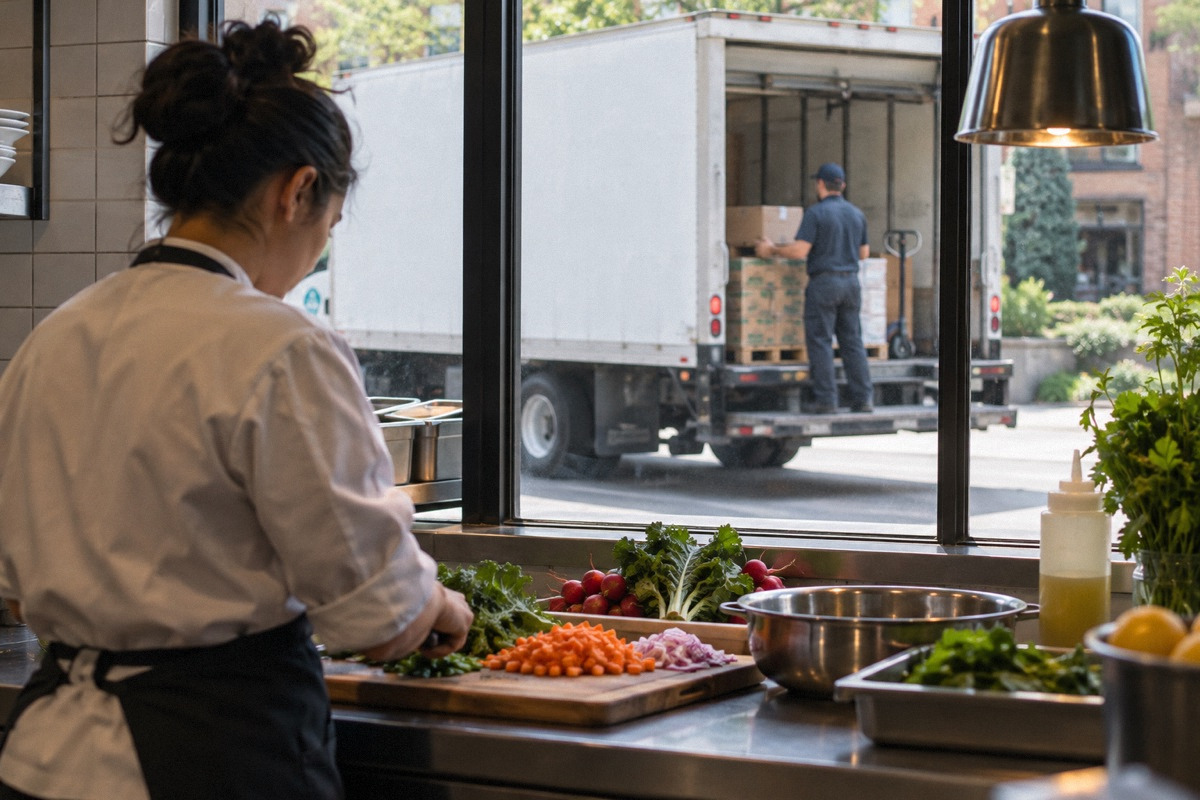
In a widely upvoted r/restaurantowners thread, an owner wrote that they get all of their food from one broadline distributor. A customer saw the delivery truck, made a nasty comment, and seemed to be putting two and two together. The recorded replies, a search excerpt rather than the full thread, split in a useful way. One commenter asked why anyone would buy everything from one distributor. Another answered that it's a one-stop shop carrying fresh items and basic ingredients as well as premade products. A third said what matters is whether you buy fresh product and make things in house or mostly use prefab frozen options. Someone suggested guests had been influenced by a recent documentary.
That last reply is the core of it. To a guest, a familiar truck stands for the frozen, reheated food they have read about. Arguing with that association rarely works. What works is knowing exactly what your kitchen makes, and saying it in words that hold up.
Audit what your kitchen actually makes
Before you change a single word of marketing, classify every menu item. You're not judging whether prepared products are bad. Many good restaurants buy bread from a bakery or use a purchased stock base. The point is to know which statements are true. For each dish, list its components and mark each one as made in house from raw ingredients, made in house with a purchased base, or purchased ready to use and finished or reheated.
Do the audit with the person who does the prep, not just the menu writer. Kitchens drift. A sauce that was made from scratch at opening may have become a purchased base during a staffing gap, and nobody updated the menu.
| Category | What it means | Example | Wording you can usually support |
|---|---|---|---|
| Made in house from raw ingredients | Prepared on site from basic ingredients | Salsa from fresh tomatoes, onions and chiles | "House-made", "made here daily" |
| Made in house with a purchased base | Your recipe, built on a bought component | Soup built on a purchased stock concentrate | Describe the dish; avoid "from scratch" for that item |
| Purchased, finished in house | Bought prepared; you cook, assemble or garnish it | Par-baked bread finished in your oven | "Baked here" only if the claim is accurate and not misleading in context |
| Purchased ready to serve | Bought prepared; reheated or plated | Frozen dessert portions | Name the item without a house-made claim; naming a reputable producer is an option |
Worked example: auditing a 24-item menu (hypothetical)
These figures are invented for illustration. Picture a neighborhood restaurant with 24 menu items. Its website says "everything made from scratch." The audit finds that 14 items are made in house from raw ingredients, 6 include at least one purchased component such as buns, a dressing base or a stock concentrate, and 4 are purchased ready-to-serve products: two desserts and two fried appetizers. That means 14 of 24, about 58 percent, fully meet the scratch claim, and 10 of 24 don't.
The blanket website claim has to go. A truthful replacement might say: "Most of our menu is cooked here from fresh ingredients, including our sauces, dressings and braises. We buy our buns from a local bakery and a few desserts and appetizers from suppliers." On the menu, mark the 14 items as house-made and drop that wording from the others. The restaurant may still decide to bring one or two of the purchased items in house later. That's a business choice, made after the wording is already accurate.
As a check on whether a switch makes sense, the kitchen costs one candidate, using hypothetical numbers. A purchased dressing costs $0.18 per ounce. A house version uses $0.14 per ounce in ingredients, plus 20 minutes of prep labor for a 128-ounce batch at $18.00 an hour, which is $6.00 per batch, or about $0.047 per ounce. The house version comes to about $0.187 per ounce, close to break-even. So the decision rests on flavor and the value of being able to call it house-made, not on savings.
Words to use, words to avoid, and the net-impression test
In the United States, the Federal Trade Commission regulates food advertising under Section 5 of the FTC Act. Its Enforcement Policy Statement on Food Advertising (1994) explains that an ad is deceptive if it contains a representation or omission likely to mislead consumers acting reasonably and that representation is material. It also says the Commission looks at the ad's overall net impression, including how phrases and images are placed together. That statement was written mainly about nutrient and health claims, so treat it as the general federal framework rather than a rule about the word "scratch." FTC guidance applied more directly to restaurants is its 2024 business blog post, "Mind your net impression,". It treats menus, décor and social media as advertising and says false implied claims are illegal. State consumer protection laws can apply as well.
In practice, the test is whether a reasonable guest would come away believing something untrue. A photo of a chef rolling pasta beside a dish made with purchased ravioli creates an impression even if no sentence claims the pasta is homemade. So does a "scratch kitchen" banner over a menu that's 40 percent reheated product.
- Use specific, checkable claims: "our salsa is made fresh every morning" rather than "everything homemade."
- Avoid blanket terms such as "scratch kitchen," "nothing frozen" or "all house-made" unless the audit supports every item.
- Name purchased components plainly when guests ask. Naming a reputable bakery is a selling point, not a confession.
- Keep images consistent with what the dish actually is.
Responding to a review that says your food comes off a truck
Answer once, briefly and factually, and don't argue about the distributor. Something like: "Thanks for coming in. We do buy produce, meat and dry goods from a distributor, like most restaurants. Our sauces, dressings and braises are made here daily, and the burger is ground and formed in our kitchen. If you visit again, ask your server what's made in house and we'll tell you." Every sentence in that reply has to be true according to your audit. If the reviewer specifically complained about an item that is, in fact, a purchased product, don't deny it. Acknowledge the item and say what you're doing about it, if anything.
Don't attack the reviewer, speculate about what documentary they watched, or post invoices to prove a point. A calm reply is written for the next hundred readers, not the one person who complained.
Train front-of-house to answer the question truthfully
Guests who ask "is this made here?" deserve a correct answer, and servers can't give one without a reference. Give servers a one-page sheet drawn from the audit, listing each dish and what's made in house, purchased, or finished here. Update it whenever the kitchen changes a component. A server who guesses "everything's homemade" creates the same problem as a misleading menu, in person and with more confidence.
The same sheet supports allergy conversations, because purchased components carry their own ingredient labels. Keep those labels on file and connect the sheet to your allergen process.
Sourcing upgrades that change the guest's experience
If the criticism points to something real, such as a dish that really is a reheated product priced like a signature item, the fix is in sourcing or prep, not in public relations. Choose the upgrades guests will notice: the components a guest tastes first or that the dish is named for, like the bread, the burger patty, the fries or the house dressing. Cost each one the way the worked example above does, including labor. Some will save money, some will cost more, and some will break even but give you an honest claim to make.
Changing suppliers isn't always the answer. The same distributor may carry a raw or less processed version of what you're buying prepared. Ask your rep for whole-muscle, raw or fresh alternatives to your current prepared lines before deciding the truck itself is the problem.
Failure modes
Reacting to criticism by adding bigger claims instead of more accurate ones. Running the audit once and never updating it. Letting servers improvise answers. Replying to every negative review with a defense of your distributor. And assuming that buying from a broadliner is the problem, when the real question is what happens to the product in your kitchen. The documents to keep are the audit, the server reference sheet, the purchased-component labels, and the date each menu claim was last checked.
Questions that come up next
Should I hide distributor deliveries so guests don't see the truck?
Changing delivery times for operational reasons is fine, but hiding the truck doesn't solve anything if your menu claims don't match what you serve. Build credibility by auditing what's made in house and describing it accurately, so a guest who sees the truck and asks a question gets a truthful, specific answer.
Can I call a dish house-made if it uses one purchased ingredient?
It depends on the overall impression. FTC guidance looks at what a reasonable consumer would take from the claim in context. A sauce made here with purchased canned tomatoes is generally understood differently from a purchased sauce that's reheated. Be specific when you can, avoid blanket claims, and check any state or local rules where you operate.
Sources & context
Forum accounts are unverified experiences. Read government sources for their stated jurisdiction and check requirements with the responsible authority for your location.
- r/restaurantowners: Does anyone elses customers complain about all of the food being from Sysco?reddit · Search-excerpt capture of selected comments, not a full thread review. The OP describes a customer reacting to the delivery truck; replies distinguish buying fresh ingredients and cooking in house from relying on prefab frozen products. Owner and commenter opinions only.
- FTC Enforcement Policy Statement on Food Advertising (May 13, 1994)government · U.S. federal policy statement. Supports the Section 5 deception standard (a material representation or omission likely to mislead reasonable consumers) and the net-impression analysis. Written mainly about nutrient content and health claims; applied here by analogy to scratch and house-made wording, not as a specific rule on those terms.
- FTC Business Blog: Mind your net impression (Sept 18, 2024)government · U.S. federal business guidance about a hypothetical restaurant. Treats menus, décor and social media as advertising and says false implied claims are illegal. It concerns seafood origin claims, so it supports house-made wording indirectly.


