The practical answer
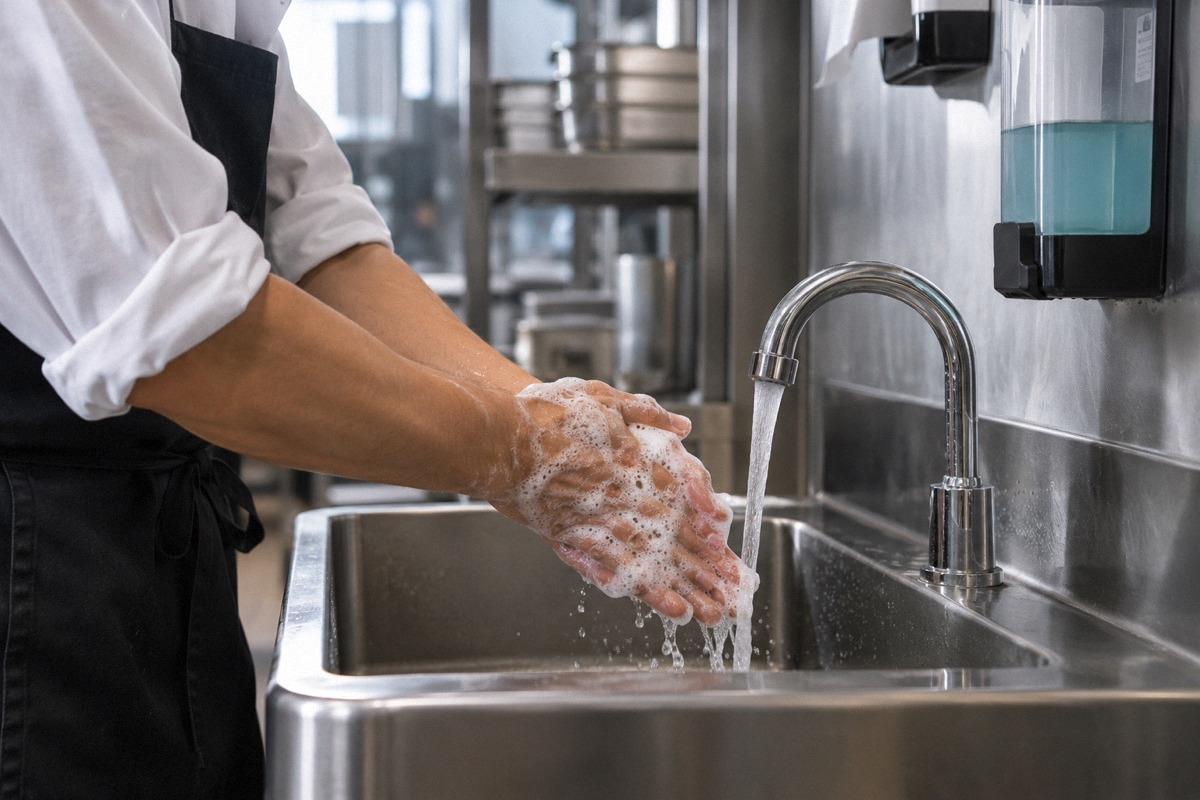
Hand hygiene and cross-contamination slip during rushes because the station makes the wrong move easier than the right one, and because leaders take shortcuts in front of staff. Put stocked hand sinks within easy reach of the prep and warewashing areas. In DC, the plan-review packet asks for one in each of them. Separate raw and ready-to-eat work by space, tools and storage order, and swap utensils on a set routine. Use gloves or utensils for ready-to-eat food without letting them replace handwashing. Then coach on the spot, with owners following the same rules.
Why posters don't change the habit
In a KitchenConfidential thread, Hiding the B grade from the health department., a commenter described coworkers putting bare hands into chopped lettuce and rarely washing hands. They also described handling raw chicken without gloves and not washing afterward, justified with 'it's OK because I used tongs,' though the tongs had sat in the chicken bucket all day. One example involved a knife used on half-cooked chicken being used to open a bag of shredded cheese served raw. The commenter said they stopped wondering how this happened once they saw the owner do most of it too. The source is a search excerpt of one unverified account, and the thread's main topic, hiding a grade, is not something this article helps with.
That account names the real problem. Each of those behaviors breaks a rule every cook has heard. The habits survive because the station design makes the shortcut faster and because the most senior person in the room demonstrates that the rule is optional. In another thread, How scary are these restaurant inspection violations? Would you eat here?, a commenter singled out storage order (produce, fish, beef, poultry), cross-contamination and handwashing as the major issues in the report being discussed. Their reaction was opinion, but it lines up with what health agencies treat as core risk factors.
What the District's guidance and paperwork ask for
In the District of Columbia, DC Health's page Understanding Food Establishment Inspections lists cross-contamination and poor personal hygiene among the five foodborne-illness risk factors identified by the CDC. Under its 'Hands as a vehicle of contamination' item, it says hands must be washed between tasks using the correct procedure and length of time, and that bare-hand contact with ready-to-eat foods should be avoided. It places these among the Priority and Priority Foundation areas that carry the shorter correction window.
DC Health's Plan Review Guidance Packet (Dec 2019, ver. 8) turns those principles into design questions. It asks whether there is a handwashing sink in each food preparation and warewashing area, and whether handwashing lavatories are designated in the immediate area of food preparation. It asks whether all handwashing sinks have a mixing valve or combination faucet, whether hot water at a minimum of 100 F and cold running water under pressure are available at every hand sink, and whether hand-drying facilities are at all hand sinks. It also asks whether self-closing metering faucets run at least 15 seconds without reactivation. It asks whether disposable gloves, utensils or food-grade paper will be used to prevent handling of ready-to-eat foods, and how cross-contamination will be prevented if raw meats, poultry and seafood share refrigeration with cooked or ready-to-eat foods. These are questionnaire items, not the full rule text. Check the adopted provisions in your own jurisdiction for exact procedures and durations.
Sink placement: make the right move the short move
Handwashing frequency drops sharply when the sink is out of the way, blocked, or missing soap or towels. In practice, a cook who must walk past three stations and around a speed rack to reach a hand sink will wipe hands on an apron instead. The design goal is that a cook at any raw-protein or ready-to-eat station can reach a stocked hand sink in a few steps without crossing another station's work. In a new build, that is settled at plan review. In an existing kitchen, it may mean adding a hand sink with the proper plumbing permits and approvals, or rearranging stations around the sinks you have.
Keep the sink usable. Nothing gets stored in the basin. Soap and towels are checked at the start of every shift and at the mid-shift reset, and the hot water reaches temperature quickly enough that people don't give up. A hand sink full of dirty pans is a design failure as much as a discipline one. It usually means warewashing space is too small for the volume, and adding more signage won't fix that.
| Station problem | Shortcut it causes | Design fix |
|---|---|---|
| Hand sink across the kitchen | Wiping hands on apron between tasks | Add or relocate hand sink near raw and RTE stations (with approvals) |
| Hand sink used for pan storage | Skipped washing | Increase pot-sink and drying space; daily check of basin |
| One set of tongs per station | Raw-protein tongs reused for cooked food | Color-coded tongs per protein and a separate set for cooked/RTE |
| Glove box far from RTE board | Bare hands in lettuce or garnish | Mount glove dispenser at RTE station; keep utensils within reach |
| Single cutting board area | Raw and RTE prep on same surface | Dedicated, labeled boards and timed or physical separation |
Raw and ready-to-eat separation: space, tools and storage order
Separation works on three levels. Space: raw-protein prep and ready-to-eat prep happen at different stations, or at different times with full cleaning and sanitizing between them. Tools: raw-protein tongs, boards and knives are visibly distinct (color-coding is common) and never move to the ready-to-eat side without washing and sanitizing. Storage: in walk-ins and reach-ins, ready-to-eat and cooked foods sit above raw animal foods, so drips fall onto items that will be cooked rather than items that won't.
Ordering raw items by the temperature they must be cooked to is a sensible way to set shelves. DC Health's inspection page lists minimum cooking temperatures: 145 F for whole-muscle intact beef steak (surface), and for raw shell eggs prepared for immediate service; 155 F for ground meats, injected meats and pooled raw eggs; and 165 F for poultry and stuffed items. Shelving from top to bottom as ready-to-eat, then whole-muscle cuts, then ground meats, then poultry (with seafood placed according to the cooking temperature your adopted code assigns it) means anything that drips lands on food that will be cooked hotter. That ordering is a common operational approach consistent with those temperatures. Your jurisdiction's adopted code may specify its own storage requirements, and those control.
Utensil swap routines and gloves that don't become a false barrier
The 'I used tongs' defense in the w7aiu5 account fails because the tongs themselves were contaminated and never changed. A swap routine fixes that. Raw-protein tongs live with the raw product, are pulled for washing and sanitizing on a regular schedule and whenever the cook changes task, and never touch cooked or ready-to-eat food. Your adopted code may set a cleaning frequency for in-use utensils. Find it and build the schedule to it rather than relying on habit. A simple way to make the swap visible is a clean-tongs crock refilled at each reset, with the used set going straight to the dish pit.
Gloves prevent bare-hand contact with ready-to-eat food, which DC's guidance asks operators to avoid. They are not a substitute for handwashing. A glove put on over unwashed hands carries whatever was on the hands, and a glove worn from raw chicken to lettuce is as bad as a bare hand. Train three rules: wash hands before putting on gloves, change gloves when switching from raw to ready-to-eat or after touching anything else (phone, face, trash, money), and change torn gloves immediately. Utensils or deli paper can be better than gloves for some ready-to-eat tasks, because there is less to forget.
- Color-code raw-protein tongs and boards; keep a separate clean set for cooked and RTE food.
- Refill a clean-utensil crock at each station reset and send used utensils directly to warewashing.
- Set the utensil cleaning schedule to the frequency your adopted code requires.
- Mount glove dispensers at RTE stations and require handwashing before gloving.
- Never open a package for RTE use with a knife or tool used on raw animal food.
Leaders model it, or nobody does
The detail that made the w7aiu5 account stick was that the owner did the same things. Staff copy what managers do, not what managers say. If the chef tastes from a spoon and puts it back, grabs garnish bare-handed during a rush, or walks from the raw station to plating without washing, every cook watching learns the real rule. The fix is unglamorous: owners and chefs wash hands visibly and often, use the same gloves and utensils they require of staff, and correct themselves out loud when they slip.
This matters most during a rush, which is exactly when leaders are most tempted to cut corners. A useful practice is for the chef to narrate the habit briefly in the moment, for example 'washing, then plating,' so the behavior is visible and expected. It also gives staff a script for correcting a senior person, which is the hardest correction in any kitchen. Make it explicit that anyone may say 'hands' to anyone, including the owner, and that the right response is to go and wash.
Hypothetical worked example: measuring handwashing before and after a station change
This is a hypothetical with no real establishment implied. A DC restaurant's chef watches the sauté and garde-manger stations for 30 minutes during a Friday rush. A handwashing opportunity is counted each time a cook changes from raw to ready-to-eat work, touches face or phone, handles trash or returns to the station. The chef counts 24 opportunities and 9 actual washes, a compliance rate of 9 / 24 = 37.5 percent. Most misses happen at garde-manger, where the nearest hand sink is behind the dish pit and usually has a sheet tray in it.
The restaurant clears the hand sink, adds a towel dispenser, assigns the sink check to each reset, and moves the glove dispenser to the garde-manger board. A hand sink is also planned next to the station, with the plumbing permits and approvals it needs. Three weeks later the same 30-minute observation counts 24 opportunities and 18 washes, or 18 / 24 = 75 percent. The figures are illustrative, but the method works. Count opportunities and actual washes, find where the misses cluster, change the station, then measure again. The remaining 25 percent is the coaching target, not a reason to give up.
Spot coaching that corrects without humiliating
When a cook skips a wash or uses raw tongs on cooked food, correct it right away, quietly and specifically. Stop the food if it is affected, because a contaminated plate doesn't go out, and remake it. Name the action, not the person's character: 'those tongs were in the chicken, grab a clean set,' not 'you're careless.' Then make sure the fix is available, meaning a clean set really is within reach. If it isn't, the station is the problem.
Track repeat issues by station and shift rather than by person, at least at first. If garde-manger misses handwashing every Friday, the cause is likely Friday staffing or layout. Individual performance management is for someone who still skips steps after the station supports the habit and the leaders model it. That order of operations, station first and then leadership and then individual coaching, keeps the culture focused on safe food rather than blame.
Questions that come up next
Are gloves required for handling ready-to-eat food?
DC Health's inspection guidance says bare-hand contact with ready-to-eat foods should be avoided, and its plan-review packet asks whether gloves, utensils or food-grade paper will be used for that purpose. Gloves are one option, not the only one, and they never replace handwashing. Wash before gloving and change gloves between raw and ready-to-eat tasks. Check your own jurisdiction's adopted code for the exact rule.
How many hand sinks does a restaurant kitchen need?
It depends on your layout and adopted code. In DC, the plan-review packet asks whether there is a handwashing sink in each food preparation and warewashing area, with hot (minimum 100 F) and cold running water, a mixing valve or combination faucet, and hand-drying facilities. In practice, place sinks so every raw and ready-to-eat station reaches one in a few steps, and confirm with plan review.
Sources & context
Forum accounts are unverified experiences. Read government sources for their stated jurisdiction and check requirements with the responsible authority for your location.
- Hiding the B grade from the health department. (r/KitchenConfidential)reddit · Search excerpt: commenter describes bare-hand lettuce, raw-chicken tongs used all day, a raw-chicken knife opening a cheese bag, and the owner doing the same. Unverified account; thread's concealment topic used only for remediation.
- How scary are these restaurant inspection violations? Would you eat here? (r/KitchenConfidential)reddit · Search excerpt: commenter names storage order, cross-contamination and handwashing as the major issues in a posted report. Opinion, not a regulatory statement.
- DC Health: Understanding Food Establishment Inspectionsgovernment · District of Columbia guidance: CDC risk factors including cross-contamination and personal hygiene; handwashing between tasks; avoid bare-hand contact with RTE food; minimum cooking temperatures. Does not specify storage order or utensil schedules; those are labeled operational approaches.
- DC Health Food Establishment Plan Review Guidance Packet (Dec 2019, ver. 8)government · District of Columbia plan review form, read directly: hand sink in each prep and warewashing area, 100 F minimum hot water, mixing valve, hand drying, 15-second metering faucets, RTE handling and raw/RTE storage questions. Questionnaire, not full rule text.


