The practical answer
Allergy and celiac requests disrupt service mainly when each one is handled from scratch: a server guesses, walks back to ask the chef, and the cook improvises mid-rush. A written allergen matrix, with a separate gluten field for celiac guests, lets servers narrow choices at the table. A fixed script, a specific ticket flag, and one designated cook who verifies every flagged order turn the rest into a routine. Cross-contact controls, an emergency plan and an honest 'we can't do this safely' protect the guest. Check which allergen rules your local health code has actually adopted.
Why allergy tickets jam the line, and why that is a process problem
An owner in an r/restaurantowners thread about vegan options said they offer a handful of celiac and vegan options, but those requests throw a wrench into the flow of service every time; they keep the options mainly because few nearby restaurants try, which helps them win groups (Reddit discussion). That comment is only indirect support here. It was recorded as a search excerpt, it is about dietary requests generally rather than allergy safety procedures, and it describes one owner's experience. Still, the frustration is familiar, and its cause is worth naming.
The disruption usually comes from improvisation, not from the request itself. A server who does not know whether the romesco contains almonds has to find the chef. The chef has to remember, or dig out a spec sheet. A line cook has to stop, wipe down, find clean tools and remember which pan is safe, all while other tickets wait. Every one of those steps is a decision being made under time pressure, which is exactly when mistakes happen. The fix is to make those decisions once, in advance, and write them down.
That matters for guest safety as much as for speed. A food allergy reaction can be severe, and a guest who discloses an allergy is trusting the restaurant with information that affects their health. A calm, practiced routine serves both goals.
Which allergens to track, and where the rules come from
Under federal law, the major food allergens are milk, eggs, fish, crustacean shellfish, tree nuts, peanuts, wheat, soybeans and sesame; sesame became the ninth through the FASTER Act, with labeling effective January 1, 2023 (FDA, Food Allergies). Those federal labeling rules apply to packaged foods. FDA states that they do not apply to most foods sold at retail or food service establishments that are not prepackaged with a label, including food placed in a wrapper or container after the customer orders.
Restaurant obligations come instead from the food code your state or local health department has adopted. FDA's model Food Code 2022 added sesame to its major food allergen definition and added a provision, section 3-602.12(C), for informing consumers in writing of major food allergens in unpackaged food, along with expanded person-in-charge duties related to allergen awareness (FDA, Summary of Changes in the 2022 Food Code). FDA has since published a 2026 edition (FDA, Food Code 2026). The Food Code is a model offered for adoption by jurisdictions (FDA, Food Code 2022); none of these provisions bind your restaurant unless your jurisdiction has adopted them, possibly with amendments.
In the District of Columbia, for example, DC Health describes its rules as DCMR Title 25, adopted from the FDA model Food Code, and lists demonstration of knowledge by the person in charge among the items checked during inspection (DC Health, Understanding Food Establishment Inspections). That page does not say which Food Code edition's allergen provisions DC currently enforces, so a DC operator should check the current regulations or ask DC Health rather than assume the 2022 model text applies. Operators elsewhere should do the same with their own health department. Track all nine allergens in your matrix regardless, and add any others your guests commonly ask about, such as mustard or specific seeds.
Celiac disease needs its own field, because it is not a wheat allergy and the nine-allergen list does not cover it. Gluten comes from wheat, barley and rye and from ingredients derived from them, such as malt, malt vinegar, brewer's yeast and some soy sauces, seasonings and coatings. A dish can contain no wheat and still contain barley malt. Give the matrix a separate gluten column that is checked against verified supplier labels for all three grains and their derivatives, and never treat a wheat-free mark as meaning gluten-free.
Build the allergen matrix once, from the actual products
An allergen matrix is a grid: dishes down the side, allergens across the top, and a mark wherever a dish contains that allergen. It is the single tool that most reduces walk-backs to the kitchen, because it lets a server answer at the table. It is only as good as its inputs, so build it from the actual ingredient labels and supplier specification sheets of what you buy, including sub-recipes such as sauces, dressings, marinades, spice blends and fry oil.
The hidden sources cause most errors. Worcestershire sauce typically contains fish. Many pestos contain tree nuts or cheese. Sesame oil appears in marinades where no one thinks of sesame. A house spice blend bought from a supplier may list wheat. Shared fryer oil can carry allergens from battered items into otherwise allergen-free foods. Record each sub-recipe as its own row so a change to one sauce updates every dish that uses it.
Add a column for whether the allergen is removable. A garnish of toasted almonds can be left off; almonds ground into a sauce cannot. That one column tells the server immediately whether a modification might be possible or whether to suggest a different dish; the designated cook still confirms the actual preparation.
The table below is illustrative only. Its rows show how to record information, not facts about any real recipe, and no matrix can certify a dish as safe. Cross-contact cannot be rated from a recipe; it depends on the actual equipment, setup and prep order in your kitchen, so the matrix should name the specific controls the kitchen uses or say that preparation must be assessed for that order.
| Dish or sub-recipe (illustrative) | Contains (of nine major allergens) | Gluten sources (wheat, barley, rye, derivatives) | Removable on request? | Cross-contact: controls or assessment |
|---|---|---|---|---|
| House vinaigrette | None listed; mustard tracked locally | Check vinegar type and any seasoning labels | Mustard no, emulsified in | Must assess actual preparation |
| Romesco | Tree nuts (almond) | Check bread used as thickener | No | Shared blender; not offered to tree nut allergy |
| Grilled chicken plate | Milk (butter baste) | Check marinade and spice blend labels | Butter can be replaced with oil | Clean dedicated pan and tools required; shared grill not relied on |
| Fries | None in ingredients | None in ingredients | Not applicable | Shared fryer with battered fish (fish, wheat); not offered to celiac or fish allergy |
| Marinated tofu bowl | Soy, sesame (sesame oil) | Soy sauce may contain wheat; verify label | No | Must assess actual preparation; recheck labels at each delivery |
An order-taking script that gets the right information the first time
The server's job is to collect clear information and pass it on accurately, not to judge how serious the allergy is. A short script keeps that consistent across staff. Ask which allergen or allergens, ask whether it is an allergy or a preference when the guest has not said, and, for allergies, confirm that the kitchen will treat it as one. Avoid promising that anything is completely free of an allergen; describe what the kitchen will do instead.
A workable script for a tree nut allergy: Thank you for telling me. Which allergens should the kitchen know about? Let me check our allergen chart. That dish has almonds in the sauce, which we can't remove. Our chart doesn't list nuts in the roast fish, but our allergen cook will check its ingredients and confirm they can prepare it in a clean pan with separate tools before I put it in. Our kitchen does handle nuts, so I can tell you what we do to prevent contact, but I can't promise zero exposure. The alternative is offered only after the kitchen verifies the nut-relevant ingredients and controls, and the last sentence is what keeps the promise honest.
Ticket flags and a designated cook on every shift
Once the order is taken, the information must reach the cook without relying on a shouted reminder. Use a distinct flag that cannot be confused with a routine modifier: a dedicated POS button that prints the allergen in capitals at the top of the ticket, a colored ticket, or both. The flag should name the allergen specifically. A ticket reading ALLERGY with no detail forces the cook to come find the server, which recreates the walk-back you were trying to remove.
Assign one designated allergen cook per shift, usually a senior line cook or sous chef, who takes ownership of every flagged ticket, including those where the server already found the answer in the matrix. That person either prepares the dish or directly supervises it, confirms the ingredients and setup for that specific order, and is the one who answers server questions the matrix does not cover. The matrix shortens the conversation at the table; it never replaces the cook's check. Concentrating responsibility does two things: it stops every cook from being interrupted, and it makes one person accountable for the full sequence from clean tools to handoff. The expediter should then verify the flag against the plate and send it out separately or clearly marked, ideally delivered by the server who took the order, who can confirm it with the guest.
- Dedicated POS allergen button that prints the specific allergen at the top of the ticket.
- Designated allergen cook named on the shift schedule, with a backup.
- Expediter checks the flagged ticket against the plate before it leaves the pass.
- Allergen plates marked, such as with a pick or separate tray, and hand-delivered by the server who took the order.
- Server confirms the allergen with the guest when setting the plate down.
Cross-contact controls that work during a rush
Cross-contact happens when an allergen is transferred to food that does not contain it: a knife used on cheese, a cutting board with flour on it, a spoon dipped in two sauces, shared fryer oil, or gloves worn while handling bread. Do not rely on cooking to fix it; heat that controls pathogens should not be treated as removing an allergen that has already been transferred.
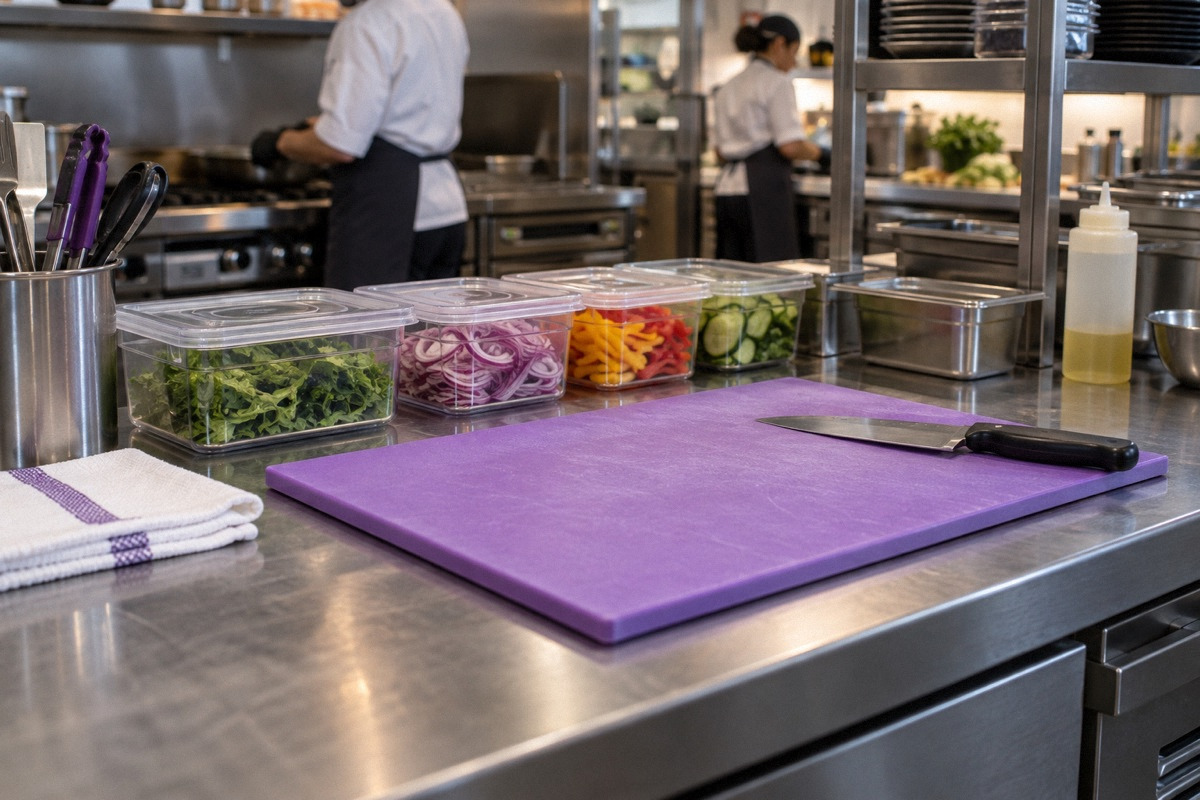
Practical controls are simple but must be ready before service. Keep a set of clean, color-coded tools and a cutting board stored separately for allergen orders. Prepare allergen dishes in a cleaned area, with fresh gloves after handwashing, ideally before or apart from other work on that station. Use clean pans rather than wiping the one in use. Do not use shared fryer oil for any guest with an allergy to something fried in it, and treat shared fryers as unsuitable for celiac guests. Store allergen-free sub-recipes covered and labeled, above, not below, allergen-containing items.
When the honest answer is no
Some requests cannot be met safely, and saying so is part of a sound procedure, not a failure of hospitality. If a dish's allergen is built into a sauce or batter, if your only fryer is shared with breaded items, if your kitchen uses flour heavily in open air, or if the designated cook is unavailable at a critical moment, the safest response is a clear explanation and an alternative where one exists.
Celiac requests deserve particular care, because a guest with celiac disease may react to small amounts of gluten from shared surfaces or oil. If your kitchen cannot control those, say so plainly rather than offering a dish described as gluten-free. The related article on gluten-free menu claims explains how FDA's definition applies and how to word claims you can stand behind. For a guest who describes a severe allergy you cannot reasonably control, a respectful decline protects them and you.
Worked example: a Friday dinner with six allergy tickets
Hypothetical example, for illustration only. A 70-seat restaurant serves 140 covers on a Friday, and 6 tickets carry allergy requests. Before the procedure, each request sent a server to the line to find the chef before the order could even be placed. If each of those walk-backs cost about 4 minutes of the chef's attention, that was 6 times 4, or 24 minutes pulled away from the pass during the busiest hours, and the answers depended on what the chef remembered.
After the matrix, script and flags are in place, servers can narrow the choices at the table for 4 of the 6 requests without a walk-back: two tree nut allergies and one dairy allergy are steered to dishes the matrix does not list as containing those allergens, and one shellfish allergy involves no dishes that list shellfish. The remaining 2 need a conversation with the designated cook before ordering: a sesame allergy, where the cook checks the current marinade label, and a celiac guest asking about fries. At the same 4 minutes each, pre-order walk-backs drop to 2 times 4, or 8 minutes. The cook declines the fries because the fryer is shared with battered fish and offers roasted potatoes only after confirming the seasoning label lists no gluten sources and that a clean pan and tools are available.
What does not change is ownership. All 6 tickets print with the allergen flag, and the designated cook verifies the ingredients and setup for every one of them, including the 4 the servers answered from the chart. The time saved comes from fewer walk-backs before ordering, not from skipping the kitchen check.
If a guest shows signs of a reaction
A procedure that prevents most errors still needs a plan for the one that gets through. Write a short escalation sequence, post it where the manager and servers can see it, and walk through it at training. It should be simple enough to follow under stress.
Do not minimize symptoms, argue about whether the dish could have caused them, or offer a home remedy. The guest and their companions know their condition and medication best; let them direct use of their own prescribed medication if they ask for help reaching it. Afterward, set aside the plate and ticket and record what happened so the cause can be found.
- Stop serving the guest the suspected dish and anything else from that order.
- Ask the guest or their companions what help they need; take their description of symptoms seriously.
- Call emergency services immediately for any severe reaction or suspected anaphylaxis, or if in doubt.
- A manager stays with the guest, keeps the area clear and meets responders.
- Keep the plate, ticket and ingredient labels, and note who prepared the dish and how.
Keeping the system current, and what to keep on file
The matrix decays whenever a supplier changes a product, a cook tweaks a recipe, or a special is added. Make updating it part of receiving and menu change routines: when a substitute product arrives, someone checks its label against the matrix before it is used. Review the full matrix at least whenever the menu changes, and date each version.
Keep the current matrix and dated prior versions, supplier specification sheets and labels for sub-recipe ingredients, the staff training record showing who has been trained on the script and cross-contact procedure, and a brief note of any allergy incident or near miss with what was changed afterward. After any incident, once the guest has been cared for, review the record against the matrix and the prep procedure and change whichever step failed.
Questions that come up next
What are the major food allergens a restaurant should track?
Under federal law the nine major food allergens are milk, eggs, fish, crustacean shellfish, tree nuts, peanuts, wheat, soybeans and sesame, according to FDA. Federal labeling rules cover packaged foods, not most restaurant food, and local codes may add duties. Track all nine, plus a separate gluten field for celiac guests covering wheat, barley, rye and their derivatives, since wheat-free does not mean gluten-free.
Does the FDA Food Code require restaurants to provide written allergen information?
FDA's model Food Code 2022 added a provision, section 3-602.12(C), for informing consumers in writing of major food allergens in unpackaged food. The Food Code is a model, so it applies only where your state or local jurisdiction has adopted that provision. Check your health department's current regulations rather than assuming the model text is local law.
Sources & context
Forum accounts are unverified experiences. Read government sources for their stated jurisdiction and check requirements with the responsible authority for your location.
- Providing Vegan Options on Menu (r/restaurantowners)reddit · INDIRECT support, search excerpt only. One owner says celiac and vegan options throw a wrench into service every time but keeps them to win groups. Supports the service-disruption problem only; it says nothing about allergen procedures or safety outcomes.
- Food Allergies (FDA)government · Federal. Lists the nine major food allergens, sesame's addition via the FASTER Act effective January 1, 2023, and states federal allergen labeling rules do not apply to most unpackaged retail and food service foods. Does not set restaurant procedures.
- Summary of Changes in the FDA Food Code 2022 (FDA)government · Federal model code summary. Describes sesame added as a major food allergen, the new section 3-602.12(C) written allergen notification for unpackaged foods, and expanded person-in-charge allergen duties. Applies only where adopted locally.
- Food Code 2022 (FDA)government · States the Food Code is a model offered for adoption by jurisdictions and lists a sesame allergen factsheet. FDA has since published Food Code 2026, so 2022 is not the latest edition.
- Food Code 2026 (FDA)government · Confirms the newer 2026 model edition exists and that FDA encourages jurisdictions to adopt the latest version. Cited only to show the edition timeline; its allergen text was not reviewed for this article.
- Understanding Food Establishment Inspections (DC Health)government · District of Columbia only. States DC's rules are DCMR Title 25, adopted from the FDA model Food Code, and lists person-in-charge demonstration of knowledge as an inspection item. Does not specify which edition's allergen provisions DC enforces.


