
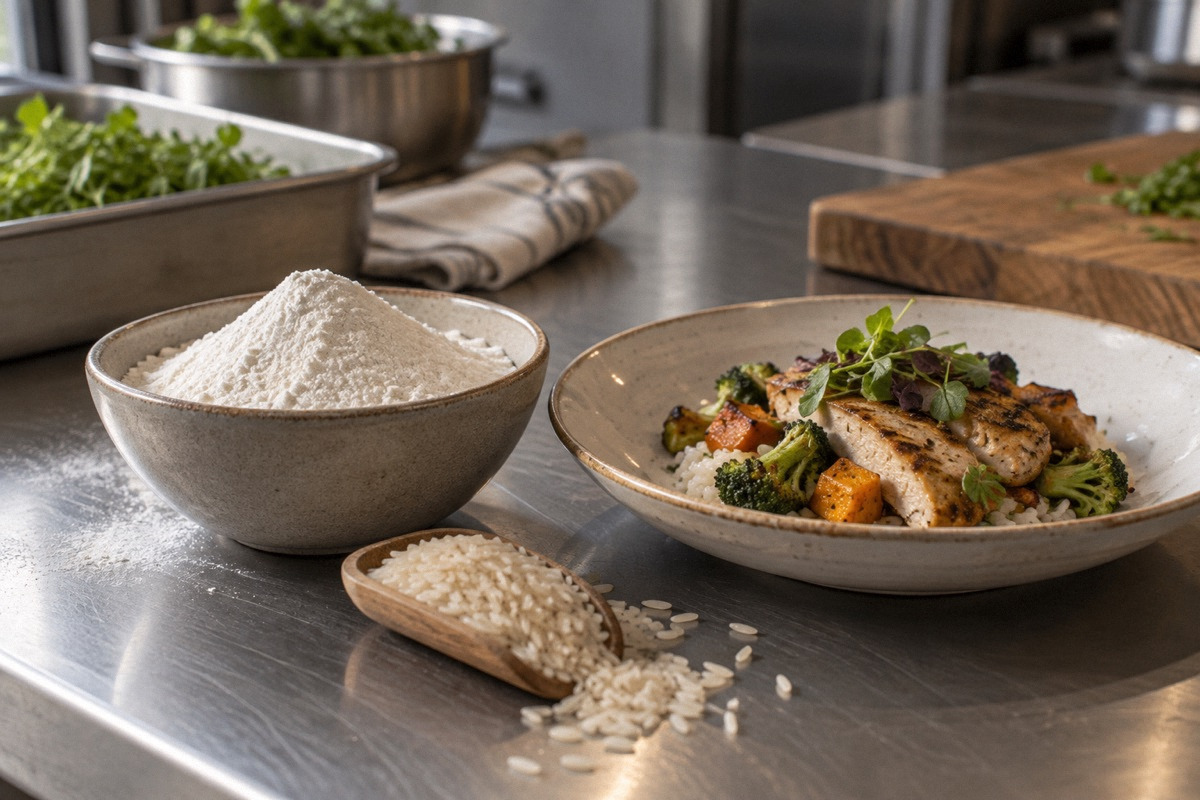
The practical answer
FDA's gluten-free regulation binds packaged foods, but FDA recommends that restaurants making gluten-free menu claims be consistent with its definition: no gluten-containing grain ingredients (or derivatives not processed to remove gluten) and any unavoidable gluten below 20 parts per million. A dish fried in shared oil or prepped on floury surfaces may not meet that standard. Use 'gluten-free' only where your ingredients and prep support it, describe other dishes accurately with a clear cross-contact note, and correct any overclaim everywhere it appears.
The menu that says GF next to the fries
A common pattern: a kitchen reviews its menu, finds dishes with no wheat, barley or rye in the recipe, and marks them GF. The fries qualify because potatoes, oil and salt contain no gluten. But the fries share a fryer with battered fish, the grilled chicken is cut on the same board as bread, and the salad's croutons are added at the same station. The recipe is gluten-free; the plate the guest receives may not be.
That gap matters most to guests with celiac disease, who are the people most likely to rely on the claim. It also matters to the restaurant, because a menu claim is a representation the business makes and must be able to support. An owner in an r/restaurantowners thread said they offer a handful of celiac options and that those requests disrupt service every time (Reddit discussion). That excerpt is only indirect support: it shows an owner trying to serve celiac guests under operational strain, not anything about menu wording. The rest of this article relies on FDA and FTC sources.
What FDA's definition covers, and what it recommends for restaurants
FDA's gluten-free regulation, 21 CFR 101.91, sets the conditions for using the term on FDA-regulated food labels (FDA, Questions and Answers on the Gluten-Free Food Labeling Final Rule). Under it, a food labeled gluten-free must contain less than 20 parts per million of gluten from unavoidable presence, and must not contain an ingredient that is a gluten-containing grain (wheat, rye, barley or their crossbreeds), an ingredient derived from those grains that has not been processed to remove gluten, or a derived ingredient processed to remove gluten if it leaves 20 ppm or more in the food (FDA, 'Gluten-Free' Means What It Says; FDA, Gluten-Free Labeling of Foods). Naturally gluten-free foods can carry the claim only if any gluten from contact is also below 20 ppm.
The binding rule applies to packaged foods, which FDA notes may be sold in some food service settings such as carry-out restaurants. For menus, FDA's Q&A states that, given the public health significance of gluten-free labeling, it recommends restaurants making a gluten-free claim on their menus be consistent with its definition, and that state and local governments play an important role in overseeing restaurants. So the federal definition is not irrelevant to your menu. It is the benchmark FDA expects restaurants to meet, while enforcement for unpackaged restaurant food generally sits with your state and local authorities. If you sell prepackaged items labeled gluten-free, such as bottled sauces or packaged baked goods, the regulation itself applies to those labels.
One practical consequence: the 20 ppm figure includes cross-contact. A recipe with no gluten ingredients is only part of the test. The other part is whether your preparation keeps unavoidable gluten that low.
Do not confuse gluten-free with wheat-free. Wheat is one of the nine major food allergens, but the gluten-free definition also covers barley, rye and their crossbreeds and derivatives. Malt, malt vinegar, malt syrup and many beers come from barley; some soy sauces contain wheat; some oats are contaminated with other grains. A dish built for a wheat allergy may still contain barley malt, so a wheat-free mark in your allergen matrix never qualifies a dish as gluten-free on its own.
Shared fryers, surfaces and air: where kitchen claims break
Most restaurant overclaims come from preparation, not recipes. Shared fryer oil is the clearest example: when battered or breaded items are fried in the same oil, that oil can carry gluten into everything else fried in it. Other common sources are shared cutting boards and knives, toasters and panini presses, grill surfaces where buns are toasted, pasta water reused for gluten-free pasta, flour dusted in open air in a busy bakery or pizza kitchen, and gloves or hands moving between bread and other food.
You cannot see whether a plate is below 20 ppm, so the honest question is whether your process makes that reasonably likely. A dedicated fryer, separate clean tools and boards, a defined prep area and trained staff make the claim supportable for specific dishes. A kitchen that relies on wiping down shared equipment mid-rush is in a weaker position, and a kitchen that fries everything in one vat cannot reasonably claim fried items are gluten-free.
| Kitchen situation | Supportable wording | Avoid |
|---|---|---|
| Dedicated fryer, gluten-free ingredients verified, staff trained | Gluten-free | Unqualified claims on items outside that process |
| No gluten ingredients, but shared fryer or surfaces | Made without gluten-containing ingredients; prepared in a shared kitchen, not suitable for celiac disease | Gluten-free, GF, celiac-safe |
| Gluten ingredient removable on request | Can be prepared without the bun or croutons; ask your server about cross-contact | GF option, without explaining preparation |
| Gluten ingredient in a sauce, batter or marinade | Contains gluten (name the grain, such as wheat or barley malt) | Any gluten-free or wheat-free-equals-gluten-free implication |
| Packaged item bought in labeled gluten-free | Gluten-free if served unopened or handled to avoid contact | Relabeling after open-air handling without controls |
Why 'gluten-friendly' is not a safe harbor
Some restaurants switch from gluten-free to gluten-friendly, gluten-conscious or GF-ish, assuming a softer word removes the obligation. It may not. The FTC evaluates advertising by its overall net impression, including how phrases and images work together, and treats implied claims as well as express ones (FTC, Enforcement Policy Statement on Food Advertising). That 1994 statement was written mainly about nutrient content and health claims in food advertising, so it is not a rule about gluten terms specifically, but its net-impression and substantiation principles describe how deception analysis works generally. If a guest with celiac disease would reasonably read gluten-friendly next to a dish as meaning they can eat it safely, the softer word may convey the same message as the stronger one.
The FTC's small-business advertising guidance adds two points that apply directly to menus: advertisers need a reasonable basis for their claims before making them, and fine print cannot contradict other statements or clear up a misimpression (FTC, Advertising FAQ's: A Guide for Small Business). A large GF icon on a dish with a tiny footnote saying the kitchen is not gluten-free sends a mixed message. The guide also notes that every state has its own consumer protection laws governing advertising. The more reliable approach is to describe exactly what you do, in words the guest will see next to the dish, rather than searching for a label that sounds safe but commits to nothing.
Wording options that match what the kitchen actually does
Pick wording dish by dish, based on the audit described below, not one blanket label for the menu. Short, specific phrases work best because they fit next to a menu item and are easy for servers to repeat.
If the dish meets your gluten-free process, say gluten-free and, if space allows, note the controls briefly, for example gluten-free, prepared separately. If the dish has no gluten ingredients but is prepared in a shared environment, say so: made without gluten ingredients; shared fryer, not suitable for celiac disease. If a modification is possible, describe the modification rather than labeling the dish: available without the bun. A general menu note can explain your kitchen in more detail, but it should support, not contradict, what appears next to the dish.
- Use 'gluten-free' only for dishes whose ingredients and preparation you have verified against FDA's definition.
- Put cross-contact information next to the dish, not only in a footer.
- Never use 'celiac-safe' unless your process is designed and maintained for that purpose.
- Apply the same wording on printed menus, website, online ordering and delivery-app listings.
- Date the wording review so you know when each claim was last checked.
What staff need to know to answer the follow-up questions
FDA's consumer update suggests that guests concerned about gluten-free claims in restaurants ask what the restaurant means by gluten-free, what ingredients are used, and how the item is prepared (FDA, 'Gluten-Free' Means What It Says). Your servers should be able to answer all three without guessing, because a well-informed guest will ask them.
Give servers a one-page reference generated from your allergen matrix: which dishes are gluten-free under your process, which are made without gluten ingredients but share equipment, what the shared equipment is, and which modifications are possible. Train them to say I don't know, let me check with the kitchen rather than reassure a guest from memory. The related article on handling allergy and celiac requests covers ticket flags and the designated cook who should answer kitchen-specific questions.
Worked example: auditing nine GF marks on one menu
Hypothetical example, for illustration only. A neighborhood restaurant's menu marks 9 dishes GF. The manager audits each one against ingredient labels, supplier specifications and actual preparation.
Three dishes are fried items with no gluten ingredients, but the restaurant has one fryer shared with breaded calamari. Two dishes use a soy-based glaze whose label lists wheat. One salad uses a malt vinegar dressing; malt is typically made from barley, and the label confirms it. The remaining 3 dishes, a grilled fish, a rice bowl and a flourless chocolate cake, use ingredients verified free of gluten grains and are prepared on a dedicated board with separate tools, and the cake is baked before any bread is handled. That accounts for all 9: 3 plus 2 plus 1 plus 3.
The rewrite follows the evidence. The 3 verified dishes keep gluten-free, with a note that they are prepared separately. The 3 fried items become made without gluten ingredients; shared fryer, not suitable for celiac disease. The 2 glazed dishes are relabeled contains wheat, with a note that the kitchen is testing a glaze made with a certified gluten-free tamari. The salad switches to a wine vinegar dressing, its label is checked, and it goes through the same prep review before receiving any claim. The menu goes from 9 GF marks to 3 supportable ones, plus accurate descriptions for the rest.
Correcting an overclaim you have already made
If an audit finds that a dish was marked gluten-free when your process did not support it, correct it promptly and everywhere: printed menus, menu boards, your website, online ordering, delivery-app listings, social media highlights and any table tents. Old claims in one channel undo the fix in another. Brief every server on the change before the next shift, because regulars may order the dish expecting the old claim.
Consider whether guests who relied on the claim should be told directly, for example regulars who regularly ordered the dish as gluten-free. A short, factual note that the dish is now prepared differently or described more accurately is better than letting them discover it. Do not quietly remove the label and hope no one noticed. If a guest reports a reaction, record what they ordered and how it was prepared, and review the process rather than defending the claim. If your health department asks about gluten-free claims, provide your audit, the updated wording and the date it changed.
Evidence to keep behind every gluten-free claim
A claim you can stand behind has paperwork behind it. For each dish you call gluten-free, keep the ingredient labels or supplier specification sheets for every component, the written preparation procedure including equipment and order of prep, staff training records, and the date of your last review. If you buy products certified gluten-free by a third party, keep that documentation too; FDA notes it does not endorse, accredit or recommend any particular third-party gluten-free certification program (FDA, Gluten and Food Labeling), so certification supports but does not replace your own review.
Recheck claims whenever a supplier substitutes a product, a recipe changes, or equipment is shared differently, such as when a second fryer is taken out of service. A product swap on a busy delivery day is the most common way a supportable claim silently becomes an overclaim.
Questions that come up next
Does FDA's gluten-free rule apply to restaurant menus?
The binding regulation applies to packaged foods, including some sold in carry-out restaurants. For menus, FDA recommends that restaurants making a gluten-free claim be consistent with its definition: no gluten-grain ingredients not processed to remove gluten, and unavoidable gluten below 20 ppm. State and local governments oversee restaurants, so check your local rules too.
Is 'gluten-friendly' safer wording than 'gluten-free' for a shared kitchen?
Not necessarily. The FTC judges advertising by its overall net impression, including implied claims, so a softer term can still suggest a dish is safe for celiac guests. Clearer wording describes what you do, such as 'made without gluten ingredients; shared fryer, not suitable for celiac disease', placed next to the dish rather than in fine print.
Sources & context
Forum accounts are unverified experiences. Read government sources for their stated jurisdiction and check requirements with the responsible authority for your location.
- Gluten-Free Labeling of Foods (FDA)government · Federal. FDA's main page on the gluten-free labeling definition (less than 20 ppm plus ingredient conditions) for FDA-regulated food labels. The page itself focuses on packaged-food labeling; FDA's restaurant recommendation comes from the Q&A and consumer update below.
- Questions and Answers on the Gluten-Free Food Labeling Final Rule (FDA)government · Federal. States the regulation (21 CFR 101.91) applies to packaged foods, including some sold in carry-out restaurants, and recommends restaurants making menu gluten-free claims be consistent with FDA's definition. A recommendation for menus, not a binding menu rule.
- 'Gluten-Free' Means What It Says (FDA consumer update)government · Federal. Restates the definition's ingredient conditions and 20 ppm limit, the restaurant recommendation, the role of state and local oversight, and three questions consumers can ask restaurants. Consumer-facing guidance.
- Gluten and Food Labeling (FDA)government · Federal. States restaurants' use of gluten-free labeling should be consistent with the federal definition and that FDA does not endorse, accredit or recommend any particular third-party gluten-free certification program.
- Enforcement Policy Statement on Food Advertising (FTC, 1994)government · Federal. Describes net-impression analysis, express and implied claims, the need for a reasonable basis, and clear and prominent qualifications. Written mainly for nutrient content and health claims, so its application to gluten wording is by analogy to general deception principles.
- Advertising FAQ's: A Guide for Small Business (FTC)government · Federal guidance. Ads must be truthful with a reasonable basis before they run; fine print cannot contradict other statements or cure a misimpression; state consumer protection laws also apply. General advertising guidance, not menu-specific.
- Providing Vegan Options on Menu (r/restaurantowners)reddit · INDIRECT support, search excerpt only. One owner offers celiac options and says they strain service. Shows operator motivation only; says nothing about gluten-free wording or compliance.


