
The practical answer
Over-portioning often comes from generosity or guesswork rather than theft, and it hides inside food cost. Write a spec for every costly component that states weight, raw or cooked, and the tool used. Pre-portion proteins and cheese during prep, give the line scoops and ladles that match the spec, and spot-check a few plates at random each shift. Then compare POS theoretical usage with actual usage, adjusted for trim yield. The spot-check average tells you how much variance is portioning; whatever is left points to waste, unrung items or loss.
Why portions drift even in kitchens that care about them
In a thread asking for advice on cost control, an owner explained they had built a reputation on never cutting portions. One reply set out a familiar order: lower food cost if you can, then portions, then prices. Another asked whether they were pre-portioning meats and using the POS to show ideal usage so they could see what they were losing. We have a search excerpt of that thread, not every reply. The owner's position is actually a strong argument for portion control. A promise that the plate never shrinks is also a promise that it does not quietly grow by an ounce every busy Friday.
Portions drift for ordinary reasons. Cooks add a little extra so a plate does not look light. New staff copy whoever trained them, not the spec. A scale lives in a drawer because it slows the line. Product changes size when a supplier swaps a case pack. None of these is dishonest, which is why lectures do not fix them. Tools, specs and measurement do.
Find where over-portioning is costing you
Not every item deserves the same attention. Rank menu components by cost per portion times monthly count and start with the top handful. Proteins, cheese, avocado, shrimp, fries, and sauces that go on nearly every plate often lead the list. A quarter ounce extra on a garnish matters little; a quarter ounce on the burger patty or the shredded cheese sold three hundred times a week matters a lot.
Then look at how each is portioned now. Items that arrive pre-sized, such as a cut steak, a formed patty or a case-packed portion, drift less than items portioned by hand from bulk: pulled pork, rice, cheese, dressings, fries. Hand-portioned, high-volume, costly components are where spot checks pay off first.
Write a spec the line can actually follow
A portion spec should answer four questions without ambiguity: how much, measured how, at what stage, and what it looks like. "Six ounces of chicken" is not a spec until it says whether that is raw or cooked weight, because the two can differ substantially. State the tool: the scale, the specific scoop or ladle, or the count. Add a photo of the correct plate at the station. If the recipe card used to cost the dish assumes a different weight than the line serves, the plate cost is fiction, so the costing card and the line spec must match.
| Type of component | Best control | Practical note |
|---|---|---|
| Whole proteins: steaks, fillets, chicken breasts | Buy pre-cut or pre-portion and weigh during prep | Record raw weight and allowed tolerance on the label |
| Shredded or pulled proteins, cheese | Pre-portion into cups or bags during prep | Bag weights are checked at prep, not during the rush |
| Rice, grains, mashed sides, salads by volume | Numbered scoop or disher matched to spec | Level or rounded scoop must be specified |
| Soups, sauces, dressings | Marked ladle, portion cup or pump | Pumps need occasional calibration checks |
| Fries and fried sides | Fry basket fill line or weighed bags | Weigh a few baskets weekly |
| Garnish and toppings | Count or small scoop | Lower priority unless costly |
Choosing and maintaining scales, scoops and ladles
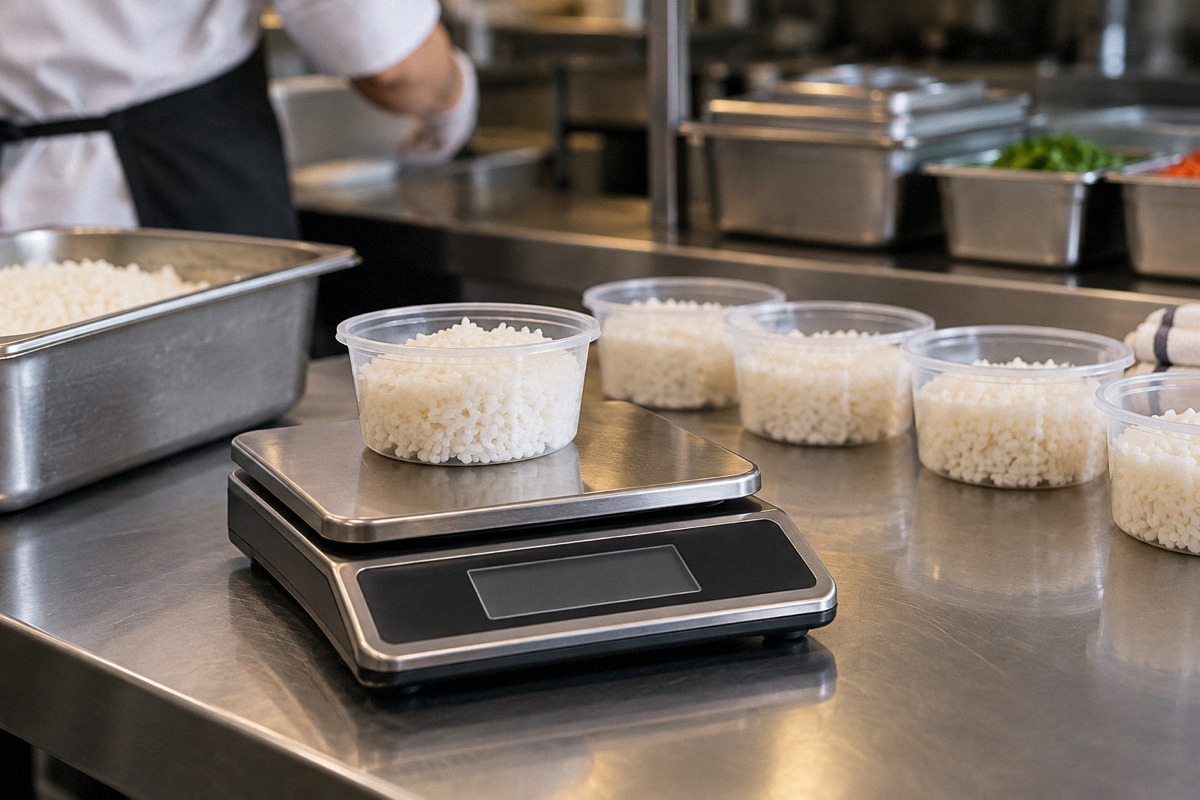
A line scale should be fast to read, easy to clean, sized for the plate or container being weighed, and able to tare so the container weight is subtracted. Keep one at each station that portions by weight, not one shared scale on a shelf. Check accuracy regularly with a known weight, or an item whose weight you have confirmed, and replace scales that drift or fail. A scale that reads half an ounce light quietly approves every heavy portion.
Scoops and ladles are faster than scales and, once matched to the spec, keep portions consistent without weighing every plate. Their weakness is technique: a heaped scoop and a level scoop are different portions. Specify level or rounded, train it, and occasionally weigh a few scoops of the actual product to confirm the tool delivers what the costing card assumes. Color-coded handles make the right tool easy to grab and a wrong one easy to spot.
Pre-portioning as part of prep, without creating food safety problems
Pre-portioning moves the measuring out of the rush and into prep, when someone has time to weigh carefully. Proteins and cheese go into labeled bags, cups or containers at spec weight, and the line simply pulls one per order. It makes counting easier, too: forty portioned bags at the start of the shift and twelve left at the end means twenty-eight should match the POS count.
Pre-portioning adds handling, so build it into your food safety routine rather than around it. Portion cold food quickly in small batches so it is not sitting out, return it to refrigeration promptly, and label each container with what it is and the date, following the cold-holding and date-marking rules your health department enforces. Those rules vary by jurisdiction, so check the code your local authority has adopted rather than assuming a number. Use clean, food-safe containers and keep raw proteins separate from ready-to-eat items.
- Portion during prep, in small batches, back into refrigeration promptly
- Label with item, portion weight and date per local rules
- Store raw proteins below and away from ready-to-eat items
- Count portions out at the start of service and back at the end
A spot-check routine that measures instead of accuses
In a thread about preventing inventory from being skimmed, one reply listed controls that included weekly theoretical-versus-actual comparisons and randomly checking portion sizes with a cheap ounce scale. We have a search excerpt of that thread. The idea is simple and needs no special equipment. A manager pulls a few plates or portions at random times during a shift, weighs the controlled component, writes the result down, and sends the plate on.
Make the routine predictable in method and unpredictable in timing. Check a handful of portions per station on each shift, at varying times, and record date, station, item, spec, actual weight and who plated it. Set a tolerance band as an operational choice, then coach on results outside it in both directions: light portions hurt guests just as heavy ones hurt margin. Share averages with the team weekly. When cooks see the numbers, many correct themselves, and the checks stop feeling like suspicion.
Theoretical versus actual usage, adjusted for yield
Spot checks show what is happening on the plate. The POS comparison shows what is happening to the whole inventory. Theoretical usage is units sold times the recipe quantity per unit. Actual usage is beginning inventory plus purchases minus ending inventory. The gap between them is variance, and it has several causes at once: portioning, trim and cooking yield, waste, comps or meals not rung in, recipe cards that are out of date, receiving errors, and theft.
Yield is the piece most often skipped. If the spec is a raw portion cut from product that loses some weight to trimming, the theoretical figure must be divided by the yield, or every week will show a variance that is really just trim. Run a yield test on your actual product: weigh a case as received, trim and portion it as the kitchen does, weigh the usable portions, and divide. Update the test when supplier or product changes.
Hypothetical worked example: splitting one variance into causes
Every figure here is hypothetical. A kitchen sells 900 chicken sandwiches in a week, each specified at 5 ounces raw. Theoretical portion weight is 900 times 5 ounces, which is 4,500 ounces or 281.25 pounds. A yield test shows that 90% of purchased chicken ends up as usable portions after trimming, so theoretical purchased weight is 281.25 divided by 0.90, or 312.5 pounds. Counts and invoices show actual usage of 340 pounds. Variance is 340 minus 312.5, or 27.5 pounds, about 8.8% of theoretical.
Spot checks during the week averaged 5.3 ounces instead of 5.0. That 0.3-ounce overage times 900 sandwiches is 270 ounces, or 16.875 pounds of portioned chicken, which equals 16.875 divided by 0.90, or 18.75 pounds purchased. Portioning therefore explains 18.75 of the 27.5 pounds. The remaining 8.75 pounds still needs an explanation, so the manager checks the waste log, comps and staff meals, and the POS for unrung orders before drawing any conclusion. At a hypothetical $3.20 per purchased pound, the over-portioning costs $60.00 that week (18.75 times $3.20) and the unexplained remainder $28.00 (8.75 times $3.20). Had the yield adjustment been skipped, the variance would have looked like 58.75 pounds (340 minus 281.25), more than double, and invited the wrong conclusion.
Making it stick, and records to keep
Portion control usually fades when it depends on one manager's attention. Build it into the station setup, with the right tools, a spec photo and portioned product in place, and into the weekly routine, with spot-check averages and the theoretical-versus-actual report reviewed together. When the variance on an item moves, look at the spot checks first. If portions are on spec, look at yield, waste and unrung items next, and only then at loss.
Keep the spec cards with dates, yield tests, scale accuracy checks, spot-check sheets and the weekly variance report. Together they show whether a change worked, and they make conversations with staff about facts rather than impressions.
- Specs state weight, raw or cooked, tool and photo for each costly component
- Costing cards match line specs exactly
- Scales at each weighing station, checked against a known weight
- Pre-portioned proteins and cheese counted out and back
- Random spot checks each shift, recorded and shared weekly
- Weekly theoretical versus actual usage, divided by measured yield
- Unexplained variance investigated through waste, comps and POS before assuming theft
Questions that come up next
Is it better to pre-portion meat or weigh it to order?
For most high-volume proteins, pre-portioning during prep is more consistent because weighing happens when staff have time, and counting bags makes usage easy to check. Weighing to order can suit low-volume or variable items. Either way, spot-check finished portions at random and follow your health department's cold-holding and date-marking rules for pre-portioned product.
How do I know if food cost variance is over-portioning or theft?
Measure before assuming. Weigh random portions to estimate how much portioning adds, convert that to purchased weight using a yield test, and subtract it from the theoretical-versus-actual variance. Check waste logs, comps and unrung orders for the rest. Only an unexplained remainder that persists after those checks justifies looking at loss, and even then it is a lead, not proof.
Sources & context
Forum accounts are unverified experiences. Read government sources for their stated jurisdiction and check requirements with the responsible authority for your location.
- Please share advice and methods for "Cost Control" within your restaurant (r/restaurantowners)reddit · Search excerpt with a few comments. An owner refuses portion cuts; replies suggest lowering cost, then portions, then prices, and ask about pre-portioning meats and POS ideal usage. Advice from forum users, not tested benchmarks.
- How do you prevent your inventory being skimmed? (r/restaurantowners)reddit · Search excerpt. One reply lists weekly theoretical-versus-actual checks and random portion checks with a cheap ounce scale. A third-party savings figure quoted in the thread is unverified and is not used here.


