
The practical answer
A Q-factor is an allowance on plate costs for food no recipe card lists, such as table condiments, to-go sauce packets and cups, and the free extras guests request. Measure one normal week instead of guessing. Divide each cost by its real allocation base, for example entrees sold, to get dollars per entree, and keep to-go packet costs on to-go orders only. Use either a flat or a targeted allowance, not both. Track price volatility separately, and never use the allowance to absorb unexplained loss.
What a Q-factor covers, and what it should not
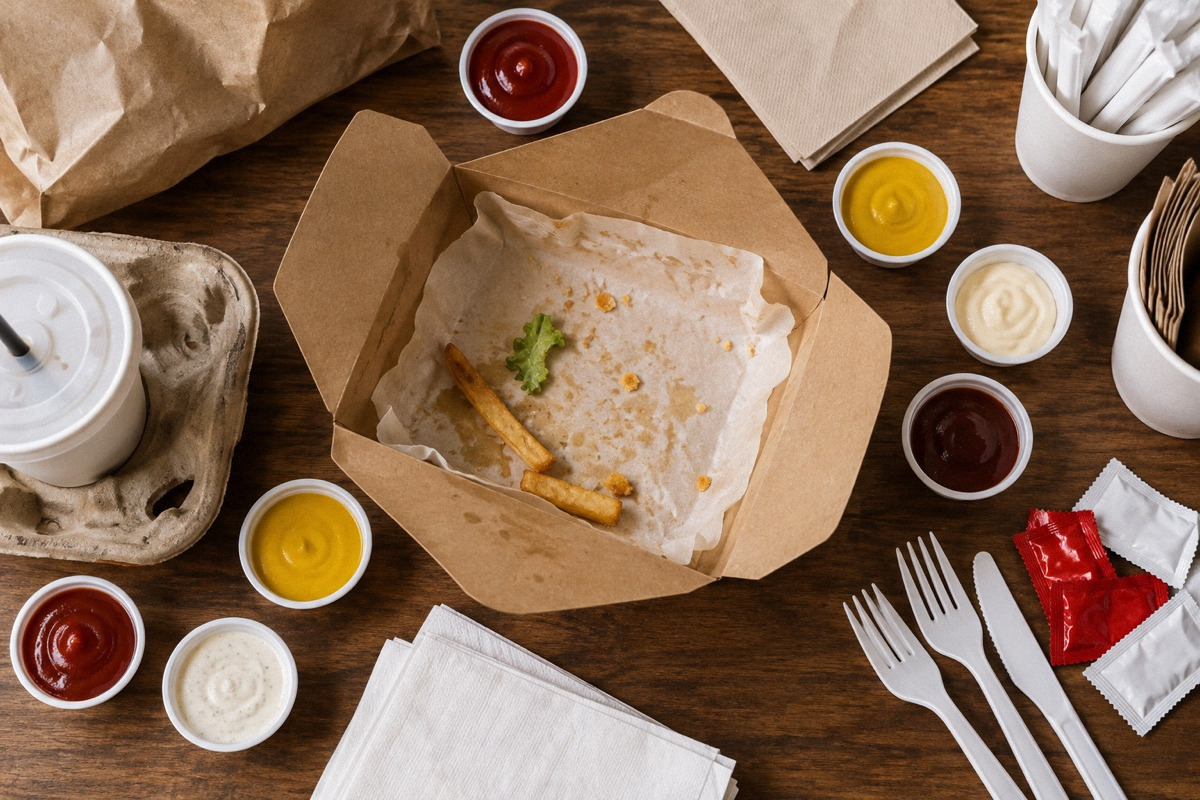
In the r/restaurantowners thread 'Tips for itemizing costs of each menu item', one commenter mentioned running a 'higher Q-factor' because ingredient prices change so often. When the original poster asked what that meant, the commenter described it as an allowance for everything you do not and cannot account for in your recipe and business food cost. Their examples were condiment bottles on the tables, sauce packets for to-go orders, customers asking for extra items, and price fluctuations due to seasonality, inflation and supply-chain problems.
Terms vary between kitchens. Some use 'Q-factor' only for tiny unmeasured items like salt, pepper and frying oil, while this commenter's definition is broader. The useful distinction is between items that are consumed but hard to put on a single recipe card, such as condiments, packets and freebies, and price risk, which is uncertainty about what next week's invoices will say. Both are legitimate to plan for. They behave differently, so this article measures them separately rather than folding them into one guessed percentage.
Why small, uncosted items matter
Recipe cards describe what a dish should cost. Inventory-based food cost describes what the kitchen actually used. The gap between them always includes some waste and over-portioning, but it also includes a steady flow of items that leave the building without belonging to any recipe: the ketchup bottle refilled three times a day, the ramekin of ranch for a to-go order, the second basket of bread, the lemon wedges for iced tea.
Individually these are pennies. Across thousands of covers they can account for a noticeable slice of food cost, and they grow quietly as to-go volume grows. Another r/restaurantowners thread, 'Cutting Costs?', shows a related pressure. A reply asked the original poster whether they were portioning food into small bags and cups thrown away with every ticket, and the poster said yes. Disposable portion cups and packets are a real per-order cost whether you book them under food or packaging, and they are easy to leave off a plate cost.
Measuring one normal week
Pick a week without holidays or unusual events and measure each category directly. For bulk table condiments, record how many bottles or containers were refilled or opened, at their current cost. For to-go packets and cups, count what went out, either by tallying cases opened or by counting the starting and ending stock in the packet bin. For free extras, the simplest method is a point-of-sale modifier priced at zero, such as 'extra dressing, no charge' or 'bread refill', which servers ring in so the extras show up in a report without anyone being charged.
At the end of the week, cost each category at current invoice prices. Then divide each one by the base you plan to allocate it to. If the allowance goes onto entree recipe cards, divide by entrees sold, not by covers, because one cover can order several plates and a per-cover figure added to every plate would count it more than once. Divide channel-specific costs, such as to-go packets, by orders in that channel only. A percentage of net food sales is useful for comparing weeks, but it is a ratio, not a dollar amount you can add to a recipe card. Record the base and method next to each result. A figure of '1 percent' without notes cannot be checked or updated later.
- Table condiments: count refills and newly opened containers.
- To-go packets and portion cups: count starting and ending stock, or cases opened.
- Free extras: use zero-priced POS modifiers for one week, then review.
- Bread, chips or other complimentary items: count batches or bags used.
- Note covers, entrees and net food sales for the same week.
Worked example: one week at a casual restaurant (hypothetical numbers)
These figures are invented for illustration and are not benchmarks.
During the measured week the restaurant served 1,400 entrees and had $21,000 in net food sales, and 420 of those entrees were to-go orders. Table condiment refills cost $46. To-go sauce packets and portion cups cost $63. Free extras rung in as zero-priced modifiers, mostly extra dressing, additional bread and side sauces, cost $91. Total uncosted items came to $200.
Per entree, that is $200 divided by 1,400, or about $0.14. As a share of food sales, it is $200 divided by $21,000, or about 0.95 percent. Breaking it down further shows where the money goes. The to-go packets alone are $63 divided by 420 to-go orders, or $0.15 per to-go order, while the table condiments spread across all 1,400 entrees are only about $0.03 each. The free extras, at about $0.065 per entree, are the largest single category and the one most worth a closer look.
| Category (hypothetical week) | Weekly cost | Spread over | Per unit |
|---|---|---|---|
| Table condiments | $46 | 1,400 entrees | about $0.03 |
| To-go packets and cups | $63 | 420 to-go orders | $0.15 |
| Free extras (zero-priced modifiers) | $91 | 1,400 entrees | about $0.065 |
| Total | $200 | 1,400 entrees | about $0.14 (about 0.95% of food sales) |
Choosing how to apply the allowance
There are two practical ways to put the measured figure onto plate costs. The flat method adds the same per-plate amount, $0.14 in the example, to every entree's recipe-card cost. The targeted method assigns each category where it belongs: the to-go packet cost goes only to to-go orders, and the remaining categories go to the entrees they actually accompany. In the example, using entrees as the base for everything except packets, that means about $0.15 on each to-go order, plus about $0.03 for table condiments and about $0.065 for free extras on every entree. A kitchen with detailed data could narrow the condiment figure further to the dishes that usually get condiments, recalculating the per-dish amount on that smaller base. The flat method is simpler and usually good enough for a menu with similar dishes. The targeted method matters when one channel, like takeout, carries a cost that dine-in does not. Use one method or the other. Adding the flat $0.14 and then also adding the to-go $0.15 to takeout orders would count the packets twice.
Price volatility is a different problem from consumed extras, and it is better handled with its own buffer. If a key ingredient regularly swings in price, some operators cost recipes at a recent high price, or add a separate volatility margin to that ingredient's line rather than inflating the Q-factor for the whole menu. That keeps the measured extras figure meaningful. If you use one combined number, as the commenter in the thread described, write down how much of it is measured extras and how much is volatility cushion.
Charge, limit or absorb: deciding what to do with each extra
Once the extras are visible, each one needs a decision, and the right answer depends on guest expectations as much as cost. A free item that guests strongly expect, such as ketchup with fries, usually costs more in goodwill to charge for than it saves. An extra that is requested by a minority and costs real money, such as a second side of a premium sauce, is a reasonable candidate for a small charge. In between, giving one portion by default and charging for additional ones is a common middle ground.
For to-go packets, the usual control is to give them on request rather than dropping a handful into every bag. That is an operational choice, not a rule, and it should be paired with a clear question at the point of order so guests are not surprised. Whatever you decide, make it visible. If an extra now costs money, show it on the menu or ordering screen and train staff to mention it, rather than letting it appear unexpectedly on a check.
| Situation | Reasonable default |
|---|---|
| Expected by nearly every guest, low cost | Absorb; include in Q-factor |
| Requested by a minority, meaningful cost | Consider a disclosed charge |
| Often taken but frequently unused (to-go packets) | Provide on request; ask at order |
| Large, growing cost with no clear owner | Investigate before setting any allowance |
Controls that cut extras without looking stingy
Portioned ramekins rather than free-pour bottles make extras countable and consistent. Stocking to-go packets behind the counter rather than in self-serve bins makes them a choice rather than a handful. Keeping zero-priced modifiers in the point-of-sale system after the measurement week lets you see whether extras are rising, and which shifts or servers give them out most. That last data point is for coaching and consistency, not discipline over small hospitality gestures.
Avoid the opposite failure: cutting standard portions of condiments or sauces so far that guests ask for more, which raises the extras count and leaves a worse impression. If a dish regularly triggers a request for extra sauce, the recipe may simply need more sauce, costed on the card where it belongs.
Reviewing the allowance, and not using it as a plug
Re-measure whenever packet or condiment prices change noticeably, when to-go volume shifts, or at least a couple of times a year. In a different r/restaurantowners thread about distributor pricing, owners described paper goods and gloves changing price week to week and a case of cups containing fewer units than expected. Those swings flow straight into the to-go part of the allowance, so check unit counts as well as case prices.
The biggest risk with a Q-factor is using it to make the numbers work. If actual food cost runs three points above theoretical, it is tempting to declare a three-point Q-factor and move on. Only the measured portion belongs in the allowance. Anything left over is unexplained variance, which points toward waste, portioning or loss that needs its own investigation. Our article on measuring food waste and our guide to detecting inventory loss cover those next steps.
Questions that come up next
What is a normal Q-factor percentage?
There is no reliable universal figure. The commenter in the r/restaurantowners itemizing thread who described a Q-factor did not give a number, and kitchens define it differently. Measure your own week of condiments, packets and free extras, divide by food sales, and use that. If your result is much larger than expected, investigate before accepting it.
Should to-go packaging be part of food cost or a separate cost?
Either can work if you choose one and keep it consistent. Many operators track paper and packaging separately from food so each can be reviewed on its own. What matters is that the cost lands somewhere visible. Portion cups and packets thrown out with every ticket, as described in the 'Cutting Costs?' thread, are real per-order costs.
Sources & context
Forum accounts are unverified experiences. Read government sources for their stated jurisdiction and check requirements with the responsible authority for your location.
- r/restaurantowners: Tips for itemizing costs of each menu itemreddit · Directly inspected thread text. Supports the commenter's definition of a Q-factor (table condiments, to-go sauce packets, guest extras, price fluctuations) and running a 'higher Q-factor' because of volatility. No percentage is given. The split between measured extras and a volatility buffer is this article's recommendation, not the commenter's.
- r/restaurantowners: Cutting Costs?reddit · Recorded search excerpt. Supports the exchange where the owner confirms pre-portioning food into disposable bags and cups thrown away with each ticket. Indirect support for per-order disposable costs.
- r/restaurantowners: How do you guys manage random pricing at Sysco?reddit · Directly inspected thread text. Used only for owners' reports of week-to-week price swings on gloves and paper goods and a case of portion cups containing fewer units than expected. Distributor criticisms in the thread are opinions and are not relied on.


