The practical answer
Passing inspection shows a system was installed acceptably. It does not prove the system copes with a full service. Commission each system against its spec sheet and test report: hood capture and make-up air balance, refrigeration pull-down and recovery, hot water at every sink, drains, the dish machine, lighting and electrical under load. Then run a full-load shakedown service with every appliance on and real volumes. Log every deficiency with an owner and a date. Fix safety items before anything else, and tie final payment and retainage to a signed commissioning record.
Passing inspection is not the same as surviving a Saturday
One owner of a smash-burger shop posted help, grease pan from hood fills up twice everyday about a month after opening. The new hood's grease pan was overflowing, the hood was dripping, and grease was coating the backsplash. We saw the thread only as search excerpts, so we do not know the cause. We also do not know what inspections or approvals the shop had. The point here is timing: the problem showed up under real cooking volume, a month into service.
A general contractor with a restaurant background makes the preventive case in 10 Things I Would Keep In Mind Before My Buildout, which we read through an archive: simulate a full Saturday service before opening. Commissioning is the structured version of that advice. Each system is tested against what it was supposed to do, under realistic load, while the installers are still under contract and before the final check is written.
What to commission, and what evidence to keep
Make a list of systems before the last month of construction and assign a responsible party for each test. Many tests are run by the installing trade or a specialist, such as a test-and-balance contractor for air systems or the suppression vendor for the hood fire system, with the owner or representative witnessing. Ask for written results, not a verbal 'it's good.'
| System | What to verify | Evidence to keep |
|---|---|---|
| Exhaust hood and make-up air | Capture and containment with all appliances cooking; air balance; filters correctly installed; grease drainage path | Test-and-balance report; video of capture test; manufacturer start-up sheet |
| Hood fire suppression | Acceptance testing as required by the authority and the system manufacturer | Vendor test report; authority sign-off as applicable |
| Walk-in and reach-in refrigeration | Pull-down to set point, holding under door openings, recovery time, alarms | Temperature logs with dates; start-up sheets |
| Hot water | Temperature and recovery at every sink during peak dish-machine use | Thermometer readings by sink and time |
| Dish machine | Wash and rinse or sanitizing parameters per data plate; gauges working | Start-up report; test-strip or thermometer records |
| Drains and grease interceptor | Flow with all sinks and the dish machine discharging; no backups | Observation notes; interceptor start-up documents |
| Electrical | All equipment running at once without nuisance trips; labeled panels | Load notes; corrected panel schedule |
| Lighting | Light levels in prep, storage and warewashing areas | Light-meter readings by area |
Test procedures, system by system
Hood and make-up air: run every appliance under the hood at operating temperature with food on it. Watch whether smoke and vapor stay inside the hood's edges, including when doors open and staff move across the line. Check that the space is not strongly negative. Signs include doors that are hard to open, whistling at door gaps or pilot flames that waver. Compare measured airflow to the design values in the test-and-balance report. Confirm filters sit in the correct orientation and that grease drains toward its cup or container, not onto the cooking surface. The design values come from your engineer and the equipment listing, not from a rule of thumb.
Refrigeration: let each unit reach its set point empty, then load it with product at realistic temperatures and open doors at service frequency. Record product temperatures, not only the display. Check the cold-holding temperature your adopted food code requires for refrigerated food. DC Health's Plan Review Guidance Packet (DC, Dec 2019 ver. 8) asks whether refrigeration can store refrigerated foods at 41°F (5°C) or below. Freezers are tested separately: they must keep frozen food frozen. Do not read a refrigerated-food figure as a freezer target.
Hot water and sinks: the same DC packet asks whether hot water of at least 100°F and cold running water under pressure are available at all handwashing sinks, and whether self-closing metering faucets run for at least 15 seconds. Measure the hot water at the farthest hand sink while the dish machine and prep sinks are running, because recovery under load is where problems appear. The packet also lists minimum light levels for different areas: 110 lux (10 foot-candles), 220 lux (20 foot-candles) and 540 lux (50 foot-candles). A light meter makes this a five-minute check. These are DC plan-review figures. Other jurisdictions set their own, so use the code that applies to your site.
When a new hood drips or overflows
If grease is overflowing, dripping or coating surfaces, treat it as a defect for the installer and designer to diagnose, not a cleaning chore. Possible causes include filter installation, drain path or slope, a mismatch between hood design and actual cooking volume, and air-balance problems. Only an inspection can say which applies. Call the installer promptly, in writing. If grease is accumulating where it creates a fire hazard, stop the affected cooking until it is made safe.
Do not improvise a bigger catch container or modify the hood yourself. Any change to grease collection should be one the manufacturer approves for that hood. Keep photos, cooking-volume notes and the dates you emptied the container. That record helps the installer diagnose the cause and documents the warranty claim, which our related hood article discusses in more detail.
The full-load shakedown service
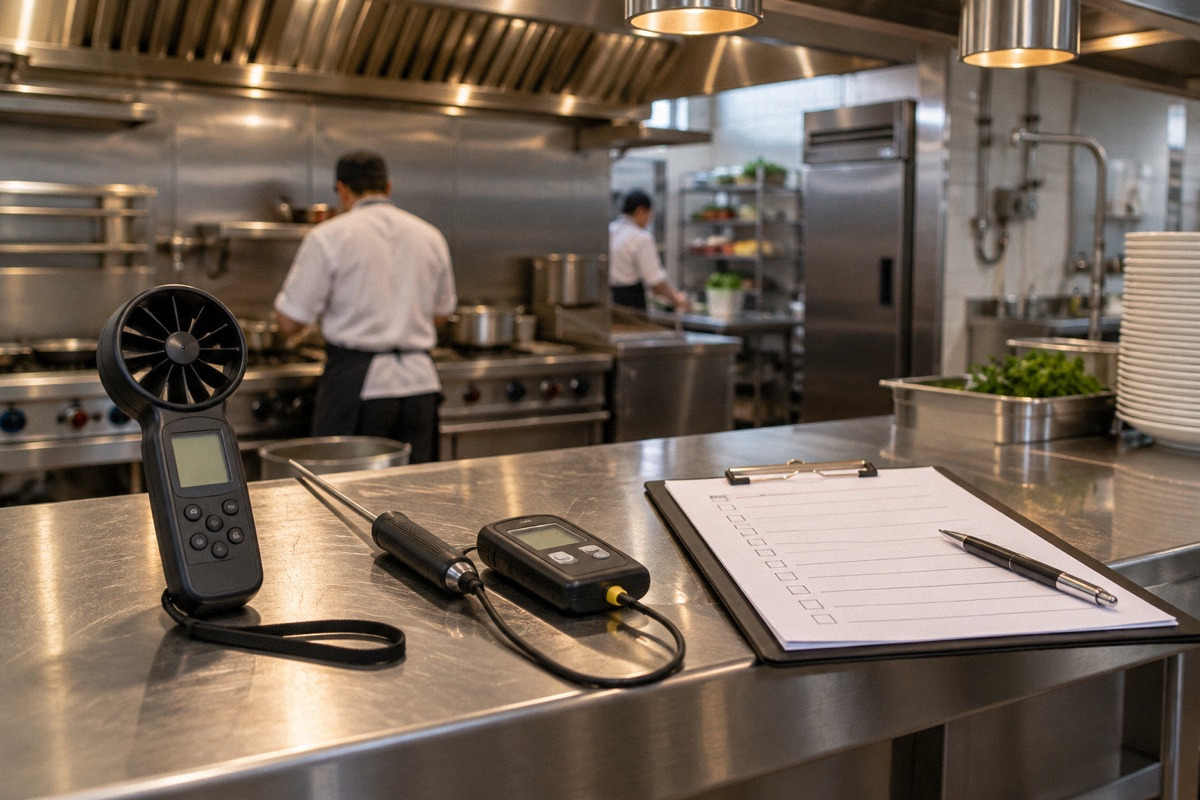
The shakedown is a controlled commissioning exercise for staff, not a public service. Run it only after the installing contractors confirm each system is safe to energize and operate, and after any test authorizations the fire, building or health authorities require are in place. Do not serve the public until all operating approvals are issued. Within those limits, schedule at least one rehearsal that matches your busiest expected service, not a friends-and-family evening at half volume. Fire every appliance at once. Run the dish machine continuously. Cook the actual menu at expected ticket counts, open the walk-in as often as a real rush would, and run the bar and prep sinks together. Assign one person who is not cooking to walk the building with a clipboard and thermometer, reading breakers, drains, hand-sink temperatures, hood capture and refrigerator displays every 15 minutes.
Schedule the shakedown early enough to fix what it finds. Some fixes, such as a re-balanced fan or a replaced breaker, take a day. Others, such as a larger water heater, an added circuit or a refrigeration component, can take weeks. A shakedown held two days before opening can only tell you what will go wrong on opening night.
Hypothetical worked example: a shakedown deficiency log
All details are hypothetical. Twelve days before opening, an operator runs a full-load shakedown and logs nine deficiencies. Each one gets a severity, a responsible party and a date. Severity A means stop the affected activity until a qualified person has diagnosed and fixed it. B means it must be fixed, retested and, where applicable, signed off before opening. C is limited to purely cosmetic items with no code or safety element, which can be finished after opening with a dated commitment.
Two items are A: grease collecting at the hood's front edge with all fryers running, and the farthest hand sink dropping below 100°F during continuous dish-machine use, which falls short of the DC packet's stated minimum. The hood item goes to the installer the same day, and fryer use stops in testing until the installer has inspected it. Five items are B. One breaker trips when the second fryer and the hot-holding cabinet start together. The walk-in takes much longer than its start-up sheet suggests to recover after a door-propped delivery. A floor sink backs up when the dish machine drains. A dry storage corner measures below the required light level. And the panel directory is unlabeled. Even as B items, the tripping circuit, the backing-up drain and the slow-recovering walk-in are taken out of use in testing until a qualified tradesperson diagnoses them. No food is held in the walk-in until it holds temperature on a logged retest. Two items are C: a scuffed stainless kick plate and a paint touch-up by the back door.
The water-heater fix has a 9-day lead time. That leaves 3 days of margin before opening, so it is tracked daily. The operator also plans a second, shorter shakedown after the A and B fixes, to confirm they worked under load.
| Deficiency (hypothetical) | Severity | Responsible | Fix lead time | Retest |
|---|---|---|---|---|
| Grease at hood front edge under full fryer load | A | Hood installer and designer | Inspection same day; repair time set after qualified diagnosis; an opening gate | Second shakedown |
| Far hand sink below 100°F during dish cycle | A | Plumber and engineer | 9 days (heater change) | Second shakedown |
| Breaker trips with fryer 2 and holding cabinet | B | Electrician | 1 day | Load test |
| Walk-in slow recovery after delivery | B | Refrigeration contractor | 3 days | Logged pull-down |
| Floor sink backs up on dish drain | B | Plumber | 1 day | Full dish cycle |
| Dry storage corner below required light level | B | Electrician | 5 days | Light meter |
| Panel directory unlabeled | B | Electrician | 1 day | Visual check against panel schedule |
| Scuffed stainless kick plate | C | GC | After opening, dated | Visual |
| Paint touch-up at back door | C | GC | After opening, dated | Visual |
How commissioning fits the DC pre-operational inspection
DC Health's inspection explainer (DC) describes the pre-operational inspection as checking that a facility is 'up to code' with respect to placement of sinks, refrigeration, heating elements and other items, following menu and plan review. The plan-review packet says a pre-opening inspection with equipment in place and operational is needed to determine compliance. In other words, the inspector expects working equipment. Commissioning before that inspection means you find out first whether the hand sinks reach temperature and the coolers hold. The inspection checks compliance on its day. Your commissioning record shows how the systems behave under load. You need both. Other jurisdictions run similar pre-opening inspections under their own adopted codes.
Sign-off before final payment
Make commissioning a contract deliverable, not a courtesy. Include it in the closeout line of the schedule of values, and make release of final payment and retainage depend on it, as described in our progress-payment article. Passing a test is one condition of payment, not the only one. Final payment still follows every other contractual and legal condition, such as the punch list, closeout documents and lien waivers.
- Every system on the commissioning list tested, with written results
- Test-and-balance report and suppression acceptance documents on file
- Full-load shakedown completed; second shakedown after major fixes
- Every A and B deficiency closed and retested; C items dated and assigned
- Start-up sheets, manuals and warranty registrations handed over
- Staff trained on shutoffs, filters, grease containers and alarms
- Signed commissioning record filed with the closeout package
Questions that come up next
What is a hood balancing test?
It is a test, usually by a test-and-balance contractor, that measures exhaust and make-up airflows and compares them with the engineer's design values. It is paired with a capture test using real cooking. Ask for the written report, and repeat the capture check during your full-load shakedown, because a balanced system on paper can still spill vapor under real cooking and door traffic.
When should a restaurant run its shakedown service?
Early enough to fix what it finds, usually well over a week before opening. Some fixes, like a water heater or refrigeration component, can take days or weeks. Run it at your busiest expected volume with every appliance on, then run a shorter second test after the main fixes to confirm they work under load.
Sources & context
Forum accounts are unverified experiences. Read government sources for their stated jurisdiction and check requirements with the responsible authority for your location.
- help, grease pan from hood fills up twice everyday (r/restaurantowners)reddit · Controller search excerpts only. A month-old smash-burger shop with a new hood reports pan overflow, dripping and backsplash grease. The cause is not established by the excerpt.
- 10 Things, In No Particular Order, I Would Keep In Mind Before My Buildout (r/restaurantowners)reddit · Post read via archive. A self-described NYC GC with restaurant background recommends simulating a full Saturday service before opening. Credentials unverified; operational advice, not code.
- DC Health Food Establishment Plan Review Guidance Packet (Dec 2019 ver. 8)government · PDF pages 1-6 read 2026-10-03. Refrigerated storage at 41°F (5°C) or below question, 100°F minimum hot water at hand sinks, 15-second metering faucets, lighting at 110/220/540 lux, and pre-opening inspection with equipment operational. DC plan-review form; confirm current requirements with DC Health. Other jurisdictions differ.
- Understanding Food Establishment Inspections, DC Healthgovernment · Fetched 2026-10-03. Pre-operational inspection checks placement of sinks, refrigeration and heating elements after menu and plan review. DC only.


