
The practical answer
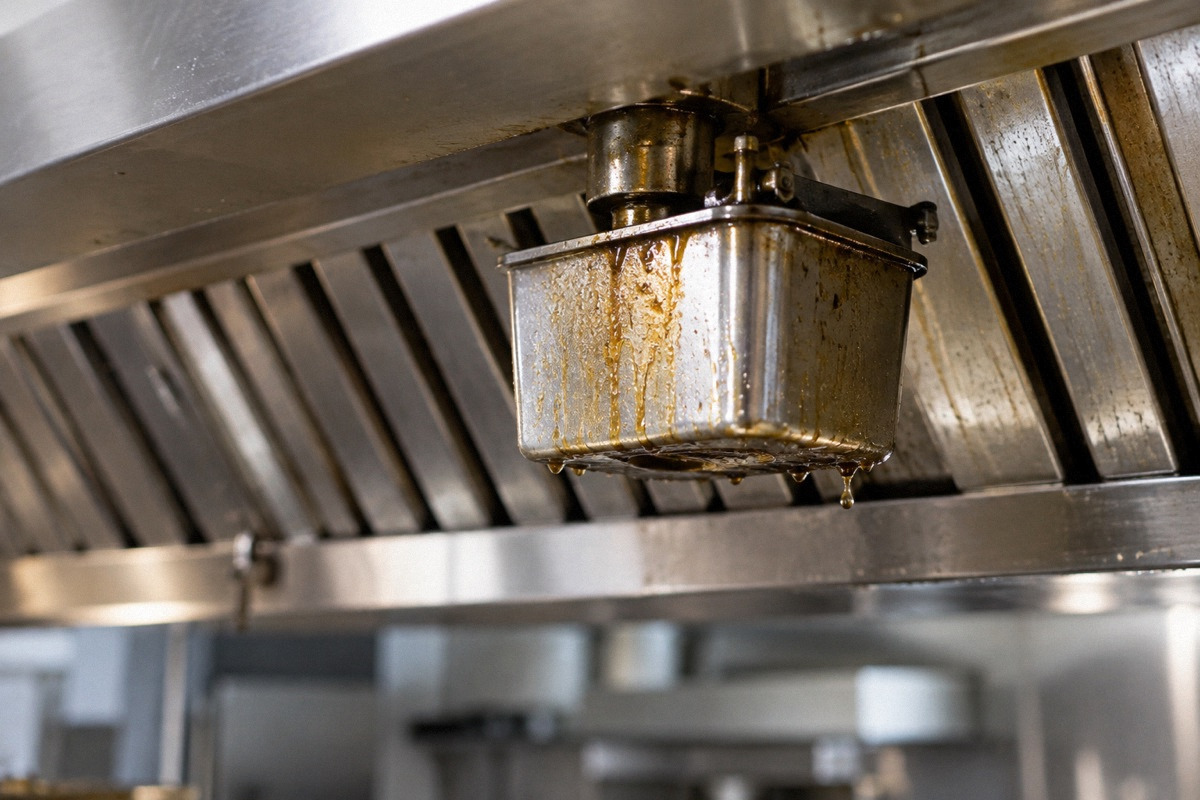
A filling grease cup, grease dripping from the hood and grease film on the walls are three different symptoms. A cup that fills in step with cooking volume may reflect heavy grease cooking, but it still needs emptying well before it's full. Drips point to filters, troughs or condensation. Film beyond splash range suggests vapor escaping capture, so check exhaust flow, makeup air, drafts and appliance placement. Log the symptoms, empty the container before it's full, and ask the installer to fix drips and overflow promptly. Stop cooking on the line if it's unsafe.
Three symptoms that are easy to lump together
A r/restaurantowners post titled 'help, grease pan from hood fills up twice everyday' describes a smash burger restaurant about a month old, with a new hood installed about two months earlier. The owner wrote that they empty the grease pan twice a day, and that if they forget, it overflows and spills behind the grill. They pull the equipment out and clean the backsplash daily because of grease buildup. The hood needs cleaning every other day, and grease drips from the hood onto the equipment during service. They said they use high-fat patties on a flat top, but that the grease isn't splatter. It comes from the air and sticks to everything around. Our research recorded this post as a search excerpt. We don't know what was ultimately found, and this article doesn't diagnose that restaurant.
The post usefully contains three distinct symptoms. A grease container that fills quickly is about how much grease reaches the filters. Grease dripping from the hood is about where captured grease goes after it hits the filters and hood surfaces. A film on the backsplash may be grease vapor that never entered the hood, though splatter from the cooking surface and other sources have to be ruled out first. Each points to different causes, so separate them before calling anyone.
Capture versus overload: what each symptom points to
Smash burgers are a heavy grease load. Pressing high-fat patties hard onto a hot griddle releases a lot of fat as vapor and spatter. A grease cup that fills quickly, in proportion to how many burgers you cook, may simply reflect that load, especially if the cup is small. An overflowing container is still a hazard, though. Grease spilling behind a hot griddle is a fire and slip risk, so the container has to be emptied well before it's full, and the installer should be asked about it promptly. If a larger container is needed, use only one the hood manufacturer approves. Grease on surfaces outside the hood is a different matter. A film on walls or equipment beyond the reach of splatter suggests vapor is escaping capture. Check that before assuming it's normal, because grease outside the hood is a cleaning burden and a fire concern.
Use the table to sort what you're seeing. The causes listed are common possibilities, not a diagnosis. Hood performance depends on design airflow, hood type and size, appliance layout and makeup air, and verifying those is a job for the installer or a qualified balancing contractor.
| Symptom | Common possible causes | Who checks |
|---|---|---|
| Grease cup fills fast, in step with cooking volume | Heavy grease load; small cup | Owner: log volume and empty well below full; installer: advise on a manufacturer-approved container |
| Grease drips from the hood's front edge or onto equipment | Saturated or misfitted filters; gaps between filters; clogged trough or drain; grease condensing on interior surfaces | Owner checks filters and trough; installer fixes the drain path promptly |
| Grease film on the backsplash, walls or nearby equipment | Splatter from the cooking surface; or vapor escaping because of low exhaust flow, makeup air blowing across the hood, cross drafts, or an appliance extending beyond the hood | Owner rules out splatter; installer or a test-and-balance contractor checks capture |
| Smoke rolling out at peak cooking | Same as above, plus a load beyond what the hood was designed for | Installer, with the design data |
| Doors hard to open or whistling when the hood runs | Building under negative pressure; makeup air not running or undersized | Installer or HVAC contractor |
Equipment placement under the hood
A hood captures best when the appliance sits well inside the hood's footprint, with the hood overhanging the appliance on the front and sides as its design requires. On a new build, the line sometimes changes after the hood is ordered. A griddle gets wider, equipment shifts toward an end, or a piece is added that wasn't in the design. The plume from an appliance at the edge of the hood can escape sideways, and that grease lands on whatever is next to it.
Check four things. Compare the current appliance layout with the drawing the hood was designed for. Measure whether any cooking surface extends past the hood's edges. Look for anything that pushes air across the cooking surface, such as a fan, an HVAC supply diffuser, a pass-through window or a door that's often open. Finally, check whether tall equipment or shelving beside the griddle blocks the plume from rising into the hood. Required overhang and clearance distances come from the hood manufacturer's listing and your adopted mechanical code, so get them from the installer's documents, not from a rule of thumb.
Exhaust and makeup air balance
A hood can only capture what its exhaust fan pulls through it. That flow depends on the fan running at the design speed and direction, a belt that isn't slipping on belt-driven fans, clean filters, and enough replacement air entering the building. On a new installation, several of these depend on how things were wired and set up. They should be checked at commissioning, and the installer should verify them, not the owner on a ladder or the roof.
Makeup air is the other half. When a hood exhausts more air than the building takes in, the building goes into negative pressure, and the fan has to fight to pull air through the hood. A commenter in a residential r/HomeImprovement discussion about range hoods explained that negative pressure makes a hood work less well, so hot, greasy, smoky air moves into the space instead of into the hood. They suggested that one sign in a restaurant is the front door when you open it. That thread is about home kitchens and was recorded as a search excerpt, so treat it as an explanation of the mechanism, not commercial guidance. The opposite problem also happens: makeup air discharged too close to the hood, or aimed across its face, can blow the plume out of the capture zone. The fix is a balance measured against design values.
- Does the makeup air unit run whenever the exhaust fan runs? Ask how they're interlocked.
- Is the exterior door hard to open, or does it whistle, while the hood runs?
- Where does makeup air enter, and does it blow across the cooking line?
- Has anyone measured exhaust and makeup air flow against the design values since installation?
Filters, troughs and cleaning frequency
Drips usually start at the filters and the grease collection path. Look with the hood off and cool. Are all filter slots filled with the correct size and type, seated without gaps, and installed in the direction the manufacturer specifies? A missing or misfitted filter lets grease vapor straight into the plenum and duct, which is a fire concern as well as a performance issue. Never cook with filters removed. Check that the trough or gutter drains freely to the container and that the container fits properly. Check whether grease is running down the hood's interior walls and off the front edge, which suggests condensation on surfaces or saturated filters.
With a heavy load like smash burgers, filters may need cleaning more often than in a kitchen with a lighter menu. That might be daily, or more than once a day at high volume. Clean them following the hood manufacturer's instructions. Filter cleaning by staff is not the same as cleaning the duct and exhaust fan, which is specialized work on a schedule set by your local fire code. Our guide to hood cleaning frequency covers that split.
Worked example: a grease log that separates load from capture (hypothetical numbers)
These figures are hypothetical, chosen to show how a simple log helps. For two days, a burger shop records patties cooked, grease collected in the container (measured in a marked jug before disposal), whether grease dripped from the hood edge, and whether the backsplash needed wiping. Day 1: 280 patties, 1.4 quarts collected, which is 0.5 quarts per 100 patties. Day 2: 420 patties, 2.1 quarts, again 0.5 quarts per 100 patties. The amount collected per patty is consistent across the two days. That doesn't measure capture efficiency, and it doesn't prove the hood collects a consistent share of the grease the griddle gives off. What it shows is that container fills track cooking volume, so the owner can plan when to empty.
Suppose the container holds 1 quart. On a 420-patty day, 2.1 quarts are collected. In theory, two perfectly timed emptyings would leave only 0.1 quart in the container at close. In practice that leaves no margin for a busy hour. A safer operational rule is to empty when the container reaches half full, or 0.5 quart, which at this rate means about every 100 patties. That's four emptyings during service at roughly 100, 200, 300 and 400 patties, then a final one at close. The owner checks the level each hour against the rule, and asks the installer whether the hood manufacturer offers an approved larger container. They don't improvise one.
The same log shows the backsplash needing heavy wiping on both days, well above where griddle splatter reaches, and drips from the hood edge during the lunch peak. Those don't track container size. The owner sends the log to the installer and asks for the drips to be fixed promptly. The installer checks the system against its design. In this hypothetical, the installer finds the exhaust fan running below design flow and the makeup air diffuser aimed across the hood face, corrects both, and the backsplash film drops. The log turned a vague complaint into specific evidence the installer could act on.
| Hypothetical log | Patties | Grease collected | Per 100 patties | Edge drips | Backsplash film |
|---|---|---|---|---|---|
| Day 1 | 280 | 1.4 qt | 0.5 qt | Lunch peak only | Heavy |
| Day 2 | 420 | 2.1 qt | 0.5 qt | Lunch peak only | Heavy |
Calling the installer back
A hood installed two months ago is still the installer's project. Grease dripping onto equipment and containers overflowing behind a griddle are safety problems, not just cleaning problems. Ask for them to be addressed promptly, not just for a new cleaning schedule. If grease is dripping onto hot surfaces or pooling, stop cooking on that line until it's corrected. Before calling, write down what you've observed, attach the log and photos, and list the appliances under the hood with their positions. Then ask the installer to show, or perform, the commissioning checks. These include measured exhaust and makeup air flow compared with design, fan speed and rotation, the makeup air interlock, filter fit and type, the grease drain path, and appliance placement against the design drawings. Ask for the results in writing.
If the installer says the system meets design and the symptoms continue, ask whether the design assumed your actual menu. A hood sized for general cooking may struggle with a smash-burger line. A test-and-balance contractor can give an independent measurement. Any change to fans, ductwork or makeup air may need permits and inspections from your building and fire officials. In the District of Columbia, the Department of Buildings' permitting overview describes the permit routes, including the Permit Wizard and ProjectDox, but doesn't list hood-specific requirements. Ask DOB, or have your contractor confirm, before work starts. Keep every report, because these records matter for warranty claims and for future inspections. Our commissioning guide covers what to test before opening, so the next location starts with a verified system.
What not to do while you wait
Don't remove filters to 'let it pull better'. Don't tape over gaps or block makeup air openings. Don't swap in an improvised, larger grease container. Use only what the hood manufacturer approves. Don't adjust or disable any part of the fire suppression system. Don't send staff onto the roof to look at the fan. Empty the container well before it's full, on a trigger that matches your volume, clean filters as often as the load requires, and keep the area outside the hood clean, because accumulated grease is fuel. If you see grease pooling in the hood, smell overheating or see smoke where it shouldn't be, stop cooking on that line and call for service.
Questions that come up next
Why is my new hood dripping grease onto the cooking equipment?
Common causes include saturated filters, filters installed with gaps or in the wrong direction, a clogged grease trough or drain, and grease condensing on the hood's interior and running off the front edge. Check with the hood off and cool. Clean filters more often under a heavy load, and ask the installer to verify the drain path. Never cook with filters removed.
How can I tell if my hood isn't pulling enough air?
Watch for grease film beyond splatter range or smoke on surfaces outside the hood, smoke rolling out at peak cooking, and exterior doors that are hard to open or whistle while the hood runs, which can signal negative pressure. These are clues, not measurements. Ask the installer or a test-and-balance contractor to measure exhaust and makeup air flow against the design values.
Sources & context
Forum accounts are unverified experiences. Read government sources for their stated jurisdiction and check requirements with the responsible authority for your location.
- r/restaurantowners: help, grease pan from hood fills up twice everydayreddit · Search-excerpt evidence of the original post: a new smash-burger shop with a new hood; the pan fills twice daily, grease drips from the hood, and airborne grease coats the backsplash. The outcome and any diagnosis are unknown; the article does not diagnose this restaurant.
- r/HomeImprovement: What do guys only realize too late after buying a range hood?reddit · Search-excerpt evidence; indirect support. A residential thread in which a commenter explains that negative building pressure reduces hood capture and suggests a front-door check in restaurants. It explains the mechanism only and is not commercial design guidance.
- DC Department of Buildings: Permitting in the District of Columbiagovernment · DC permit routes (Permit Wizard, ProjectDox). Cited only for checking whether hood, fan or makeup air changes need permits; the page does not list hood-specific requirements.


