
The practical answer
Hood cleaning is two jobs. Staff can clean filters, grease cups and the reachable hood surfaces daily or as often as the menu requires. Cleaning the plenum, ductwork and rooftop exhaust fan is specialized work that fire officials and insurers generally expect a qualified company to do and document. How often the system needs professional cleaning depends on what and how much you cook, and on the fire code your jurisdiction has adopted and any insurer conditions. Ask your fire authority which frequency applies. Don't take a vendor's default schedule as the requirement.
Two jobs that share one name
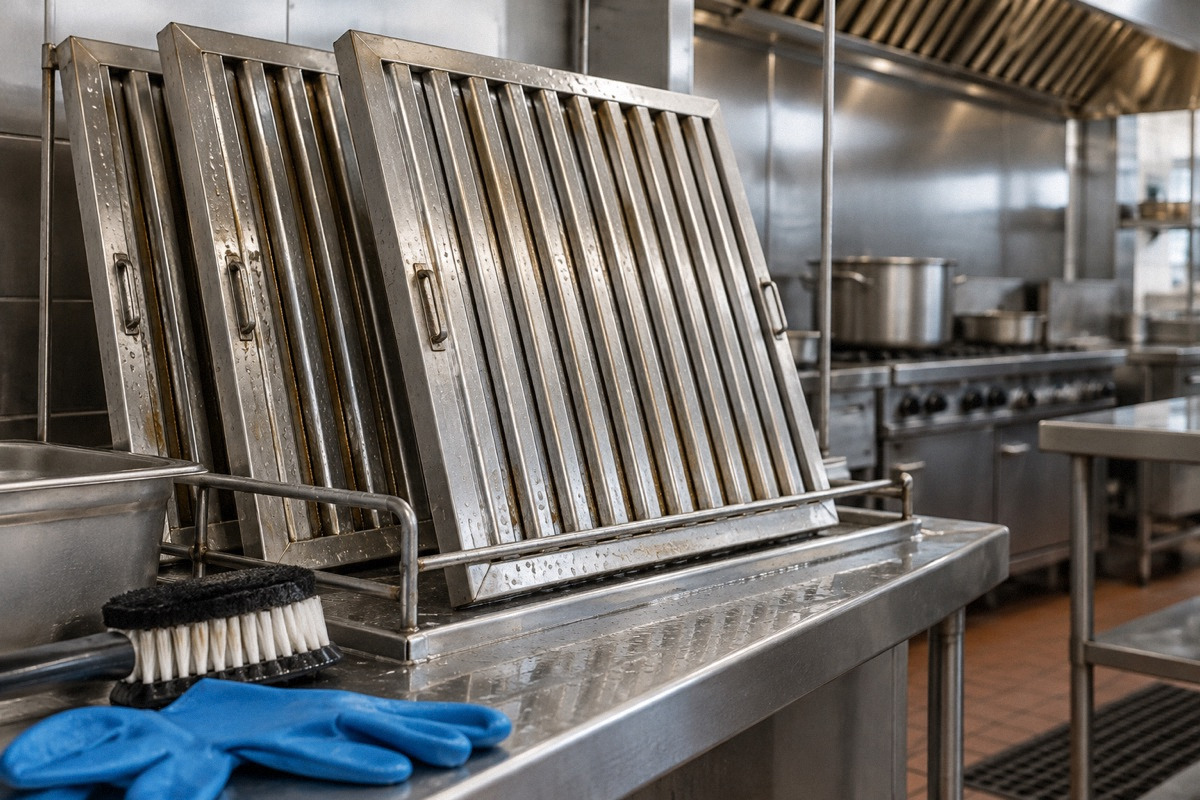
Owners asking how often to clean a hood are usually asking two questions at once. One is daily cleaning: filters, grease troughs and cups, and the stainless surfaces you can reach under and inside the hood. The other is cleaning the whole exhaust system, meaning the plenum behind the filters, the grease duct up through the building, and the exhaust fan on the roof. The first is kitchen sanitation that staff do. The second is fire-protection work, and it's the part that inspections and insurers focus on.
The r/restaurantowners 'Hood cleaning service rant' thread shows the difference. The owner described a cleaning required by their fire department and insurer and done by the company their insurer recommended. It cost $730, took about 30 minutes, and the crew never went on the roof. The owner said their own staff did a better job on all the stainless under the hood. That's probably true, and it's also beside the point. Staff can keep the visible stainless clean. What the owner was paying for, and didn't get, was the duct and the fan. Replies in that thread said their own cleaners always go on the roof. One commenter said the vent is the main thing the cleaners are supposed to clean. Our research recorded these comments as search excerpts.
What staff can clean, and what they shouldn't touch
Daily and weekly hood care by staff is useful and expected. Follow the hood manufacturer's instructions for removing and cleaning filters and for which cleaning products to use on its surfaces. How often staff clean depends on the load. A smash-burger griddle or a fryer bank may need filters cleaned daily or more often, while a light menu may need them less. Some tasks look simple but belong to trained technicians, because they involve the roof, the inside of the duct, electrical parts or the fire suppression system.
- Staff: remove and clean filters, then reinstall every one, correctly oriented, with no gaps.
- Staff: empty grease cups well before they're full, and clean them and the troughs on a schedule that matches volume. Use only manufacturer-approved containers.
- Staff: wipe reachable hood interior and exterior surfaces and the walls and equipment around the hood.
- Staff: report any grease dripping, pooling or buildup they can see beyond the filters.
- Not staff: opening duct access panels, cleaning the duct or plenum, or going on the roof to the exhaust fan.
- Not staff: anything involving suppression nozzles, detection links, cables or the control head. That's for your suppression service company.
- Not staff: spraying water or degreaser into light fixtures or electrical components.
Why do-it-yourself duct cleaning is a poor bet
An operator in a thread asking about DIY versus professional hood cleaning weighed doing it in-house. That thread is from Ontario, Canada, and we only have a search excerpt of it, so it doesn't tell us anything about US rules. The question it raises is common, though, and the answer for the full system is usually no. There are practical reasons. Cleaning a duct properly means getting inside it through access panels along its length and working at the rooftop fan. That involves roof safety, protecting the kitchen from runoff, and handling the grease-laden wash water. It also means coordinating with the fire suppression system. A commenter in the rant thread described the professional sequence: pilot lights out, plastic sheeting draped and taped to channel runoff into barrels, the suppression system locked out during cleaning and turned back on afterward, the roof fan opened and the duct power-washed.
There are documentation reasons too. The rant thread's owner was told to have the cleaning done by a fire department and an insurer, and the insurer named the company. If a fire happens, the question will be whether the system was cleaned and who documented it. Many insurers and fire authorities expect a qualified service company's report and service label. Check your policy and ask your fire authority what qualifications and documentation they require. A staff cleaning, however thorough, may not satisfy either.
What actually sets the frequency
No single interval applies to every kitchen. Commercial kitchen exhaust requirements in US fire codes generally tie inspection and cleaning to the type and volume of cooking. The widely referenced standard for commercial cooking ventilation is NFPA 96. We couldn't verify the exact frequency table in the text your jurisdiction has adopted, so this article doesn't state intervals. Ask your fire authority which frequency applies to your kitchen. A firefighter who said they now do inspections posted in r/restaurantowners that hood and fire bills are probably padded. Our research summary of that post records the claim that cleaning is often billed more often than the cooking volume warrants. We couldn't verify the author's credentials or review the 65 comments, so treat it as one informed opinion. It does point to the right question: what does your cooking require, and who decided?
| Factor | Pushes frequency up | Pushes frequency down | Who decides |
|---|---|---|---|
| Cooking type | Frying, charbroiling, high-fat griddling, solid fuel | Baking, steaming, light reheating | Adopted fire code and the AHJ |
| Volume and hours | Long hours, high covers, multiple shifts | Short hours, seasonal or low volume | Adopted fire code and the AHJ |
| Observed buildup | Inspection finds grease accumulation | Inspection finds clean surfaces | Inspector or cleaning report |
| Insurance policy | Policy conditions specifying intervals | None, beyond the code | Your insurer; read the policy |
| Vendor recommendation | Default schedules in service contracts | None | Not a requirement on its own |
DC enforcement context
In the District of Columbia, fire code enforcement sits with the Fire and EMS Department. The Office of the Fire Marshal says it issues the operational permits required by the code, conducts routine maintenance inspections of buildings other than federally owned or occupied buildings and single-family dwellings, and enforces the Fire Prevention Code. The Business Inspection Service page says businesses, including restaurants, need a fire inspection at license renewal. Neither page sets a hood-cleaning interval, so ask the Fire Marshal's office what applies to your operation and what documentation inspectors expect.
The code text itself is published through the Department of Buildings. DOB's DC Construction Codes page says the 2017 DC Construction Codes, which include a fire code based on the 2015 ICC model codes, took effect May 29, 2020. It also says Title 12 DCMR is the official text, including amendments adopted since then. The Business Inspection Service page still names an older code edition, so rely on DOB and Title 12 for what's currently adopted. Outside DC, your local fire marshal or fire prevention bureau is the authority to ask.
Worked example: what frequency does to the annual bill (hypothetical, using reported prices)
The prices here come from commenters in the rant thread and serve only as illustrations. They're not quotes, and they may not reflect your market. One commenter said they paid $400 per 10-foot hood and had three hoods, so $1,200 per cleaning. Another said they pay $2,000 every two months for three hoods. Annualizing shows how much frequency drives cost.
At $1,200 per cleaning, semiannual service costs 2 × $1,200 = $2,400 a year, and quarterly costs 4 × $1,200 = $4,800. At $2,000 every two months, that's six visits a year, or 6 × $2,000 = $12,000. The difference between a semiannual and a bimonthly schedule at those prices is several thousand dollars a year, enough to justify one call to your fire authority asking which frequency your cooking requires. If the required frequency is higher, the cost is a cost of compliance. If a vendor's default schedule is above what your authority and insurer require, you can discuss the schedule with the vendor, using the authority's answer and your cleaning reports showing how much buildup is found.
| Schedule (illustrative) | Price per visit | Visits per year | Annual cost |
|---|---|---|---|
| Semiannual, 3 hoods at $400 each | $1,200 | 2 | $2,400 |
| Quarterly, 3 hoods at $400 each | $1,200 | 4 | $4,800 |
| Every two months, as one commenter reported | $2,000 | 6 | $12,000 |
Scheduling the cleaning around service
Professional cleaning takes the kitchen out of service. The commenter who described the full sequence estimated three to four hours for their three hoods. The rant thread's owner booked theirs on the restaurant's closed day. Plan for it the way you would plan a delivery or an inspection.
- Book after close or on a closed day, and confirm the crew's arrival and expected duration.
- Put away food, smallwares and anything in the splash zone; cover what can't move.
- Confirm the crew will take roof access, and arrange keys or a building contact if needed.
- Before reopening, confirm the suppression system has been returned to service. Ask the crew to show you, and call your suppression vendor if in doubt.
- Check that every filter is back in place, the floor and equipment are clean, and the new service label is posted.
- Inspect the work before the crew's paperwork is final; our verification guide covers what to look at.
Records to keep
One commenter in the rant thread put it simply: after every cleaning you should get before and after photos of every area, so you're covered with inspectors if there's ever a fire. Keep a file with each cleaning report showing the date, company, areas cleaned, areas that couldn't be reached and why, before and after photos of the duct, plenum and fan, and the condition found. Keep the invoice and a photo of the service label too. Keep your suppression system service reports separately, and our guide to suppression bills covers what those should show. Give your insurer copies if your policy asks for them. Over time, the 'condition found' notes are your best evidence of whether the frequency fits your cooking.
Questions that come up next
How often should restaurant hoods be professionally cleaned?
It depends on what and how much you cook, the fire code your jurisdiction has adopted, and any insurance conditions. Heavy grease cooking and long hours generally mean more frequent service. Ask your fire authority which frequency applies. In DC, that's the FEMS Office of the Fire Marshal. Don't treat a vendor's default schedule as the requirement.
Can my staff clean the hood instead of hiring a company?
Staff can and should clean filters, grease cups and reachable hood surfaces regularly. Cleaning the plenum, ductwork and rooftop fan is different. It needs access panels, roof work and coordination with the fire suppression system, and fire officials and insurers generally expect a qualified company's report. Check your policy and ask your fire authority before skipping professional service.
Sources & context
Forum accounts are unverified experiences. Read government sources for their stated jurisdiction and check requirements with the responsible authority for your location.
- r/restaurantowners: Hood cleaning service rant.reddit · Search-excerpt evidence. A fire department/insurer-required cleaning ($730, about 30 minutes, no roof work); commenters describe the full scope including suppression lockout, report $400 per 10-ft hood and $2,000 every two months for three hoods, and recommend before/after photos. Prices are individual reports, used only as illustrations.
- r/restaurantowners: DIY vs. Pro hood cleaning? How often?reddit · Search-excerpt only. An Ontario, Canada operator weighs DIY versus professional cleaning and frequency. Non-US; used only to frame the question, not for any rule.
- r/restaurantowners: I worked in restaurants before I became a firefighter. Now I do inspections, and your hood and fire bills are probably padded.reddit · Archive post summary only (65 comments not reviewed). The author claims cleaning frequency is often billed beyond cooking volume. The credential is self-reported; this is an opinion, not an enforcement finding.
- DC Fire and EMS: Office of the Fire Marshalgovernment · DC: operational permits, routine maintenance inspections and Fire Prevention Code enforcement. Does not state a hood-cleaning interval.
- DC Fire and EMS: Business Inspection Servicegovernment · DC: fire inspection at license renewal for businesses including restaurants. Cited for the inspection role only; its listed code edition is outdated relative to DOB's codes page.
- DC Department of Buildings: DC Construction Codesgovernment · DC: 2017 DC Construction Codes (2015 ICC family) effective May 29, 2020; Title 12 DCMR is the official text, including later amendments. The specific hood inspection/cleaning provisions were not reviewed.


