The practical answer
You can't judge a suppression invoice by its total. Compare each line with three things: what the system's manufacturer manual and your adopted fire code require at that visit, what was actually done, and what the report documents. Ask for itemized parts with part numbers and quantities that match your system, the reason for each replacement, and the authority for the visit frequency. Get a second quote from another authorized company when replacements look unusual. Keep every report, because inspectors and insurers may ask for them.
What the inspector's post claims, and how to use it
A widely discussed r/restaurantowners post titled 'I worked in restaurants before I became a firefighter. Now I do inspections, and your hood and fire bills are probably padded.' drew 73 votes and 65 comments in our archive snapshot. Our research summary of the post records three claims. Cleaning and service are often billed more often than cooking volume warrants. Work is sometimes left incomplete even though the paperwork says it was done. Suppression components are sometimes replaced unnecessarily or marked up. The summary adds the author's view that most operators miss these issues because they don't have time to check.
Those are one person's claims, and the credential is self-reported. We reviewed a summary of the post, not its comments, and nothing in it identifies any company. This article doesn't assume your vendor is overcharging. It turns the post's three concerns into questions you can ask any vendor: how often, what was done, and why each part was replaced. A good vendor will welcome them, and the answers will tell you more than the total at the bottom of the invoice.
What a routine service visit typically covers
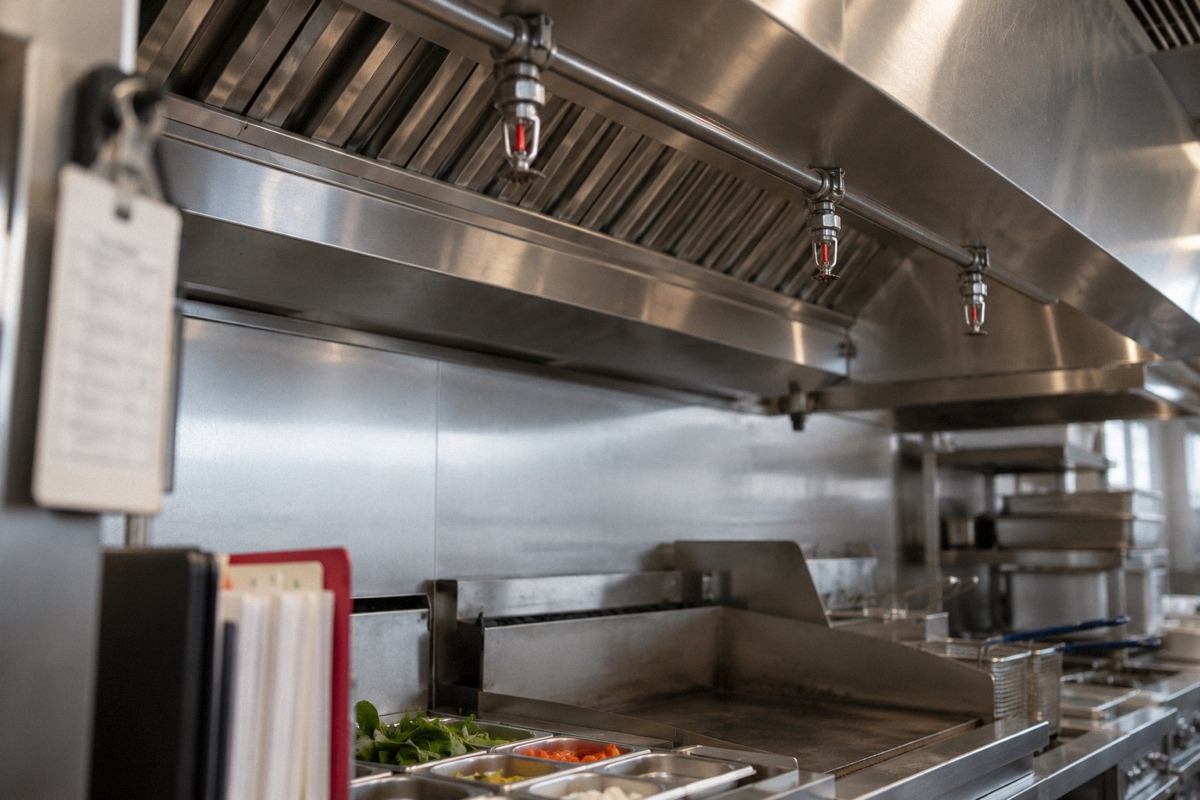
Kitchen suppression systems are pre-engineered systems, often called by one manufacturer's brand name, Ansul. Many are wet chemical systems, and the standard commonly associated with them is NFPA 17A. Listings for these systems are commonly based on UL 300, Fire Testing of Fire Extinguishing Systems for Protection of Commercial Cooking Equipment. The service tasks at each visit come from the manufacturer's installation and maintenance manual and the standard and fire code your jurisdiction has adopted. We couldn't verify the required interval in your jurisdiction's adopted text, so ask your fire authority. The topic is often framed around a twice-a-year cycle, but your requirement may differ.
Whatever the interval, a routine visit typically covers the items below. Ask your vendor for a report that lists each one with a result. Treat the list as a guide to what a thorough report looks like. It's not a code checklist.
- Hazard review: are the appliances under the hood the same as those the system was designed for, in the same positions?
- Nozzles: correct type, aimed at the right appliance, clear, and with protective caps in place.
- Detection: links and detection line in place, clean, and connected to the control head.
- Agent container and expellant: pressure or weight checked as the manual requires; seals and tags intact.
- Manual pull station: accessible and functional.
- Fuel or power shutoff: the gas valve or electrical shutoff to the protected appliances operates when the system trips, as tested per the manual.
- Tamper seals, service tag and report: system returned to service, new tag dated, and deficiencies listed.
Parts that get replaced, and the ones to ask about
Some replacements are routine, and some only make sense after a specific event. The table shows which question to ask for each. The replacement schedule for any part, including fusible links, cartridges and container testing, comes from the manufacturer's manual and the standard your jurisdiction adopts. Ask the vendor to point to the provision instead of accepting a general statement that it's required.
| Item | When replacement is typically expected | What to ask for |
|---|---|---|
| Fusible links | On a schedule in the manual or adopted standard; when damaged or greasy | Quantity matching your system's link count; the schedule cited; old links shown |
| Nozzle blow-off caps | When missing, damaged or hardened | How many were missing; photos |
| Expellant cartridge | After discharge, or as the manual specifies | Reason: discharge, failed check or scheduled; part number |
| Wet chemical agent (recharge) | After a discharge or a failed agent check | Was there a discharge? What failed? |
| Container hydrostatic test | At intervals set by the adopted standard | Container date and the interval cited |
| System upgrade | When the hazard changed (new appliances or positions) or the AHJ requires it | Which appliance or code provision triggers it, in writing |
Visit frequency: required versus sold
The post's first claim was about frequency. The same logic applies to suppression service and hood cleaning. The interval should come from your jurisdiction's adopted fire code, the standards it references, the manufacturer's manual and any conditions in your insurance policy, not from a service contract's default. If a vendor proposes more visits than you expected, ask which of those sources sets the number. If the answer is 'our policy', that's a business choice you can discuss, not a legal requirement.
In the District of Columbia, the Fire and EMS Department's Office of the Fire Marshal issues the operational permits the code requires, conducts routine maintenance inspections of buildings other than federally owned or occupied buildings and single-family dwellings, and enforces the Fire Prevention Code. That's the office to ask about required intervals and documentation. The code text is published by the Department of Buildings. Its DC Construction Codes page identifies the 2017 DC Construction Codes, including the fire code, based on the 2015 ICC model codes and effective May 29, 2020. It notes that Title 12 DCMR holds the official text and later amendments. Outside DC, ask your local fire marshal.
Worked example: reading a suppression invoice line by line (hypothetical)
This invoice is hypothetical, built to show the method. It's not a claim about typical prices. A restaurant with one suppression system, which the original installation documents show has four fusible links, receives this bill for a scheduled weekday visit: routine inspection $225, six fusible links at $28 each ($168), four nozzle caps at $9 each ($36), agent recharge $350, after-hours fee $150 and trip charge $95. The total is $225 + $168 + $36 + $350 + $150 + $95 = $1,024.
Three lines raise questions. The recharge is $350, but there was no discharge, so the owner asks what check failed and for the report entry. The after-hours fee is $150 for a visit scheduled during business hours, so the owner asks why it applies. Six links are billed against a system documented with four, a difference of 2 × $28 = $56, so the owner asks for the link count from the report. Together the questioned lines total $350 + $150 + $56 = $556 of the $1,024. The answers may all be legitimate. A failed agent check would justify a recharge, and the system may have been modified since installation. The point is that the owner asks before paying, in writing, and keeps the answers. If the explanations don't hold up, the owner raises the specific lines with the vendor, and gets a second quote for future service.
| Invoice line (hypothetical) | Amount | Question |
|---|---|---|
| Routine inspection | $225 | Report lists each item checked? |
| Fusible links, 6 × $28 | $168 | System has 4 per documents; why 6? ($56 in question) |
| Nozzle caps, 4 × $9 | $36 | Which caps were missing or damaged? |
| Agent recharge | $350 | No discharge occurred; what check failed? |
| After-hours fee | $150 | Visit was scheduled in business hours |
| Trip charge | $95 | Matches the rate sheet? |
| Total / questioned | $1,024 / $556 |
Questions to ask your vendor
Ask these questions as routine, every time and of every vendor, so asking them doesn't signal suspicion. Put them in your service agreement or purchase order so the report answers them automatically.
- What source sets our visit interval: the adopted code, the manufacturer, our insurer, or your company policy?
- Please itemize parts with part numbers, quantities and unit prices. Do quantities match our system's documented configuration?
- For each replaced part, was it a scheduled replacement, damaged, or failed? Can we see the old part or a photo?
- Was the fuel or electrical shutoff tested this visit, and what was the result?
- Are any appliances now outside the system's coverage because of layout changes?
- Are you authorized by the system's manufacturer to service it, and does our jurisdiction license or certify suppression technicians? We'll check it.
- Is your rate sheet current, and when do after-hours or emergency rates apply?
Getting a second opinion without a fight
Second opinions are normal for big-ticket recommendations, especially a system upgrade, container replacement or a large parts list. Ask another company that's authorized for your system's manufacturer to quote the same scope, using the first vendor's report as the reference. Suppression parts may be sold only through authorized channels, so compare quotes from authorized companies, not with retail listings for parts an owner shouldn't install. Never let anyone who isn't qualified work on the system, and don't disable or adjust any part of it yourself.
If a second company disagrees with the first, ask both to put their reasoning in writing, with the code or manual reference. If the disagreement is about what your jurisdiction requires, your fire authority is the one to settle it. Keep the tone factual. You're resolving a technical question, not accusing anyone. Any billing dispute should be handled under the terms of your service agreement, with professional advice under your jurisdiction's law if it escalates.
Documentation for inspectors and insurers
Keep a suppression file separate from your hood-cleaning file. It should hold installation documents showing the original design and appliance coverage, every service report with its date, items checked, parts replaced and deficiencies, invoices, photos of each service tag, and correspondence about recommendations you questioned or declined, with the reasons. In DC, FEMS's Business Inspection Service page says restaurants need a fire inspection at license renewal. Having the reports organized makes that visit straightforward, and it also answers an insurer's questions after a claim. Use this page for the inspection role only. The code edition it lists is older than DOB's currently adopted codes. Our guides on hood cleaning frequency and on verifying hood cleaning cover the companion records.
Questions that come up next
How much should an Ansul or hood suppression inspection cost?
There's no reliable standard price. It depends on the system's size, the number of appliances, your market and any parts replaced. Compare quotes from companies authorized for your system's manufacturer for the same scope, and judge each invoice line against the manufacturer's manual and your adopted code. Ask for itemized parts with quantities matching your system and a reason for each replacement.
Do fusible links really need to be replaced at every service?
The replacement schedule comes from the system manufacturer's manual and the standard your jurisdiction adopts. Damaged or grease-loaded links should be replaced. Ask your vendor to cite the provision that sets the schedule. Check that the number billed matches your system's link count, and ask to see the old links or a photo. Ask your fire authority if the answer is unclear.
Sources & context
Forum accounts are unverified experiences. Read government sources for their stated jurisdiction and check requirements with the responsible authority for your location.
- r/restaurantowners: I worked in restaurants before I became a firefighter. Now I do inspections, and your hood and fire bills are probably padded.reddit · Archive post summary only (73 score, 65 comments not reviewed): claims of over-frequency, incomplete work despite documentation, and unnecessary or marked-up suppression parts. Self-reported credential; names no company; used to frame questions, not as proof of any vendor's conduct.
- DC Fire and EMS: Office of the Fire Marshalgovernment · DC: issues operational permits required by the code, conducts maintenance inspections, and enforces the Fire Prevention Code. Does not state suppression service intervals.
- DC Fire and EMS: Business Inspection Servicegovernment · DC: restaurants need a fire inspection at license renewal. Cited for the inspection role only; its listed code edition is outdated relative to DOB's codes page.
- DC Department of Buildings: DC Construction Codesgovernment · DC: 2017 DC Construction Codes (2015 ICC family) effective May 29, 2020; Title 12 DCMR is the official text, including later amendments. Specific suppression provisions were not reviewed.
- UL 300: Fire Testing of Fire Extinguishing Systems for Protection of Commercial Cooking Equipmentprimary · Title verified from the UL standards product page; the scope text was unavailable there. Cited only to name the listing standard, not for service intervals.


