
The practical answer
A service label on the hood records the company's own claim and date. It's not independent proof that anyone attended, or that the whole system was cleaned. Agree on the full scope in writing before the visit: filters, hood interior, plenum, every reachable section of duct, and the rooftop fan. Require before and after photos of each area, and a note of any area that couldn't be reached. After the crew leaves, run safe spot checks, compare the report against the scope, and raise any gaps with the company in writing, with dated photos.
Why the service label isn't proof
The owner who started the r/restaurantowners 'Hood cleaning service rant' thread described a $730 cleaning required by the fire department and insurer. The crew was there about 30 minutes, didn't go on the roof, and left grease on the floor and the flattop. The owner said the hood looked worse afterward. A commenter who listed their own crew's process said a cleaning of three 10-foot hoods takes three to four hours. Another wrote that the crew should date the service label on the hood and take photos for the insurance report. Our research recorded the thread as search excerpts.
Put those together and you see the gap this article addresses. The label and the invoice are the company's own record. They look the same whether the duct and fan were cleaned or not. The kitchen-level parts are visible, but most of the fire risk sits in places owners rarely look: the plenum behind the filters, the duct running up through the building, and the fan on the roof. Verification means checking those places, and making the vendor's documentation show them. This article is about recognizing and correcting incomplete work. It doesn't assume any particular vendor is acting in bad faith. Rushed new crews, unclear scope and missing roof access produce the same result.
The full-scope checklist to agree on before the visit
Put the scope in writing when you book. The list below is based on the process one commenter in the rant thread described, organized into stages. Your system's layout, your adopted fire code and your insurer may add items. Use this list as the written scope you agree with the vendor, and adjust it to match your system and your contract.
- Before cleaning: pilot lights off; equipment covered; plastic sheeting draped and taped to channel runoff to collection containers.
- Suppression: the system placed out of service for cleaning according to the suppression company's procedure, then returned to service. Confirm who is responsible and how it's verified.
- Filters: all removed and cleaned.
- Hood: interior and plenum cleaned down to bare metal, with the grease trough and drain cleared.
- Duct: every vertical and horizontal section cleaned through its access panels, with any section that couldn't be reached listed in the report.
- Rooftop fan: opened or tilted, the fan bowl and blades cleaned, and the rooftop grease containment emptied and cleaned.
- After cleaning: sheeting removed, surrounding equipment wiped, the floor mopped, filters reinstalled, and a dated service label posted.
- Report: before and after photos of each area, the condition found, and anything left unreached and why.
Spot checks after the crew leaves
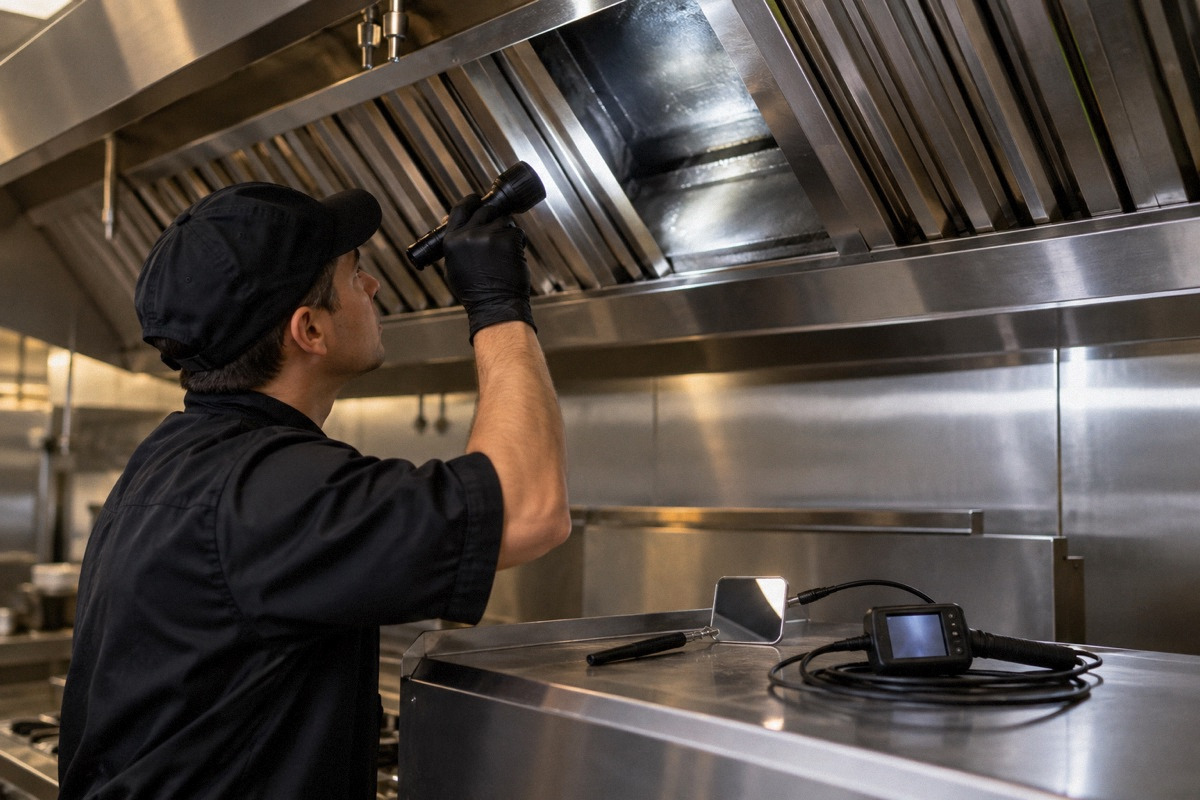
A reply in the rant thread gave owners a practical set of checks. Remove a couple of filters and shine a flashlight up the duct to look for remaining grease. Look for access panels, which the commenter said should be every 10 to 12 feet on horizontal runs, and open one to see whether the system was cleaned all the way through. If you're comfortable on the roof, look around the base of the exhaust fan for pooled grease, and use a flashlight to see whether the fan blades in the fan bowl are clean. The commenter noted that grease buildup on fan blades can damage the motor. Panel spacing and access requirements come from your adopted mechanical code and the system's design, so treat the commenter's figure as a field rule of thumb, not a code citation.
Do these checks safely. Look up the duct only with the hood off and the cooking equipment cold, and put every filter back before anyone cooks. Ask the crew to open an access panel for you before they leave, rather than opening one yourself. Panels are part of the grease duct's enclosure, and they must be resealed properly. Go on the roof only where there is safe, permitted access and fall protection, never alone, and never during bad weather. If the roof isn't safely accessible, rely on photos and ask the vendor to show you on a tablet before they leave.
| Area | What to look for | Safe way to check |
|---|---|---|
| Filters and hood interior | Bare metal; no grease on seams or corners; trough clear | Hood off and cool; flashlight |
| Plenum and duct entry | No grease visible above the filter line | Remove two filters with equipment cold; flashlight up; reinstall all filters |
| Horizontal duct | Clean interior beyond the panel; panel resealed | Ask the crew to open a panel before they leave |
| Rooftop fan | No pooled grease at the base; clean blades and bowl; containment emptied | Only with safe roof access; otherwise require photos |
| Kitchen after cleaning | No residue on floors, equipment, walls or windows; pilots relit as appropriate | Walk-through before signing off |
| Suppression status | System returned to service | Ask the crew to confirm; call your suppression vendor if unsure |
What a useful photo report contains
In a thread asking whether hood cleaning photos and reports matter to owners, someone asked what owners want after an exhaust cleaning. We have only the title-level excerpt of that thread, so its answers aren't used here. The question is still the right one, and the rant-thread commenter's view supplies part of the answer: you should get before and after pictures of all these areas with every cleaning, so you're covered with inspectors if there's ever a fire.
Set the standard in writing. Photos should be date-stamped, or embedded in a dated report, and labeled by location, such as 'Hood 2, duct panel 3 (horizontal)' or 'Roof fan, blades'. They should be taken from the same angle before and after. Each photo should show enough of its surroundings that you can tell where it was taken. A close-up of shiny metal could be anywhere. The report should also list anything not cleaned and why, such as no access panel, a locked roof or a damaged fan, along with a recommendation. A report that mentions no limitations on a complex system deserves a closer look, not automatic trust.
Worked example: scoring a report against the scope (hypothetical)
This example is hypothetical. A restaurant has two hoods sharing a rooftop fan, with a horizontal duct run that has three access panels. Its written scope calls for 12 documented items: before and after photos of each hood interior (4), an after photo of each plenum (2), the three duct panels (3 after-photos), the fan blades and bowl (2), and the rooftop grease containment (1). The report that arrives has 7: the four hood-interior photos, the two plenum after-photos and one fan photo. It has no duct panel photos, no rooftop containment photo and no 'before' fan photo, and it lists no limitations. The crew logged about 50 minutes on site.
Coverage is 7 out of 12, or about 58 percent. The missing items are exactly the ones a kitchen walkthrough can't see. The evidence that matters is the documented gap in scope and the grease the owner finds, not how long the crew stayed. Time on site is weak context at most. System size, layout and crew size vary, and the three to four hours one commenter reported was for a different, three-hood system, not a benchmark for this one. The owner does a safe flashlight check, finds grease visible above the filter line in one plenum, photographs it, and sends the company a written request. The request lists the five missing items and the observed grease, and asks for a return visit to complete the scope and a revised report. It describes what was missing. It doesn't accuse anyone.
| Scope item (hypothetical) | Required | Received |
|---|---|---|
| Hood interiors, before and after | 4 | 4 |
| Plenums, after | 2 | 2 |
| Duct access panels, after | 3 | 0 |
| Fan blades and bowl, before and after | 2 | 1 |
| Rooftop grease containment, after | 1 | 0 |
| Total | 12 | 7 (about 58%) |
Handling incomplete work
Start with the company, in writing, with evidence. In the rant thread, the original poster later said the company emailed to say the work wasn't up to its standards and sent people back, though the poster described the result as only okay. Another commenter said they photographed a crew's mess, sent the photos to the company, and the owner called the next day and sent the same crew back to clean up. A third said a botched job was followed by a return visit and, they believed, a partial refund. These accounts show that a documented complaint often gets a response. They don't guarantee any particular remedy.
What you can require depends on your agreement. Check whether it promises re-performance, specifies the scope, or sets a dispute process. Whether a credit, refund or partial payment is appropriate is a matter for that contract and, if it comes to a dispute, for advice under your jurisdiction's law. Don't assume a standard answer. Meanwhile, the safety question doesn't wait. If you believe the duct or fan wasn't cleaned, the fire risk is the same whether or not a label is on the hood. Get the work completed promptly, by the same company or another, and keep records of both visits. If you're concerned that documentation shows work that wasn't done, your insurer and your fire authority are the right parties to ask about next steps. In DC, FEMS conducts fire inspections of businesses, including restaurants, at license renewal (FEMS Business Inspection Service).
Choosing a replacement vendor
Several commenters in the rant thread offered the same advice: ask other restaurants who they use. One added that a food supplier or the health department might keep lists. Others described long relationships with a single cleaner who comes after close, goes on the roof, shows up on time and leaves the area as clean as or cleaner than they found it. When interviewing replacements, ask for a sample photo report from a recent job with the client's identity removed. Ask how they handle the suppression system during cleaning. Ask whether the crew goes to the roof every time, what they do when an area can't be reached, and how long a system like yours usually takes. Choose the company whose answers match your written scope. Before the first visit, agree in writing on what a complete report contains and how the company will handle any items it couldn't complete.
Records that protect you later
Keep each cleaning's written scope, report, photos, invoice and a photo of the service label together. Add your own spot-check photos and any correspondence about gaps. Over a few cycles, this file shows whether the vendor consistently completes the scope. It's also what you'll want to show an inspector or insurer if they ask how the system has been maintained. Our guide on hood cleaning frequency covers how often the cleaning should happen, and our guide on suppression service bills covers the separate suppression inspection records.
Questions that come up next
How can I tell if the hood cleaners actually cleaned the ductwork?
With the hood off and equipment cold, remove a couple of filters and shine a flashlight up the duct to look for grease, then reinstall every filter. Ask the crew to open a horizontal-duct access panel before they leave. Require dated before and after photos of the duct, plenum and rooftop fan. A service label alone doesn't show which areas were cleaned.
What should a hood cleaning report include?
Before and after photos of each hood interior, plenum, reachable duct section and the rooftop fan, labeled by location and dated. The report should also give the condition found, note how the suppression system was handled, and list any area that couldn't be reached with the reason and a recommendation. Agree on this format in writing before the first visit.
Sources & context
Forum accounts are unverified experiences. Read government sources for their stated jurisdiction and check requirements with the responsible authority for your location.
- r/restaurantowners: Hood cleaning service rant.reddit · Search-excerpt evidence. A 30-minute cleaning with no roof work; a commenter's full-scope list (suppression lockout, roof fan, duct, filters, label, photos) and spot checks (flashlight up the duct, access panels every 10-12 ft, roof fan base and blades); follow-up accounts of re-cleaning. These are individual accounts, not a code standard.
- r/restaurantowners: Do hood cleaning photos/reports matter to you?reddit · Title-level search excerpt only: asks what owners want after an exhaust cleaning. Used only to frame the question; no answers from this thread are relied on.
- DC Fire and EMS: Business Inspection Servicegovernment · DC: businesses including restaurants need a fire inspection at license renewal. Does not specify hood-cleaning documentation; cited for the inspection role only.


