
The practical answer
Older buildings hide structural limits, outdated wiring, unpermitted alterations, water damage and hazardous materials. Reduce the surprise before you sign. Search permit and certificate-of-occupancy records, get the right investigations (a structural engineer, electrical capacity, a qualified asbestos survey where renovation could disturb suspect materials, moisture), and turn the findings into a risk register. Price known items into the budget. Size contingency to the unknowns that remain, using your own risk policy rather than a borrowed percentage. Then allocate the remaining risk in a concealed-conditions clause and in the lease.
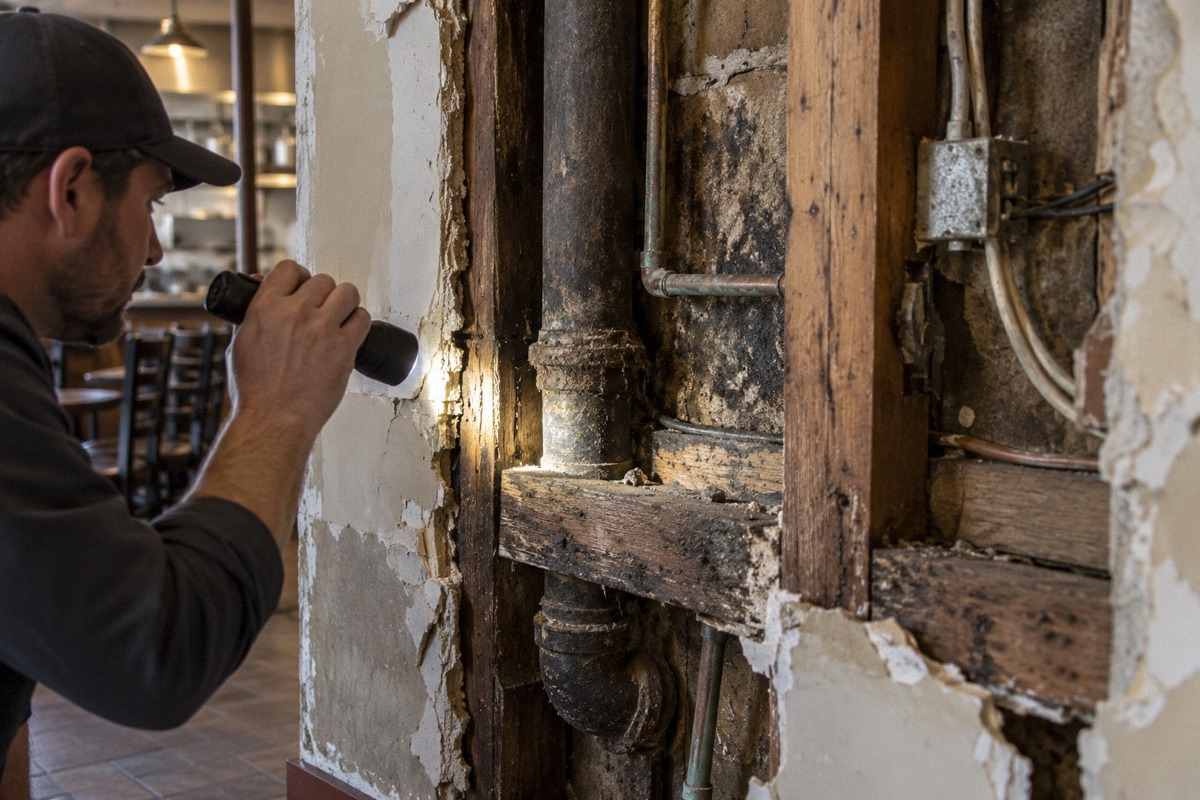
What turns up when the walls come open
In what goes wrong that costs you the most money?, multi-unit owners list construction surprises such as mold, things buried in walls and floors, and electrical problems, including breakers wired wrong. We saw that thread only as search excerpts. In Cost and Length of Time for Full Build Out?, read through controller-supplied text, one owner says a building from 1900 needed new structural steel. Replies in the 'most annoying part' thread, also excerpts only, mention unpermitted buildings described as 'grandfathered' and the difficulty of running gas lines in historic buildings.
These are individual accounts, not data on how often each problem occurs. They do show the pattern. The expensive surprises are mostly conditions that existed before the tenant arrived and could have been partly found with investigation. Each one also raises a contract question: who pays when something no one could see turns out to be wrong?
Investigate before the lease is signed
The best time to learn about a building is when you can still walk away or renegotiate. Ask the landlord for access during the letter-of-intent stage to bring in your own consultants, with permission to open small inspection holes where needed and a promise to repair them. Ask for existing drawings, prior permits, environmental reports and any asbestos survey the landlord holds. A landlord who refuses all investigation is giving you information too.
Match investigations to the building and the concept. A heavy-equipment kitchen in a century-old building calls for a structural engineer's review of floor capacity where the walk-in, cooking line and storage will sit. Any concept needs electrical and gas capacity confirmed against the equipment list. Our related electrical article covers how to compare available service with demand. Look for signs of water damage or past leaks at roofs, slabs and shared walls. Camera the main sewer line if the grease-interceptor connection will tie into it.
- Structural engineer: floor capacity, roof capacity for hood and make-up air units, signs of past alteration
- Electrical: service size, panel condition, utility capacity, signs of unpermitted circuits
- Plumbing and gas: sewer camera, water service size, gas meter capacity and route
- Moisture: roof, slab and party-wall leaks; visible staining or odor
- Hazardous materials: records review and, where renovation could disturb suspect materials, a survey by an accredited inspector
- Records: prior permits, certificate of occupancy history, open violations
Records search: permits, occupancy and what 'grandfathered' means
In DC, the Department of Buildings explains on its Certificate of Occupancy page that a C of O verifies that a building's use complies with zoning, construction codes and the Green Building Act. For a change of use or load, applicants submit a copy of the latest prior C of O and approved building permits. Get the current C of O for the space before signing. If it is not for a restaurant use, or the occupant load is far below your seating plan, you have a permitting path and possibly construction cost to price. DOB's website also links to an eRecords portal for permit records. Elsewhere, ask the local building department how to request permit history.
Be careful with the word 'grandfathered.' It is commonly used for conditions that were lawful when built and later fell out of step with newer codes. Work that was never permitted is a different situation. Whether it can stay, must be legalized with permits and inspections, or must be removed is decided by the local authority, not by how long it has been there. If records do not show a permit for a mezzanine, an added bathroom or a gas line, treat it as unverified and price both legalization and removal.
Asbestos, mold and other materials you should not disturb
The US EPA's guidance on asbestos operations and maintenance programs (federal guidance) says that before renovation, the building owner should have records reviewed to find where asbestos-containing material may be, reinspect the area, and evaluate whether the work will disturb it. Suspect material that could be disturbed should be sampled and analyzed, or the work should proceed as if it contains asbestos. EPA says trained and accredited professionals should do these tasks. It also notes that federal NESHAP rules require removal before projects that would disturb more than specified amounts, and it encourages owners to contact state or local agencies for requirements. The clearance protocols described there for schools are not mandatory for commercial abatement. Local and state rules decide what applies to your project.
In practice, old floor tile and mastic, pipe insulation, some plasters and roofing materials are commonly treated as suspect in older buildings until tested. Do not let a crew scrape, sand or demolish suspect material to 'see what it is.' Mold works the same way operationally. Hire a qualified assessor to find the moisture source and extent before demolition, so remediation and the leak repair are planned together.
Hypothetical worked example: a risk register for a 1920s storefront
All figures are hypothetical. An operator has a $450,000 base buildout budget for an older storefront. Before investigation, five unknowns carry ranges from $0 up to a high estimate, totaling $185,000 at the high end. That is far more than a typical contingency line would carry, and it is the reason to investigate first. The investigations cost $9,300: structural review $3,500, electrical load check $1,200, asbestos survey $2,800, expeditor records search $800 and moisture inspection $1,000.
The findings convert most unknowns into known costs. The engineer specifies reinforcement under the walk-in, priced at $38,000. Electrical service is adequate, so that risk drops to $0. The survey confirms asbestos in floor mastic in the kitchen area, with an abatement quote of $18,000. Records show no permit for a rear mezzanine, and the operator chooses removal at $12,000. Moisture findings are limited, but $0 to $15,000 of possible rear-wall repair remains unknown.
Known additions are $38,000 + $18,000 + $12,000 = $68,000, so the revised base is $518,000. The operator's own policy, used only for this example, is to carry the remaining identified high estimate ($15,000) plus a general allowance of 7% of the revised base ($36,260) for conditions still unseen. Contingency is therefore $51,260, and the construction budget is $569,260. The $450,000 base never included the investigations, so the $9,300 of due diligence is a separate line. That makes the total project figure $578,560 ($569,260 + $9,300). The operator now goes back to the landlord with documents. The structural condition and the asbestos are building conditions, so the operator asks for a larger tenant-improvement allowance or a landlord-performed abatement before delivery.
| Risk (hypothetical) | Before investigation | After investigation | Treatment |
|---|---|---|---|
| Floor capacity under walk-in | $0 to $60,000 | $38,000 known | Into base budget; negotiate with landlord |
| Electrical service upgrade | $0 to $45,000 | $0 | Closed |
| Asbestos in floor mastic | $0 to $25,000 | $18,000 known | Abatement by a firm qualified under state and local rules; landlord negotiation |
| Unpermitted mezzanine | $0 to $40,000 | $12,000 known (removal) | Into base budget |
| Rear-wall moisture | $0 to $15,000 | $0 to $15,000 | Carried in contingency |
| Total exposure | $0 to $185,000 | $68,000 known + up to $15,000 | Plus a general allowance per owner policy |
The concealed-conditions clause in your construction contract
Even after investigation, something will remain hidden. A concealed or differing-site-conditions clause defines what counts as an unforeseen condition. Typically that is a physical condition materially different from what the documents showed or from what is ordinarily found in similar work. It sets how quickly the contractor must give notice, usually before disturbing the condition, and how price and time are adjusted. Read it before signing, and give bidders your investigation reports so everyone prices from the same information.
Watch for two opposite failure modes. A clause that makes the owner pay for anything found behind a wall invites loose pricing. A clause that makes the contractor carry all hidden conditions, in an old building with no investigation, either inflates every bid or produces disputes later. Sharing the investigation reports and defining the threshold for 'materially different' is usually fairer and cheaper than either extreme.
Landlord responsibility and the lease
Many hidden-condition costs involve parts of the building the tenant does not control, such as the structure, roof, main utility services or hazardous materials that existed before the lease. Whether the landlord or tenant pays depends on the lease's delivery condition, repair obligations, compliance-with-laws clause and any work letter. Negotiate these before signing, while you still have leverage. Useful provisions include a landlord representation about known hazardous materials, landlord responsibility for pre-existing structural and environmental conditions, and a right to terminate or receive rent abatement if a pre-existing condition costs more than a stated threshold. Have a commercial lease attorney in the property's jurisdiction review the final language.
When something turns up mid-construction
Despite the best investigation, crews will occasionally open a wall and find something new. The response should be immediate and documented, so the condition is assessed by the right professional and the cost is allocated under the contract rather than argued over months later.
- Stop work in the affected area if the material may be hazardous or the structure may be compromised
- Photograph and measure before anything is moved or removed
- Get the contractor's written notice under the concealed-conditions clause, with the date
- Bring in the appropriate professional: engineer, accredited asbestos inspector or mold assessor
- Notify the landlord in writing if the condition is in an area the lease makes the landlord's responsibility
- Price the fix as a change order with schedule impact before work proceeds
- File reports, photos and approvals in the project record for the next site's lessons
Questions that come up next
How much contingency should I budget for an old building restaurant conversion?
There is no reliable universal percentage. Investigate first: structure, electrical and gas capacity, records, moisture and hazardous materials. Put known costs into the base budget. Then size contingency to the specific unknowns that remain, plus a general allowance your own risk policy sets. A risk register makes that figure explainable to lenders and partners.
Is unpermitted 'grandfathered' work in a lease space my problem?
It can become your problem if your permits or certificate of occupancy depend on it. 'Grandfathered' usually describes work that was lawful when built. Never-permitted work is different, and the local building authority decides whether it must be legalized or removed. Check the permit records before signing and negotiate who pays in the lease.
Sources & context
Forum accounts are unverified experiences. Read government sources for their stated jurisdiction and check requirements with the responsible authority for your location.
- Restaurant owners who have / have opened multiple restaurants what goes wrong that costs you the most money? (r/restaurantowners)reddit · Controller search excerpts only. Mentions mold, buried items and electrical surprises, including mis-wired breakers. Anecdotal; no frequency data.
- Cost and Length of Time for Full Build Out? (r/restaurantowners)reddit · Controller-supplied thread text; treated conservatively as excerpts. An owner reports a 1900 building that needed new structural steel. A single unverified account.
- What specific part of building a new restaurant/shop/coffee etc was the most annoying part? (r/restaurantowners)reddit · Controller search excerpts. Mentions unpermitted 'grandfathered' buildings and gas lines in historic buildings. Not legal guidance on grandfathering.
- Certificate of Occupancy, DC Department of Buildingsgovernment · Fetched 2026-10-03. Says a C of O verifies use complies with zoning, construction codes and the Green Building Act, and that use or load changes require the latest prior C of O and approved permits. DC only. The eRecords permit-record portal is linked from DOB's site navigation.
- Setting up an Asbestos Operations and Maintenance (O&M) Program, US EPAgovernment · Official text saved by controller. Federal guidance: review records and reinspect before renovation; sample suspect material or treat as asbestos; use trained, accredited professionals; NESHAP removal thresholds; school clearance protocols are not required for commercial abatement. State and local rules also apply.


