
The practical answer
Decide interceptor type, size and location during design. Give your plumbing designer the menu, fixture list, dish process and expected volume. Ask the sewer utility which device types it accepts. In Washington, DC, DC Water requires an interceptor per the DC Plumbing Code unless it approves otherwise, and expects registration in its FOG BMP portal. Before the lease, investigate the route to the sewer, slab depth and outdoor options. Then compare compliant options on installed cost plus cleaning frequency, because a small unit that needs pumping every few weeks can cost more over time.
Why a former retail space turns plumbing into a major line item
Retail and office spaces usually have a restroom and maybe a small sink. A restaurant needs a three-compartment sink, prep and hand sinks, floor sinks under equipment, a dish machine connection, and a grease interceptor between all of that and the sewer. Adding these to a space never designed for them means cutting the slab, trenching to the building drain, possibly connecting outside the building, and finding out what is under the floor. The post Small rant about build out describes a plumbing scope with a dishwasher hookup, a new grease trap and one gas line. It was quoted at a few days and $5,000 to $6,000, then took a month and was billed at $10,000. Our change-order article examines that gap. Here, the point is that interceptor work is where small-sounding plumbing jobs often grow.
Size can surprise owners too. A post titled 1000-gallon grease trap describes a couple who spent years bringing a property up to code, with a 1,000-gallon trap as part of the requirement. We have only a search excerpt and do not know the jurisdiction or the reasons for that size. It is a reminder that the required device can be far larger than an under-sink box, and the time to learn that is before you commit to the space.
The three device types, as DC Water describes them
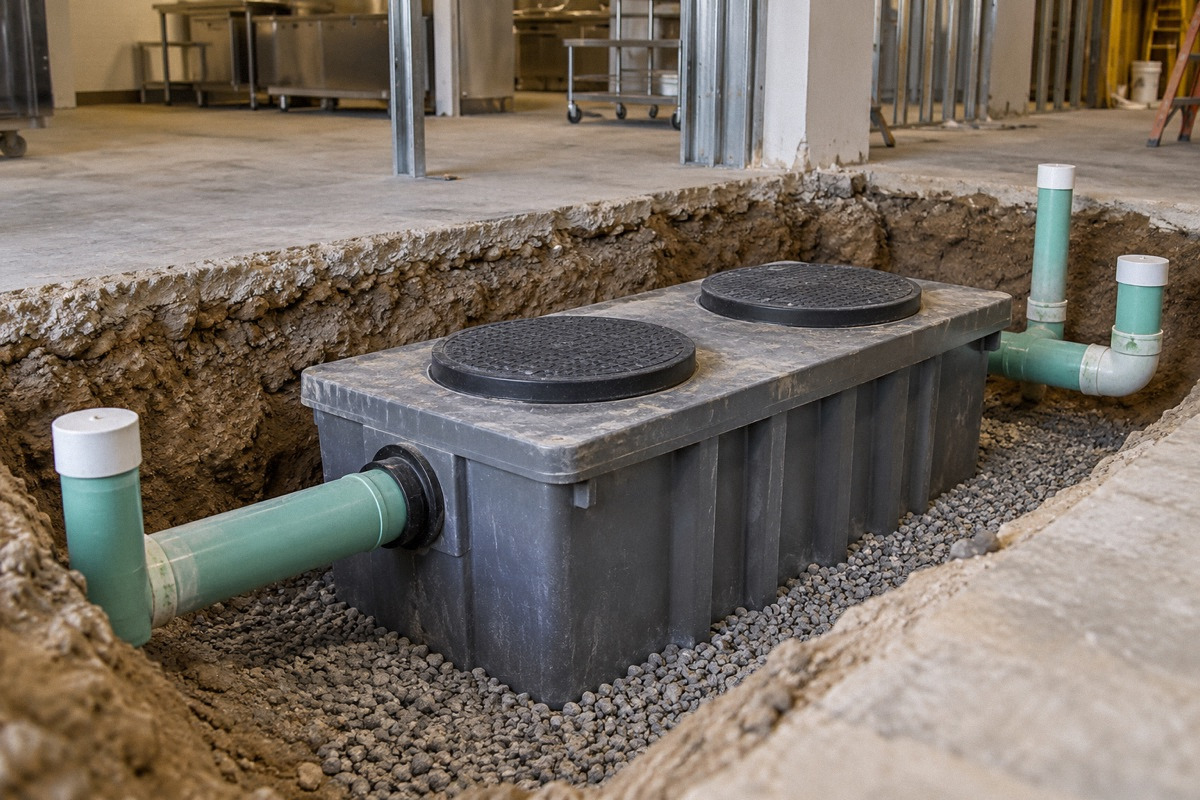
"Grease trap" is used loosely for several different devices. DC Water's Food Service Establishments & Compliance page separates them into three categories. Gravity grease interceptors are usually found outside in the ground or in parking garages. Hydromechanical, flow-based interceptors, often called grease traps, are usually inside the kitchen. Grease removal devices are usually under kitchen sinks. Other utilities use similar categories with different names, so match your device to your local program's definitions.
The categories differ in more than size. A gravity interceptor is a large tank that relies on retention time for grease to rise and solids to settle. It takes space and excavation, but it holds more between cleanings. A hydromechanical unit uses baffles and flow control in a much smaller body. It is easier to install indoors but fills faster. A grease removal device skims grease mechanically and needs strict maintenance. In DC, the type also sets the cleaning interval. DC Water lists gravity units at every 90 days or sooner if more than 25% full of grease and solids, and hydromechanical units and grease recovery devices at every 30 days or sooner if more than 50% full. That difference becomes a running cost, covered in the worked example below.
Sizing inputs your plumbing designer needs from you
Owners often ask whether a small unit will do. One thread asks whether an under-sink grease trap is sufficient for a space of about 900 square feet. We have only a search excerpt, and the replies are not a sizing method. Floor area alone does not answer it. The size depends on what drains into the device and how much grease the menu produces, run through the method in your adopted plumbing code and any utility rules. Your plumbing designer does that calculation. Your job is to give them accurate inputs and to tell them early if the concept might change.
Be honest about growth. A coffee concept that later adds a fryer and a burger, or a second-generation tenant who inherits a unit sized for pastries, can end up with a device that is legal on paper and overwhelmed in practice. If the space might change concepts, ask the designer what it would take to upsize later, and whether a slightly larger or different device now would avoid digging twice.
- Menu and cooking methods, especially fryers, griddles, roasting and sauce work
- Every fixture that will drain to the device: pot sink, prep sinks, floor sinks, mop sink, dish machine
- Which fixtures the utility or code requires or forbids connecting (ask; rules vary)
- Dish process: pre-rinse, sprayer use, dish machine water temperature and volume
- Expected meals per day and peak periods
- Possible future concepts or menu expansion in the same space
Location, excavation and what can be under the slab
An interceptor has to sit where it can be reached for cleaning and where it can connect to the sewer by gravity. In a converted space, each option has its own risk. Indoors under the slab, you may find shallow footings, old utilities, or a building drain that is too high to serve the new location. Outdoors, the ground may be the landlord's parking area, a shared alley or public space that needs separate permits, and excavation can hit rock, water or unrecorded lines. A post about replacing an in-ground grease trap drew many replies. We have only the title and a search excerpt, but it shows that in-ground units are a major job both to install and to replace.
Reduce the unknowns before you sign. Ask the landlord for as-built plumbing drawings and the building drain's location and depth. Pay for a camera inspection of the existing lines and, if an outdoor location is likely, a utility locate and test pit. Get the landlord's written position on an outdoor interceptor, including who owns it, who maintains it and whether it can stay after you leave. Our related article on hidden existing conditions covers investigation methods. Here, the decision is whether those findings change the space's economics.
Approval: the utility and code decide, not the bid
Do not let the lowest plumbing bid choose your device type. In Washington, DC, DC Water's page states that unless DC Water approves otherwise, all food service establishments must install and maintain a grease interceptor in accordance with the DC Plumbing Code, and must register through its FOG BMP portal, which is used to manage interceptor records and view inspection results. The DC Plumbing Code is part of the 2017 DC Construction Codes, which DOB's DC Construction Codes page identifies as based on the 2015 ICC family and amended through Title 12 DCMR. DOB is working on an update, so the designer should confirm which edition applies to your application date.
DC Health's plan review also expects the plumbing to be shown. Its Plan Review Guidance Packet (Dec 2019, ver. 8) asks for a plumbing schedule including floor drains, floor sinks, waste lines and wastewater connections, and asks where the grease storage receptacle will be. Outside DC, call your sewer utility's pretreatment or FOG program before design is finished. Ask which device types it accepts for your use, whether it reviews sizing, and what registration or permit it requires. Get the answers in writing.
Hypothetical worked example: comparing two compliant options
All figures are hypothetical, and the example assumes the utility has confirmed both options would be acceptable for this site, which you must verify. A 1,400-square-foot former retail space is becoming a fast-casual kitchen. The previous tenant's under-sink unit is rated 20 GPM, and the designer's calculation calls for a 50 GPM hydromechanical unit or an outdoor gravity interceptor. Option H is an indoor hydromechanical unit installed for $11,000. Option G is an outdoor gravity interceptor installed for $38,000, including excavation and surface repair. Both are cleaned by a hauler, at $275 a visit for H and $650 for G.
As a starting budget, the owner assumes each device can run to DC Water's maximum interval without passing its fill limit: H at 50% within four weeks, and G at 25% within 12 weeks. Both are assumptions to be tested by measurement, not facts. Neither utility acceptance of a device type nor a larger tank proves a given interval will hold. On those assumptions, H is cleaned every four weeks, or 13 visits a year, at $3,575. G is cleaned every 12 weeks, about 4.3 times a year, so the owner budgets 5 visits at $3,250. Over 10 years, ignoring inflation, H costs 11,000 + 35,750 = $46,750 and G costs 38,000 + 32,500 = $70,500. H looks $23,750 cheaper.
Now suppose measurements in the first months show H passing 50% full in about 15 days. To stay under its limit with a margin, it needs cleaning every two weeks, or 26 visits a year, which is $7,150 a year or $71,500 over 10 years. H's 10-year total becomes $82,500. G would then be $12,000 cheaper (82,500 − 70,500), but only if G's own measured fill stays below 25% at a 12-week interval. G has not been tested in this example, and a faster-filling G would need more visits too. The fair conclusion is narrower than "G wins": the result depends on measured fill rates for both devices, so each interval should be treated as a site-specific condition, monitored after opening with a safety margin, and the budget revised as data comes in. Estimate grease load honestly at design, and plan to measure both before trusting any long-run comparison.
| 10-year view (hypothetical, no inflation) | H: hydromechanical, indoor | G: gravity, outdoor |
|---|---|---|
| Installed cost | $11,000 | $38,000 |
| Visits per year, assuming fill stays under each limit | 13 (every 4 weeks) | 5 budgeted (every 12 weeks) |
| Cost per visit | $275 | $650 |
| 10-year cleaning cost | $35,750 | $32,500 |
| 10-year total | $46,750 | $70,500 |
| If H fills past 50% in about 15 days (26 visits/yr) | $82,500 | $70,500 only if G's measured fill stays under 25% at 12 weeks |
Design for maintenance access from the start
Whoever cleans the device needs to reach every lid and baffle without moving equipment or working over food. Indoor units should not sit under a cook line or in the middle of the prep area. Leave clear space above and around the lids, and think about the route the hauler's hose will take. Outdoor lids need traffic-rated covers if vehicles cross them and should not end up under a dumpster pad. DC Water's page describes inspections that look at best management practices, equipment and maintenance records, so a device that cannot be opened easily is also hard to show an inspector.
In-ground interceptors and vaults can hold hazardous gases. Staff should never enter or lean into them. Pumping and inspection belong to trained haulers using their own safety procedures. Plan where removed grease and the kitchen's waste-oil container will be stored, since DC Health's packet asks for the grease receptacle location. For cleaning frequency and logs after opening, see our grease trap cleaning article.
Checklist before the lease and before the permit
Most expensive interceptor surprises can be found before you are committed. Treat the items below as conditions to resolve during lease negotiation or the due-diligence period. The answers belong in the lease, the design contract and the plumbing subcontract. Keep the utility's written responses, the camera inspection report, the designer's sizing calculation and the approved drawings. Later, they show why the device was chosen, which matters if a future inspector, landlord or buyer asks.
- Utility's accepted device types and registration or permit requirements, in writing
- Designer's sizing calculation based on your fixture list and menu
- As-built drawings, camera inspection of the building drain, slab depth
- Outdoor location: landlord consent, ownership, maintenance and surface restoration terms
- Excavation contingency in the budget for unknown conditions
- Maintenance access drawn on the plan: lids, hose route, traffic-rated covers
- Estimated cleaning frequency and annual cost for each compliant option
Questions that come up next
Is an under-sink grease trap enough for a small restaurant?
Sometimes, but floor area does not decide it. Size depends on the fixtures connected, the menu's grease load and the method in your adopted plumbing code and utility rules. In DC, DC Water requires an interceptor per the DC Plumbing Code unless it approves otherwise. Have a plumbing designer calculate the size and confirm the device type with the utility before buying.
Why does an in-ground grease interceptor cost so much more?
The device is larger, and installing it means excavation, connecting to the sewer at the right depth, traffic-rated covers and restoring the surface, often on landlord or public property. Unknown conditions underground add risk. A gravity unit can need fewer cleanings, which partly offsets the higher installed cost, but only your utility's rules and measured fill rate settle the long-run comparison.
Sources & context
Forum accounts are unverified experiences. Read government sources for their stated jurisdiction and check requirements with the responsible authority for your location.
- Food Service Establishments & Compliance | DC Watergovernment · Washington, DC only. Fetched 2026-10-03. Interceptor required per DC Plumbing Code unless DC Water approves otherwise; three device types and typical locations; FOG BMP portal registration; 90-day/25% and 30-day/50% cleaning guidelines. No sizing method on this page.
- DC Construction Codes | DC Department of Buildingsgovernment · Washington, DC only. Controller-verified: 2017 DC Construction Codes on the 2015 ICC family, amended via Title 12 DCMR; update in progress. Sizing rules themselves are not quoted here.
- DC Health Food Establishment Plan Review Guidance Packet (Dec 2019, ver. 8)government · Washington, DC only. PDF read 2026-10-03. Requires a plumbing schedule (floor drains, floor sinks, waste lines, wastewater connections) and asks for the grease storage receptacle location. Does not size interceptors.
- Small rant about build out (r/restaurantowners)reddit · Post text read. Plumbing scope including a new grease trap quoted at days and $5-6k, billed at $10k after a month. Contract terms unknown; one owner's account.
- 1000-gallon grease trap (r/restaurantowners)reddit · Search excerpt only. A large trap required while bringing a property up to code. Jurisdiction and sizing basis unknown.
- Under sink grease trap sufficient for ~900sf space? (r/restaurantowners)reddit · Search excerpt only. Shows the common sizing question; replies not used as a method.
- Inground grease trap replacement. Need advice (r/restaurantowners)reddit · Title and search excerpt only (gallery post). Indicates in-ground replacement is a significant job; no details relied on.


