
The practical answer
You cannot reliably tell sewer gas from a natural gas leak by smell or location. For any new, strong or unexplained sulfur odor, leave and call 911 and the gas utility, and resume only after responders confirm the building is safe. Once gas and hazardous air are ruled out, log when and where the smell appears, then work in order: refill dry drains and unused fixtures, check interceptor lids and cleaning status, look for open cleanouts and abandoned lines, and test whether the hood pulls air backward through the plumbing. Then call the matching trade with the log.
Step zero: make sure it is not a gas leak or a hazardous buildup
A "sulfur" or "rotten egg" smell has two very different possible sources. One is sewer gas from the drainage system. The other is the odorant added to natural gas. Washington Gas, the utility serving the DC area, says on its natural gas safety page that natural gas smells like sulfur or rotten eggs, and tells people who smell it to leave immediately, avoid flames and anything that could spark, including light switches, and call 911 and then the utility's emergency leak line. Do not try to judge whether the odor is sewer gas or natural gas by where it seems strongest or how it smells; staff cannot reliably tell them apart, and a nearby floor drain does not rule out a gas line. Any new, strong or unexplained sulfur odor gets the leak response first. Other utilities publish similar instructions; follow your own. Return to the building and begin the troubleshooting below only after the utility or fire department has checked it and confirmed it is safe to occupy.
Sewer gas has its own hazard. The federal Occupational Safety and Health Administration's hydrogen sulfide hazards page explains that the rotten-egg odor becomes unreliable as concentration rises, because exposure can cause loss of smell. A smell that fades is not proof the air is safe. Never send staff into an interceptor vault, manhole or below-grade pit to investigate. Those spaces need trained contractors with atmospheric testing. If staff report headaches, dizziness or nausea, get people into fresh air and call for help before troubleshooting anything.
Why intermittent smells send owners from trade to trade
Two owner threads show the pattern. One owner posted about a sewage-ish smell that appears randomly and said they wanted to avoid calling in one trade after another. Another, running a newly opened diner, asked for help with a sulphuric/sewage smell permeating the restaurant. We have only search excerpts of both posts, not the full comment threads, so they tell us the problem is common and frustrating. They do not tell us what the cause turned out to be.
The reason these smells are hard to pin down is that the odor usually travels from where the fault is. A dry floor drain in a back corner, a loose interceptor lid in the dish area and a blocked roof vent can all produce the same smell at the host stand. A plumber called on a quiet Tuesday morning may find nothing because the conditions that release the gas are not present. The cheapest fix is to collect evidence first, so the first trade you call is the right one and arrives when the problem can be seen.
After the all-clear: keep a smell log for one to two weeks
A log is for a recurring, low-level nuisance odor after a gas leak and a hazardous atmosphere have been ruled out by the utility or responders, and after any sewage exposure has been cleaned up. It is not a way to watch an unexplained sulfur smell for two weeks. If the odor becomes strong, changes character, or anyone feels unwell, stop logging and repeat the emergency response.
Put a simple sheet by the pass and ask managers to record every episode: date, time, where it was strongest, how strong on a 1-to-3 scale, and what was happening. The useful context includes whether the hood fans were on and at what speed, whether the dish machine had just drained, whether it was raining, whether the restaurant had been closed the day before, and when the interceptor was last cleaned. Patterns show up quickly. Smells after a closed day point toward dry traps. Smells that follow hood start-up point toward air pressure. Smells during heavy rain or with slow drains point toward a sewer line problem.
| Pattern in the log | Most likely area | First check |
|---|---|---|
| Strong on reopening after a closed day | Dry trap in a floor drain, floor sink or unused fixture | Pour water into every drain and note which one ends the smell |
| Near dish area, worse before a scheduled pump-out | Grease interceptor | Lid seals, cleaning date, percent full |
| Starts when hood fans go to full speed | Building under negative pressure | Open a door or window briefly and see if the smell fades |
| During rain, with gurgling or slow drains | Partial blockage or sewer backup | Plumber with a camera; check cleanouts and backwater protection |
| Constant in one room, no timing pattern | Broken pipe, uncapped line or failed fixture seal | Plumber smoke test |
Dry traps and forgotten fixtures: the cheapest check first
Every drain connected to the sewer has a trap, a bend that holds water as a seal against sewer gas. When that water evaporates, the seal is gone. Restaurant kitchens often have more floor drains and floor sinks than anyone uses daily: under a walk-in condenser, behind the line, in a storage room, in a staff restroom, in a retired bar station. A drain that only gets mopped water once a month can go dry, especially in a warm room or near equipment exhaust.
Walk the whole space with a pitcher and refill every floor drain, floor sink, mop sink and rarely used hand sink. Include basement drains and restroom floor drains. If the smell ends within a day, put the refills on the closing checklist for drains that are not otherwise used. Some drains have trap primers, devices that add water automatically; if a primed drain keeps going dry, the primer has likely failed and needs a plumber. For a new or recently remodeled space, the approved plans can tell you where every drain is. DC Health's Food Establishment Plan Review Guidance Packet (December 2019, version 8), which applies to plan review in Washington, DC, asks for a plumbing schedule that includes floor drains, floor sinks and backflow prevention, so those drawings are worth pulling out.
The grease interceptor: overdue cleaning, loose lids and failing seals
Grease and food solids decompose in an interceptor, and an overdue unit produces strong sulfurous odors. Check the last cleaning date and how full it is against your local schedule. In Washington, DC, DC Water's Food Service Establishments & Compliance page says gravity interceptors are cleaned and inspected at least every 90 days, sooner if more than 25% full of grease and solids, and hydromechanical units at least every 30 days, sooner if more than 50% full. The establishment is responsible for keeping that maintenance and its records current. Other utilities set their own rules.
Look also at the physical seal. An under-sink unit's lid gasket can harden, crack or be left off after cleaning. Bolts get lost and lids sit crooked. Floor-level access covers on larger interceptors should sit flat and tight. If the smell is strongest after a pump-out, ask the hauler whether the unit was refilled with water as their procedure requires and whether the lids were reseated correctly. Keep this check visual. Do not open a below-grade interceptor yourself.
Open pipes, cleanouts and failed fixture seals
Sewer gas also escapes anywhere the drainage system is open without a trap. Common examples are a cleanout missing its cap, a pipe stub left behind when equipment was moved or removed, a floor sink whose fixture was abandoned during a remodel, a toilet whose wax ring has failed, or a cracked line hidden behind a wall or under the slab. Conversions of former retail or office spaces are prone to this because old fixtures were removed and their lines were not properly capped.
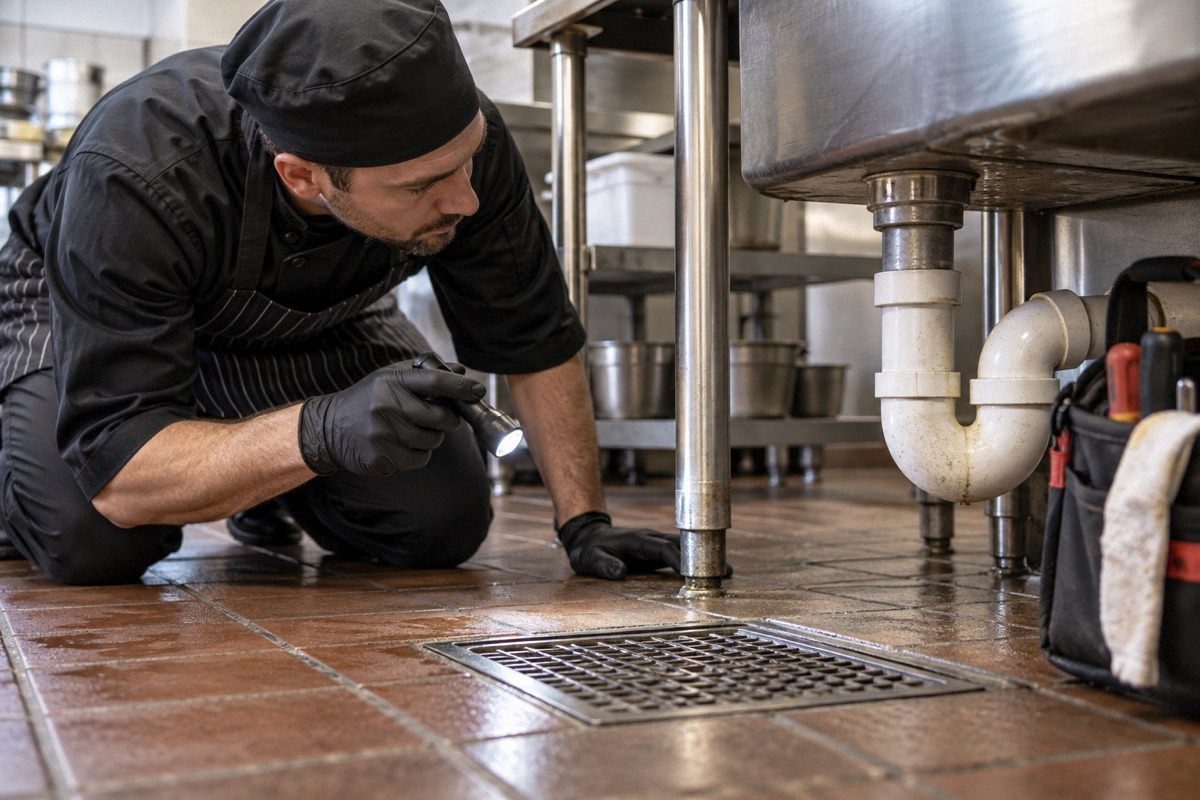
Some of these are visible on a walk-through with a flashlight. Others are not, and this is where a plumber's smoke test earns its fee: harmless smoke is pushed into the drain-waste-vent system and escapes wherever there is a leak. Schedule it outside service hours and tell the alarm company if smoke detectors might respond. A camera inspection of the main line is a separate test for blockages and breaks.
Vents and building pressure: when the hood pulls sewer gas in
Plumbing vents carry sewer gases up through the roof. Two vent problems cause indoor smells. A blocked vent, from debris, a nest or ice, can slow drains and siphon or bubble through trap seals. A vent terminal located close to a rooftop air intake can let sewer gas get drawn into the supply air. If the smell seems to come from ceiling diffusers rather than drains, ask a roofer or HVAC technician to check what is near the intakes.
A kitchen exhaust hood removes a large volume of air. If makeup air does not replace it, the building runs at negative pressure and pulls air in through every gap, which can include weak trap seals and openings in the plumbing system. The tell is timing: the smell appears when the fans ramp up and fades when someone opens the back door. This is a ventilation balance problem, not a plumbing repair, and it belongs with the hood or HVAC contractor responsible for makeup air. It is also worth fixing for reasons beyond odor, because poorly balanced exhaust affects how well the hood captures smoke and grease.
Hypothetical worked example: two causes in one diner
This example is hypothetical. After the gas utility checks the building, finds no leak and confirms it is safe to occupy, a diner logs 11 mild smell episodes in 14 days. Two happen on Monday mornings after the Sunday closure, strongest near a storage-room floor drain nobody uses. The other nine happen during dinner service, each within about 20 minutes of the hood going to full speed, and each fades when the rear door is propped open. None coincides with rain, and the interceptor was cleaned on schedule the week before.
The log points to two separate causes rather than one mystery. The manager adds the storage-room drain to the Saturday closing checklist, and the Monday episodes stop. For the nine dinner episodes, the owner skips the drain cleaner and calls the hood and makeup-air contractor, showing them the log. If the contractor confirms the makeup air is not running, is undersized or has a clogged filter, the repair targets the actual cause. If they find the system balanced, the next call is a plumber's smoke test focused on the line and vents, with the log in hand. Either way, two visits replace the round of guesswork the original thread was trying to avoid.
Who to call, and what counts as an emergency
Call the gas utility and 911 for any suspected gas leak. Call a licensed plumber for dry traps that keep recurring, primer failures, cleanouts, fixture seals, smoke tests, camera inspections and backups. Call your interceptor hauler for overdue cleaning or lid problems, and your hood or HVAC contractor when the smell follows the exhaust fans. A sewage backup into a kitchen or food storage area is a food safety event, not just a nuisance. Stop using affected areas, protect or discard exposed food, and contact your health department about whether operations must stop and what cleanup is required. In DC that is DC Health. Keep the log, invoices and each contractor's written findings together so the next person does not start from zero.
- Have the gas utility or responders rule out a leak and hazardous air before anything else
- After the all-clear, log time, place, strength and conditions for every episode
- Refill every floor drain, floor sink and unused fixture; recheck after a closed day
- Confirm interceptor cleaning date, fill level and lid seals
- Walk the space for uncapped cleanouts and abandoned lines
- Test whether opening a door changes the smell while the hood runs
- Bring the log to the first contractor you call
Questions that come up next
Why does my restaurant smell like sewer only when the hood is on?
That timing often suggests the exhaust is removing more air than the makeup air replaces, leaving the building under negative pressure that can pull sewer gas through weak trap seals or plumbing openings. A quick test is opening a door during an episode. If the smell fades, call your hood or HVAC contractor about makeup-air balance before paying for plumbing repairs. Confirm with a professional; this is a diagnostic clue, not proof.
Can a grease trap cause a sulfur smell in the dining room?
Yes. An overdue interceptor or a poorly sealed lid can release strong odors that travel well beyond the kitchen. Check the cleaning date and fill level against your utility's schedule; in DC, DC Water's guidance gives 90-day and 30-day maximums by device type with earlier cleaning at set fill levels. Because natural gas also smells like rotten eggs, treat any new or unexplained sulfur odor as a possible leak first.
Sources & context
Forum accounts are unverified experiences. Read government sources for their stated jurisdiction and check requirements with the responsible authority for your location.
- Sewage-ish smell randomly (r/restaurantowners)reddit · Search excerpt only. An owner with an intermittent sewer smell wants to avoid calling multiple trades. The cause was not visible in our record; used only to frame the problem.
- Advice desperately needed - sulphuric/sewage smell permeating restaurant (r/restaurantowners)reddit · Search excerpt only. A new diner with a persistent sulphur/sewage smell. No resolution was visible in our record.
- Natural gas safety | Washington Gasprimary · Utility serving the DC area; fetched 2026-10-03. States natural gas smells like sulfur or rotten eggs and gives leave-and-call instructions. Customers of other utilities should follow their own utility's emergency instructions.
- Hydrogen Sulfide: Hazards | OSHAgovernment · US federal agency page, fetched 2026-10-03. Supports the point that the rotten-egg odor is unreliable because exposure can cause loss of smell. Workplace exposure guidance, not a restaurant plumbing code.
- Food Service Establishments & Compliance | DC Watergovernment · Washington, DC only. Interceptor cleaning intervals and fill limits by device type and the establishment's maintenance and record responsibilities. Does not address odors directly.
- DC Health Food Establishment Plan Review Guidance Packet (Dec 2019, ver. 8)government · Washington, DC. Read directly. Item 6c asks for a plumbing schedule including floor drains, floor sinks and backflow prevention. Cited only to show approved plans can locate drains; it is not an odor-troubleshooting guide.


