
The practical answer
There is no single national interval. Your local sewer authority sets it, and it usually works as a maximum interval plus a fill limit, whichever comes first. In Washington, DC, DC Water's guidance says gravity interceptors are cleaned and inspected at least every 90 days, sooner if they become more than 25% full of grease and solids, and hydromechanical units at least every 30 days, sooner if more than 50% full. Measure how fast your unit actually fills, set the interval so you clean before the limit, and keep a cleaning log you can show an inspector.
Why "how often" has no universal answer
New owners keep asking each other this. A thread titled How often do you actually schedule grease trap cleaning? drew dozens of replies, and another owner described a drain cleaner pumping the trap every six months for years before wondering whether that was normal. We only have search excerpts of those threads, not every comment, so they show the question is common. They do not tell you a correct number. Replies in threads like these come from different cities, different menus and different equipment, so a figure that works for one operator says nothing about your obligation.
Two things decide the right frequency. The first is the rule your sewer utility or pretreatment program enforces, which can set a maximum interval, a fill limit, or both. The second is how fast your own kitchen fills the device. A fry-heavy burger kitchen and a salad counter can share a building and still need very different schedules. The useful approach is to find the local rule, measure your own fill rate, and let whichever limit arrives first set the calendar.
Under-sink traps and in-ground interceptors behave differently
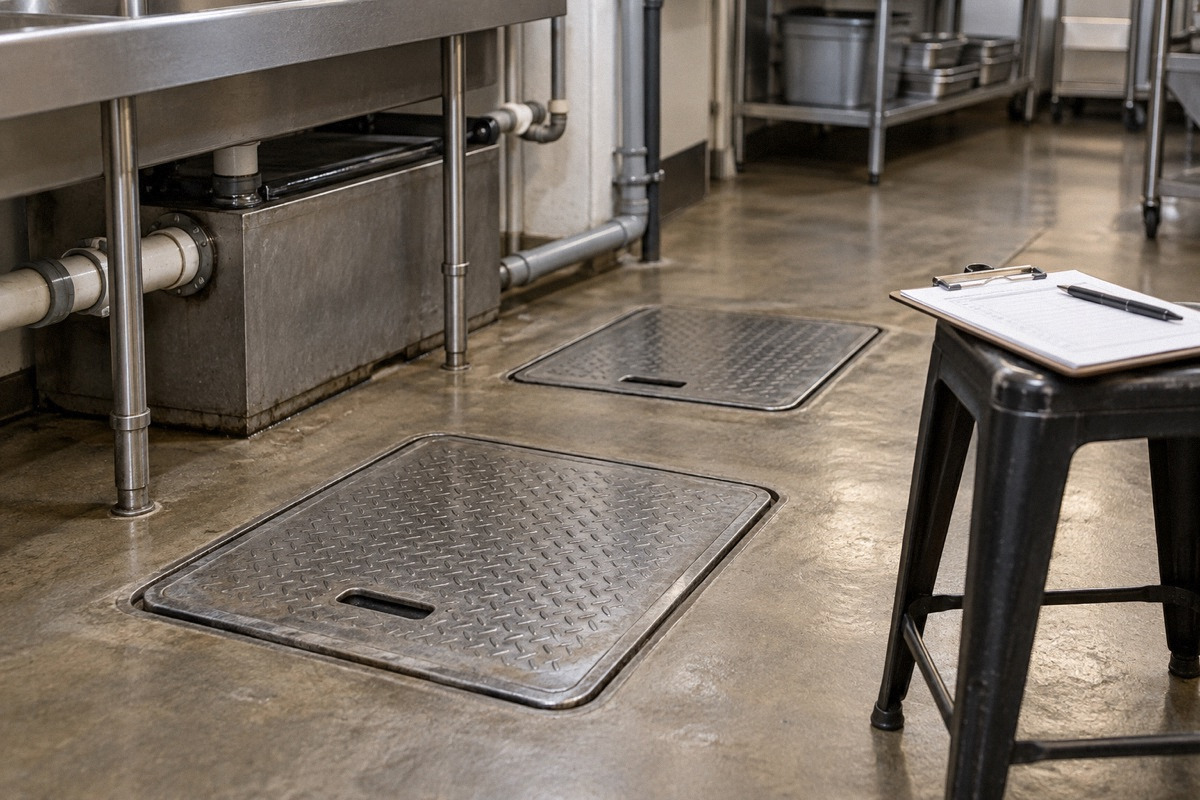
"Grease trap" gets used for several different devices, and the rules usually treat them separately. A hydromechanical interceptor, often the steel or plastic box under or beside a three-compartment sink, is relatively small and rated by the flow it can handle in gallons per minute. It uses baffles and flow control to separate grease quickly, but its small volume means it fills fast. A gravity grease interceptor is a much larger tank, often buried outside or below the floor, that relies on retention time for grease to float and solids to settle. It holds more, so it can usually go longer between cleanings, but it is harder to inspect and almost always needs a pump truck.
Some kitchens also have grease recovery devices, electromechanical units that skim grease automatically into a container. These still need regular cleaning and inspection; automatic skimming does not mean zero maintenance. Before setting a schedule, confirm which type you have, its rated size, and where every access lid is. If you inherited the space, the previous tenant's hauler, the building owner, or the approved plumbing drawings may tell you. If you are planning a new installation or a conversion, sizing is a separate decision covered in our interceptor sizing article.
DC Water's published schedule, as a precise local example
Washington, DC is a useful example because the utility publishes its expectations plainly. DC Water's Food Service Establishments & Compliance page says cleaning frequency depends on the type of interceptor and the kind of food operation, can vary from one establishment to the next, and that DC Water works with establishments to make sure a cleaning schedule is sufficient. It then lists general guidelines from the code. Gravity grease interceptors are to be cleaned and inspected every 90 days, or sooner if they become more than 25% full of grease and solids. Hydromechanical or flow-based interceptors are to be cleaned and inspected every 30 days, or sooner if more than 50% full. Grease recovery devices or electromechanical interceptors are to be cleaned and inspected every 30 days.
The same DC Water page says all food service establishments operating in the District must register through its online FOG BMP portal, which is used to manage interceptor records and view inspection results. It also provides a downloadable Grease Interceptor Cleaning Log. Read the two-part structure carefully: the day count is a maximum, not a target. A DC kitchen that fills a hydromechanical unit past 50% in 18 days has to clean it more often than every 30 days.
| Device type (DC Water guidance) | Maximum interval | Clean sooner if | Who may clean, per the page |
|---|---|---|---|
| Gravity grease interceptor | 90 days | More than 25% full of grease and solids | A contractor that specializes in that service |
| Hydromechanical / flow-based interceptor | 30 days | More than 50% full of grease and solids | Depends on rated size; see the self-cleaning section below |
| Grease recovery device / electromechanical | 30 days | Not stated as a fill limit on the page | Confirm with DC Water |
Outside DC, find the rule that actually binds you
DC Water's numbers apply to establishments in the District. They are not a national standard, and another utility may set different intervals, define "full" differently, require a licensed hauler for every device, or demand a hauler's manifest for each pump-out. Some programs also issue a permit with a site-specific schedule that overrides any general rule. Do not borrow DC's figures, or a forum commenter's, as proof of compliance elsewhere.
To find your own rule, search for your city or county sewer utility together with "FOG program" or "pretreatment," call the industrial pretreatment or environmental compliance office, and ask four questions. What interval and fill limit apply to my device type? Who is allowed to clean it? What records must I keep, and for how long? Do you require registration or hauler manifests? Write down the name of the person you spoke to and the date, and save any written guidance they point you to.
Measure fill rate instead of guessing
A fill limit only helps if someone measures it. The common field method uses a clear sampling tube, sometimes called a sludge judge, or a marked measuring stick. You lower it to the bottom and read three things: the thickness of the floating grease layer, the thickness of the settled solids, and the total liquid depth. Grease plus solids divided by total depth gives percent full. DC Water's page does not describe a measuring method, so ask your utility or hauler how they measure it and record readings the same way every time.
Measure right after a cleaning, which should be close to zero, and then at regular points before the next one. Two or three readings per cycle are enough to see the trend. Accumulation is rarely perfectly even. Brunch weekends, a new fried item, or a dishwasher who stops scraping plates can all speed it up, so repeat the measurement whenever the menu or volume changes.
Hypothetical worked example: two kitchens, two different answers
All figures here are hypothetical and assume both kitchens are in DC. Kitchen A has a hydromechanical unit under the pot sink. After a cleaning it measures 20% full on day 10 and 45% full on day 20. That is about 2.25 percentage points per day (45 divided by 20). If that pace held, it would pass 50% at about day 22 (50 divided by 2.25 is roughly 22.2), well before the 30-day maximum. Two readings are a thin basis for a straight-line projection, and a busy week can run faster, so the owner treats day 22 as an estimate, not a guarantee. A provisional schedule of every 16 to 18 days leaves a margin, with a reading every few days during the first cycles to confirm the unit stays under 50%. Cleaning only every 30 days would likely leave it over its limit for part of each cycle.
Kitchen B has a gravity interceptor. It measures 12% full at day 30 and 26% full at day 60. The pace is not even: 12 points in the first 30 days, 14 in the second. Already at 26%, it has crossed the 25% limit before day 60, so it should have been cleaned before this reading, and the 90-day maximum clearly does not govern. Averaged from zero, it gained about 0.43 points per day (26 divided by 60), which would put 25% near day 58 (25 divided by 0.433 is about 57.7), but the second-month pace was faster than that average. A cautious provisional interval is around six to seven weeks, confirmed by a reading at four weeks and another a week later, then adjusted as data builds up. Neither answer matches what a peer kitchen happens to do, which is why measurement matters more than averages.
Cleaning it yourself versus hiring a hauler
The bagel-shop manager who posted Cleaning the grease trap...holy moly captures what in-house cleaning is like: smelly, messy, and more involved than expected. We only have a search excerpt of that post. Whether you may do it yourself is a local question. DC Water's page says gravity interceptors must be cleaned by a contractor that specializes in that service. It also says hydromechanical interceptors larger than 35 GPM should be cleaned by a FOG waste hauler, and that units under 50 GPM may be cleaned by the establishment. Those two thresholds overlap between 35 and 50 GPM as written, so if your unit is in that range, ask DC Water directly and keep its answer on file.
If self-cleaning is allowed, write a procedure before the first attempt. Cover protective gloves and eye protection, how to avoid spills on food-contact areas, the order of removal (floating grease, then solids, then a check of baffles and gaskets), and above all disposal. Removed grease and solids must never go back into any drain or toilet. Ask your utility or a grease recycler how the waste must be handled. A hauler is often the better choice when the unit is large, hard to reach or near food prep, or when the utility expects manifests you cannot produce yourself.
- Confirm the device type and rated GPM before deciding who cleans it
- Get written confirmation of self-cleaning rules for your size range
- Never return removed grease or solids to a drain; arrange approved disposal
- Inspect baffles, gaskets and flow-control fittings at every cleaning
- Ask any additive or enzyme vendor to show local utility acceptance in writing; DC Water's best-practice list cautions against corrosive cleaners
Logs, receipts and what an inspector will ask for
According to the same DC Water page, inspections happen during reasonable business hours and cover observation of best management practices, equipment, device verification, and maintenance records. In DC, use DC Water's Grease Interceptor Cleaning Log or an equivalent record and keep the portal registration current. The page does not state a record retention period, so ask DC Water how long to keep entries rather than guessing. Elsewhere, ask your own utility.
A useful log entry goes beyond "cleaned." Record the date, who cleaned it, the percent-full reading before cleaning, the condition of the baffles, any repairs, and the hauler's receipt or manifest number. Over a few months this becomes your evidence that the interval fits your fill rate, and it is the first thing to review if a downstream line backs up or a smell appears. Pair it with kitchen habits that reduce what reaches the device: scraping plates into the trash, collecting fryer oil for recycling, and keeping drain screens in place, all of which appear in DC Water's best-practice list.
- Device type, rated size and location of every access point
- Local rule: maximum interval, fill limit, who may clean, records required
- Fill readings before each cleaning, measured the same way each time
- Hauler receipts or manifests matched to log dates
- Portal registration or permit current (DC: FOG BMP portal)
- Schedule review whenever the menu, volume or dish process changes
Questions that come up next
Is every six months enough for a restaurant grease trap?
Only if your local rule allows it and your measured fill stays under its limit. In Washington, DC, DC Water's guidance sets a 90-day maximum for gravity interceptors and 30 days for hydromechanical units, with earlier cleaning at 25% and 50% full respectively, so six months would not meet that guidance. Other utilities differ. Check your sewer authority's FOG program and measure fill before relying on a long interval.
Can I clean the grease trap myself instead of paying a hauler?
Sometimes, depending on device type, size and local rules. DC Water says gravity interceptors require a specialist contractor, hydromechanical units over 35 GPM should use a FOG waste hauler, and units under 50 GPM may be self-cleaned. That overlap is worth confirming with DC Water. Wherever you are, ask your utility, follow approved disposal, and log every cleaning.
Sources & context
Forum accounts are unverified experiences. Read government sources for their stated jurisdiction and check requirements with the responsible authority for your location.
- Food Service Establishments & Compliance | DC Watergovernment · Washington, DC only. Fetched directly 2026-10-03. States the 90-day/25% gravity, 30-day/50% hydromechanical and 30-day grease recovery device guidelines, who may clean by device type and GPM (with overlapping 35/50 GPM wording), FOG BMP portal registration, the cleaning log, and inspection scope. Does not define a measurement method or record retention period.
- How often do you actually schedule grease trap cleaning? (r/restaurantowners)reddit · Search excerpt only: a new owner asking about frequency, with many replies we did not individually review. Shows the question is common; replies are not a compliance standard.
- Grease trap cleaning (r/restaurantowners)reddit · Search excerpt only. An owner reports a drain cleaner pumping the trap every six months for years and asks what others do. One self-report; location and device type not verified.
- Cleaning the grease trap...holy moly (r/restaurantowners)reddit · Search excerpt only. A bagel-shop GM describes in-house cleaning. Illustrates the practical burden of self-cleaning; says nothing about whether it was permitted locally.


