
The practical answer
Slip-and-fall claims can arrive months or years after the incident, when memories have faded and video has been overwritten. Prevention and documentation are the same job: identify your wet and uneven zones, keep floors clean and dry with mats, signage and a logged floor-check routine, and secure outdoor items before storms. When someone falls, help first, call emergency services if needed, avoid speculating about fault, complete a factual incident report the same day, preserve video, and notify your insurer under your policy's terms. This is operational guidance, not legal advice.
The claim that arrives after the evidence is gone
An owner on r/restaurantowners posted under the title Slip & Fall Lawsuit about a claim connected to an incident roughly three years earlier; the restaurant is in Canada (Reddit discussion). Only the title and a brief description were recorded, so this article does not rely on the details, and Canadian law says nothing about US deadlines. The pattern it illustrates is common enough to plan for: by the time a claim surfaces, the staff on duty may have left, nobody remembers the weather, and the camera system overwrote the footage long ago.
How long someone has to bring an injury claim depends on the jurisdiction and the type of claim, and this article does not state any specific period. What you control is whether your records outlast that period. A restaurant that can produce a same-day incident report, a floor-check log showing the area was inspected shortly before, a saved video clip, and photographs of the conditions is in a far better position than one relying on a manager's memory. None of that guarantees any outcome; whether a business is liable for a guest's fall is a question of state law and the specific facts, and your insurer and attorney handle that question.
Mapping your high-risk zones
Falls cluster where water, grease, ice or level changes meet foot traffic. Walk your restaurant with the specific question of where someone could slip or trip, and do it on a rainy night as well as a dry afternoon, because the risk map changes with weather and volume.
For staff areas, OSHA's restaurant safety eTool for young workers identifies hazards such as ice falling around ice bins and creating puddles, slippery or uneven floor surfaces, and carrying trays or bins of dirty dishes, mopping, emptying trash and spraying down areas during clean-up (OSHA, Young Worker Safety in Restaurants: Serving; OSHA, Young Worker Safety in Restaurants: Clean-up). OSHA addresses worker safety; guest injuries fall under state premises-liability law, but the same wet spots endanger both, and a guest walking to the restroom crosses many of the same floors.
| Zone | Typical hazard | Main controls |
|---|---|---|
| Entrance and vestibule | Rain, snow and slush tracked in; mats bunched or curled | Walk-off mats sized to the entry, frequent checks in bad weather, spare mats ready |
| Bar and ice wells | Dropped ice melting into puddles; spilled drinks | Wipe up ice immediately; non-slip matting behind the bar; mat edges flat |
| Server stations and kitchen doors | Spills during transfers; collisions at swinging doors | Spill kit nearby; windows in swinging doors; one-way traffic where possible |
| Restrooms | Water around sinks and toilets | Scheduled checks logged on a door sheet; prompt repairs of leaks |
| Dish area and kitchen | Grease, water spray, food debris | Drainage maintained, matting, non-slip footwear policy for staff |
| Steps, ramps and level changes | Missed step, worn nosing, poor lighting | Contrasting edge marking, handrails, lighting checked |
| Patio, sidewalk and parking | Ice, wet leaves, uneven pavers, wind-blown furniture | Weather-triggered checks, salt or sand where appropriate, storm securing routine |
Mats, signage and a cleanup routine that runs during service
The OSHA eTool's employer solutions include keeping floors clean and dry, maintaining drainage and providing mats, platforms or other dry standing places where wet processes are used, posting warning signs for wet floor areas, providing non-slip matting where floors tend to be wet, considering a slip-resistant footwear policy, and ensuring spills are reported and cleaned up immediately; its worker solutions include keeping walkways clear, cleaning spills promptly and limiting mopping during busy service (OSHA, Young Worker Safety in Restaurants: Clean-up). The serving page cites OSHA standards requiring employers to keep workplaces clean and orderly and floors clean and dry (OSHA, Young Worker Safety in Restaurants: Serving).
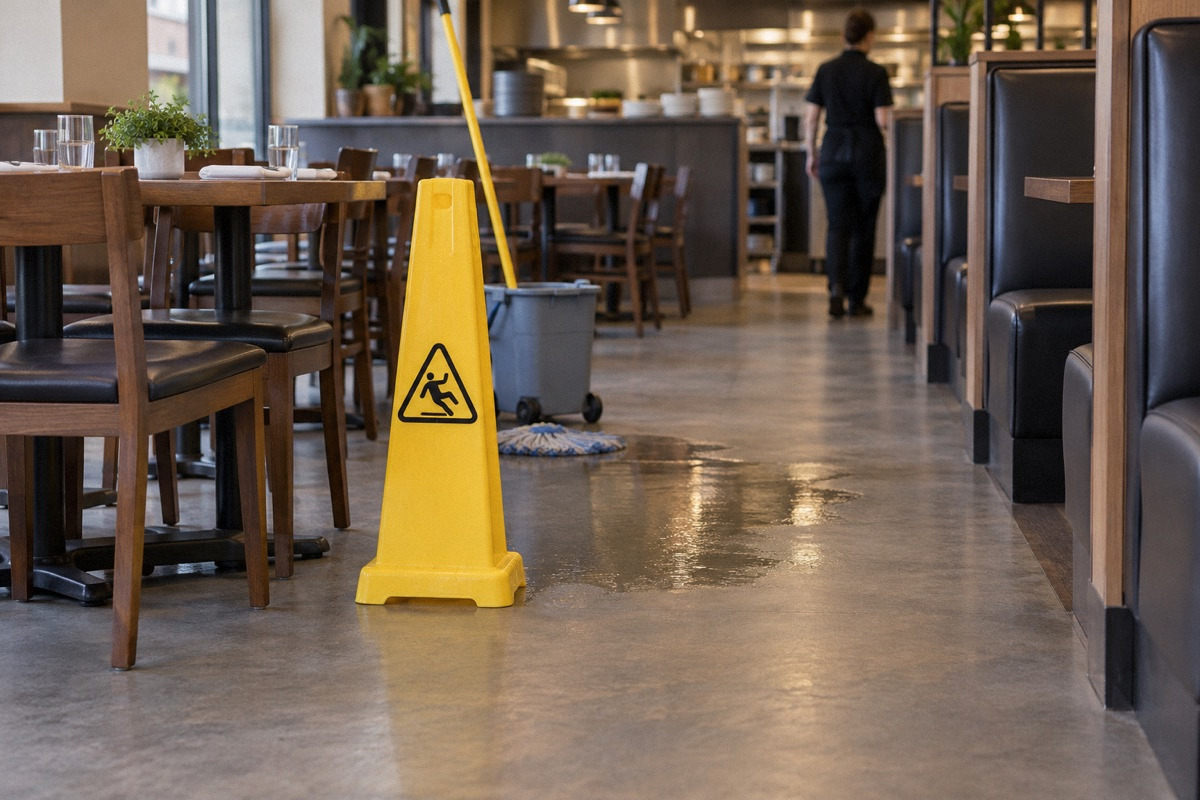
Turn those into a routine with owners. A wet-floor sign is a warning, not a fix; it belongs out while a spill is being cleaned, not standing beside a puddle for an hour. Mats help only if they lie flat, are sized for the area and are replaced when edges curl, because a curled mat is itself a trip hazard. Assign one person per shift to own the front-of-house floor, and give every staff member the same rule: whoever sees a spill guards it until it is cleaned or hands it off to someone who will.
- Spill kit with towels, a mop and a wet-floor sign at the bar, server station and kitchen door.
- Rule that the person who sees a spill stays with it or hands it off; nobody walks past.
- Wet-floor signs set out during cleanup and removed once the floor is dry.
- Mats inspected for curled edges and saturation at each floor check; spares available in wet weather.
- Mopping of guest areas scheduled outside peak service where possible.
- Non-slip footwear policy for staff, communicated at hiring.
A floor-check log: the record that shows reasonable care
A floor-check log is a simple sheet recording the time, the zones checked, what was found and who checked. Its value is twofold. Operationally, it makes someone actually look at the entrance and restrooms at set intervals. As a record, it shows what the restaurant was doing before an incident, which is often exactly what is disputed later.
Set the interval by conditions rather than one fixed rule. As an operational suggestion, a dry weekday lunch might need checks once an hour, while a rainy or snowy dinner rush might need the entrance checked every 15 to 20 minutes. Keep the log honest: an entry should be made when the check happens, never filled in afterward. A log with identical times and initials in the same pen on every line is weaker than one with real variation, and any falsified entry destroys the credibility of the whole record.
When someone falls: the first ten minutes
Care for the person first. Ask whether they are hurt and what help they want, and do not lift or move them yourself, especially if a head, neck or back injury is possible or you are unsure how badly they are hurt. Call emergency services if they request it, appear seriously hurt, hit their head or cannot get up comfortably, and follow the dispatcher's instructions. A manager should take charge, keep other guests clear and stay calm and courteous. Evidence can wait until the person has been helped.
Be careful with words. Express concern, but do not speculate about fault or causes, promise to pay expenses, or argue about whether the floor was wet. Statements made in the moment are easily misremembered later. Equally, do not discourage the person from reporting the incident or seeking medical care. The goal is to help and to record what happened accurately, not to manage the guest's account of it.
Once the person has been cared for, document the scene before anything changes. Photograph the area from several angles, including the floor surface, lighting, any mat or sign, and footwear if the guest agrees. Note the weather. Identify any witnesses and ask for their contact details. Then clean or repair the hazard, if any, and note when.
An incident report template to complete the same day
Write the report the same day while memories are fresh, and keep it factual. Record what was observed and what people said, attributed to them, rather than conclusions. The person who saw the incident or arrived first should write it, with the manager reviewing for completeness, not for tone. Store reports securely with limited access, because they contain personal information about the guest.
| Field | What to record |
|---|---|
| Date, time and exact location | Time to the minute if known; a sketch or floor-plan mark of the spot |
| Person involved | Name and contact details if they agree to provide them; guest or employee |
| What happened | Factual description; the person's own words in quotation marks, attributed |
| Conditions | Floor surface, wet or dry, lighting, mats and signs present, weather |
| Last floor check | Time and initials from the floor-check log for that zone |
| Assistance given | First aid offered, emergency services called, time of arrival |
| Witnesses | Names and contact details, short statements if offered |
| Evidence preserved | Photos taken, video clip exported with camera ID and time range |
| Notifications | Owner, insurer or broker, and landlord if the area is common space, with dates |
| Prepared by and date | Name, role, signature, and date written |
Preserving video and notifying your insurer
Many camera systems overwrite footage after a set number of days. After any fall, export the relevant clip right away, covering a generous window before and after the incident from every camera with a view of the area, and store it outside the recorder with the camera name and time range noted. Footage from before the fall can matter as much as the fall itself, because it may show the floor's condition, a mat, a sign or a staff check.
Read the notice conditions in your general liability policy now, before you need them. Policies commonly require prompt notice of an occurrence that may lead to a claim, and the details of how and when to notify are set by your policy, not by this article. Notify promptly, using an after-hours claims line or online reporting if your insurer offers one, rather than holding a Friday-night incident until Monday. When in doubt, report the incident to your broker or insurer and let them decide whether it becomes a claim. If the fall happened in a shared area such as a building lobby or a sidewalk the landlord maintains, check your lease for who is responsible and whether you must notify the landlord. If you receive a letter from an attorney or a claim notice, send it to your insurer promptly and do not respond on your own.
Securing outdoor items before storms
Another r/restaurantowners post, titled Need Advice on an Accident that Occurred, involved a storm that sent a restaurant's linen bin into something and caused damage, with the owner asking about liability (Reddit discussion). Only a brief description was recorded, so nothing here relies on its outcome. It is a reminder that slip-and-fall planning sits within a wider category: things on your property that can injure people or damage property when conditions change.
Build a storm routine and trigger it from weather alerts rather than from the first gust. Patio umbrellas should be closed and secured or taken down; stacking chairs and lightweight tables brought in or chained; sandwich boards, planters and signs moved indoors; linen and trash bins secured or stored. After the storm, walk the patio, sidewalk and parking area for debris, standing water and damage before reopening outdoor seating, and log the walk like any other floor check.
- Assign one closer per shift to run the storm checklist when a weather alert is issued.
- Close and secure umbrellas; bring in signs, planters and lightweight furniture.
- Secure or store linen bins, trash cans and delivery carts.
- Photograph the secured patio with a time stamp.
- After the storm, inspect for debris, standing water and damage before reopening outdoor areas.
Worked example: a rainy Friday and a letter two years later
Hypothetical example, for illustration only. Rain begins at 5 p.m. on a Friday, and the manager switches the entrance to checks every 20 minutes until close at 10 p.m. That is 5 hours at 3 checks per hour, or 15 logged checks. At 7:30 the host checks the entrance, replaces a saturated mat with a dry spare and initials the log. At 7:42 a guest slips just inside the door.
The manager goes to the guest, asks whether they are hurt and offers to call an ambulance. The guest says they are not badly hurt, gets up on their own, accepts a chair and declines an ambulance; the manager tells them to say if anything changes. Only after the guest has been helped does the manager write down the guest's words: I didn't see the step down. The host then photographs the entrance, showing the dry spare mat and the step edge. That night the manager exports camera footage from 7:00 to 8:00 for both entrance cameras, because the system overwrites after 30 days, and files it with the incident report and the log. The manager reports the incident to the insurer promptly, that night through the insurer's claims line, as the policy's notice terms require, rather than waiting for the weekend to pass.
Twenty-six months later, a letter arrives about the fall. Without the export, the footage would have been gone for roughly two years. Instead the restaurant can hand its insurer a same-day report, the 7:30 log entry and mat change, photos and video. The records also reveal a fixable problem: the guest's own words point to the step down, not water, so the owner adds a contrasting edge strip and a light over the step. The records do not decide the claim; they make sure it is decided on facts rather than guesses.
Questions that come up next
What should a restaurant do right after a customer slips and falls?
Help first: ask what they need, don't move them yourself if injury is uncertain, and call emergency services when needed. Avoid speculating about fault or promising payment. Afterward, photograph the scene, collect witness details, export footage before it is overwritten, write a same-day report, and notify your insurer promptly under your policy. This is operational guidance, not legal advice.
Does OSHA cover customer slip-and-fall injuries in restaurants?
OSHA addresses worker safety; its restaurant eTool covers slips, trips and falls for employees and cites standards requiring clean, dry floors in workplaces. Customer injuries are generally governed by state premises-liability law. The same controls, such as prompt spill cleanup, matting and signage, reduce risk for both groups.
Sources & context
Forum accounts are unverified experiences. Read government sources for their stated jurisdiction and check requirements with the responsible authority for your location.
- Young Worker Safety in Restaurants eTool: Clean-up (OSHA)government · Federal worker-safety guidance. Slips, trips and falls section lists clean-up hazards and solutions: keep floors clean and dry, drainage and mats, wet-floor signs, non-slip matting, footwear policy, immediate spill reporting and cleanup. Covers employees, not customer premises liability.
- Young Worker Safety in Restaurants eTool: Serving (OSHA)government · Federal worker-safety guidance. Identifies ice around ice bins and slippery or uneven floors as hazards; cites OSHA standards to keep workplaces clean and orderly and floors clean and dry; suggests non-slip matting and windows in swinging doors. Employee-focused.
- Slip & Fall Lawsuit (r/restaurantowners)reddit · Archive search result with title and brief description only: a claim connected to a fall about three years earlier, at a restaurant in Canada. Illustrates delayed claims; says nothing about US law or deadlines, and details were not reviewed.
- Need Advice on an Accident that Occurred (r/restaurantowners)reddit · Archive search result with title and brief description only: a storm sent a restaurant's linen bin into something, causing damage, and the owner asked about liability. Motivates the storm-securing routine; outcome and details not reviewed.


